Financial Trading AI and Vertical Applications
Analyzing LLMs and autonomous agents across quantitative trading, investment banking, and capital markets.
2 sources · ↑6×Voices in this topic
All paragraphs
Oct 22, 2026
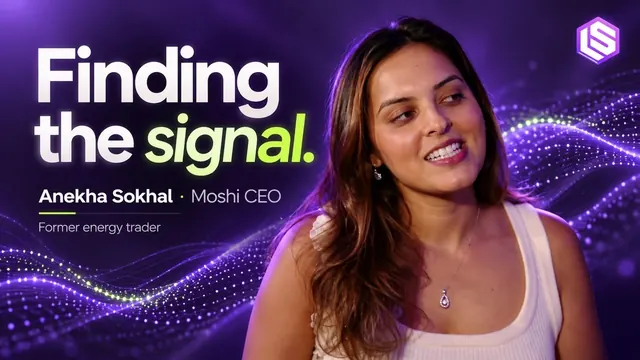
- Anekha Sokhal Moshi's positioning is deliberately not “new Bloomberg” — founder Anekha Sokhal's framing is “if Bloomberg and Claude and Netflix had a baby, it would be Moshi.” The Netflix part is literal: an internally built recommendation system that surfaces the “second- and third-order derivatives” of what a …
- Latent Space The throughput-and-breadth claim: “it takes me four seconds to say this sentence to you, and in the same amount of time, Moshi has learned 300 new things.” The stack spans futures time series and technicals, fundamentals supply/demand, unstructured news/X/podcast audio, and users' private data …
- swyx swyx's buy-side pushback is the episode's best stress test: at Balyasny, he says they were among the first to use the X Firehose; he describes it as costing around $300,000 a month for all the tweets, and questions whether he'd trade on them — “sometimes people just talk random crap, and sometimes people try to manipulate markets.” Sokhal's answer: commodity suppliers and LNG facilities post status updates on X as trusted sources, Moshi attaches confidence scores, and …
Oct 2, 2026
Sep 27, 2026

- 吴浩哲 Haozhe’s core judgment is the opposite of what holds in most industries: in finance, “decisions are almost free; what is truly expensive is acting.” Markets quote every second, and an agent can issue 100 calls a day on each of thousands of stocks; AI trading is neither an oracle …
- The open-source project Web Trading went public on April 1 this year and surpassed 30k GitHub stars in under six months, with its success driven by a shift from a professional quant tool to an ordinary investor’s trading desk. Its predecessor, Quant Agent, had 400-plus factors and 9 market backtesting engines, but “quant is a foreign language to ordinary people”—if …
- His most market-relevant call is that AI adoption will compress information processing to seconds, potentially taking the edge out of “reading” and shifting alpha from single signals to cross-desk combinations. He recalls—perhaps from a 2022 or 2023 paper titled “RIP Post-Earnings Announcement Drift”—that post-earnings drift in some US indexes had …
- His competitive ranking is clear: the marginal value of model intelligence and proprietary data is falling, while data alignment and the harness are gaining value, with alignment the most important. “Having more data really does not equal having alpha”; the real purpose of buying data is simply to make a hypothesis testable. Alignment …
- He poured cold water on the recent JARVIS trading hype: the benefit may not be zero, but it is probably close to zero. JARVIS optimizes the decision side, which is already nearly free in finance; its supposed weaknesses in the official …
- In practice, he follows AI’s recommendations 80% to 90% of the time: storage stocks ran hot in July, then sold off across the sector for nearly half a month; as the market debated whether Chinese producers’ capacity expansion would depress storage prices, the agent distinguished the impact on memory, flash, and hard disk drives and bought Seagate before earnings. He still rejects full automation because of “accountability”: someone must own every entry and every loss. He closes on a philosophical …
Sep 22, 2026
- Gabe Stengel Stengel's two-year frame: firm redesign, not just waiting for more capable models. He invokes Dario Amodei's "country of geniuses in the data center" and asks what Goldman, Millennium, or Citadel would actually do if those …
- Rogo's product eras map directly onto model eras: o1 Pro made it a reliable search tool; Opus 4.5 at the end of 2025 and beginning of this year made it "capable of basically anything a junior investment professional or junior banker was doing." Stengel is candid about the "first mover's disadvantage" — early applied-AI products stank because the models weren't there — but argues …
- Counterintuitively, Rogo's core market is dealmakers, not public equities, because private-market coordination and transaction plumbing remain heavily human. Public markets have more available data and existing automation, while much of Rogo's surface area is "the underneath of the iceberg" — data …
- The economics of investing exceptionally justify extreme token spend: "investors are happy to pay fifty thousand dollars for one really good idea." The bleeding edge Stengel imagines is ten thousand agents per PM "fraternizing, talking about ideas, pontificating" for 24 hours to surface …
- Rogo prices per seat like Bloomberg or FactSet, but Stengel wants to skip usage-based pricing entirely and jump to outcomes: "what if I just charge you for every good investment idea I give you?" He can tolerate customer-cost misalignment today because "we are one percent of the way into our product roadmap" — the vision is a …
- For incumbent firms, this is a major innovator's dilemma in the category, and his diagnostic question is brutal: if 90% of your enterprise value sits in people today but will sit in software, data, and systems in ten years, "what would you start doing?" His answer: extract "what lives in the latent minds of your best people" into systems you own — prescient exemplars, including a co-founder …