Commercial Pitfalls of AI-Native Applications
Investigating gross margin pressures, customer acquisition hurdles, and willingness-to-pay plateaus in AI software.
3 sourcesVoices in this topic
All paragraphs
Oct 26, 2026
- Paul Copplestone Better models are improving acquisition, activation and paid conversion together. The founders say agent-driven activation is almost 100%, while these users convert to paid accounts at higher rates than traditional …
- swyx AI labs and product-led growth outrank enterprise sales in Supabase’s priorities. Swyx describes Supabase’s former expectation that product-led growth might reach a $100–200 million ceiling; now the question is, “Is it a …

Oct 22, 2026
Oct 21, 2026
Oct 20, 2026

- Christina Cacioppo Vanta is eating token costs rather than charging customers for them. Customers notice a markup on a Cloud token and ask whether the application is “4X as good as Claude”; token pricing puts an application in …
- Overhyped: token pricing, low margins for their own sake, post-training “for the marketing value”—“mostly for investors, actually”—and FDEs. She says post-training can make sense for cost in some cases, and a customer-specific model may be reasonable for some enterprise …
Oct 19, 2026



- Jean-Denis Greze Town abandoned a business with just under $1 million in first-year revenue because its distribution could not outrun incumbents. Greze thought year two could reach $2.5–3 million, but annual purchasing and weak word of mouth limited compounding while established …
- The a16z Show Model neutrality and customer ownership of context are Town’s proposed defenses against its suppliers. Greze wants customers able to move their memories, contacts and data elsewhere in roughly a day, accepting lower switching costs. Rampell …
Oct 18, 2026


Oct 12, 2026
Oct 8, 2026


- Fred Wilson Making software has become cheaper, but turning it into a defensible company may require more capital than before. Startups must buy compute, subsidize inference against free offerings from OpenAI, Anthropic, and Gemini, and spend aggressively to escape a …
- Sourcery Revenue velocity is not USV’s preferred proof of product-market fit; usage retention and continued product innovation matter more. Annual subscriptions can produce impressive ARR before users have demonstrated that they actually like a product. Kaden and Wilson’s …
Oct 5, 2026

- Olivia Moore Consumer AI looks mature by traffic but remains fluid by revenue. Only 11 products were new across the combined web and mobile rankings, the series low, yet 29 of the 50 products ranked by consumer card …
- The a16z Show Broad awareness masks an exceptionally concentrated market. Nearly half of Americans report using AI and roughly 25% believe they interact with it almost daily, but only about 4.5% pay according to …
- Olivia Moore The mass-market unlock may be helping people invest time, not merely save it. Today’s biggest spenders over-index toward developer, productivity, and creative products such as n8n, Granola, Higgsfield, and Manifold; …
- Subscriptions finance today’s expensive inference, but ads and transaction fees are the more plausible route to internet-scale adoption. Roughly 85% of the web list monetizes through subscriptions, 62% also uses credits or token payments, and only 13% offers ads or another …
- The a16z Show As models improve, durable value is moving toward interfaces, proprietary context, and multiplayer networks. ChatGPT still leads consumer usage and revenue, but specialists such as Suno, ElevenLabs, Midjourney, Granola, WhisperFlow, and Town retain …
Oct 1, 2026

Sep 28, 2026
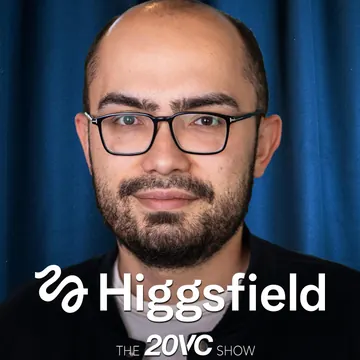
- Alex Mashrabov Higgsfield crossed $1B in annualized revenue 18 months after hitting $1M — faster than Cursor's 24 months — and Alex Mashrabov claims it's “probably the third after OpenAI and Anthropic.” The methodology is trailing-four-weeks revenue ×13, prorating annual contracts and counting “only live revenue,” not multi-year enterprise …
- The expansion math is the tradeable headline: NRR at month 12 is over 300%, which “just never happens in B2B SaaS.” Month-one churn runs around 30% then flattens, but Mashrabov's favorite specimen is a customer who started at $99/month six months ago and …