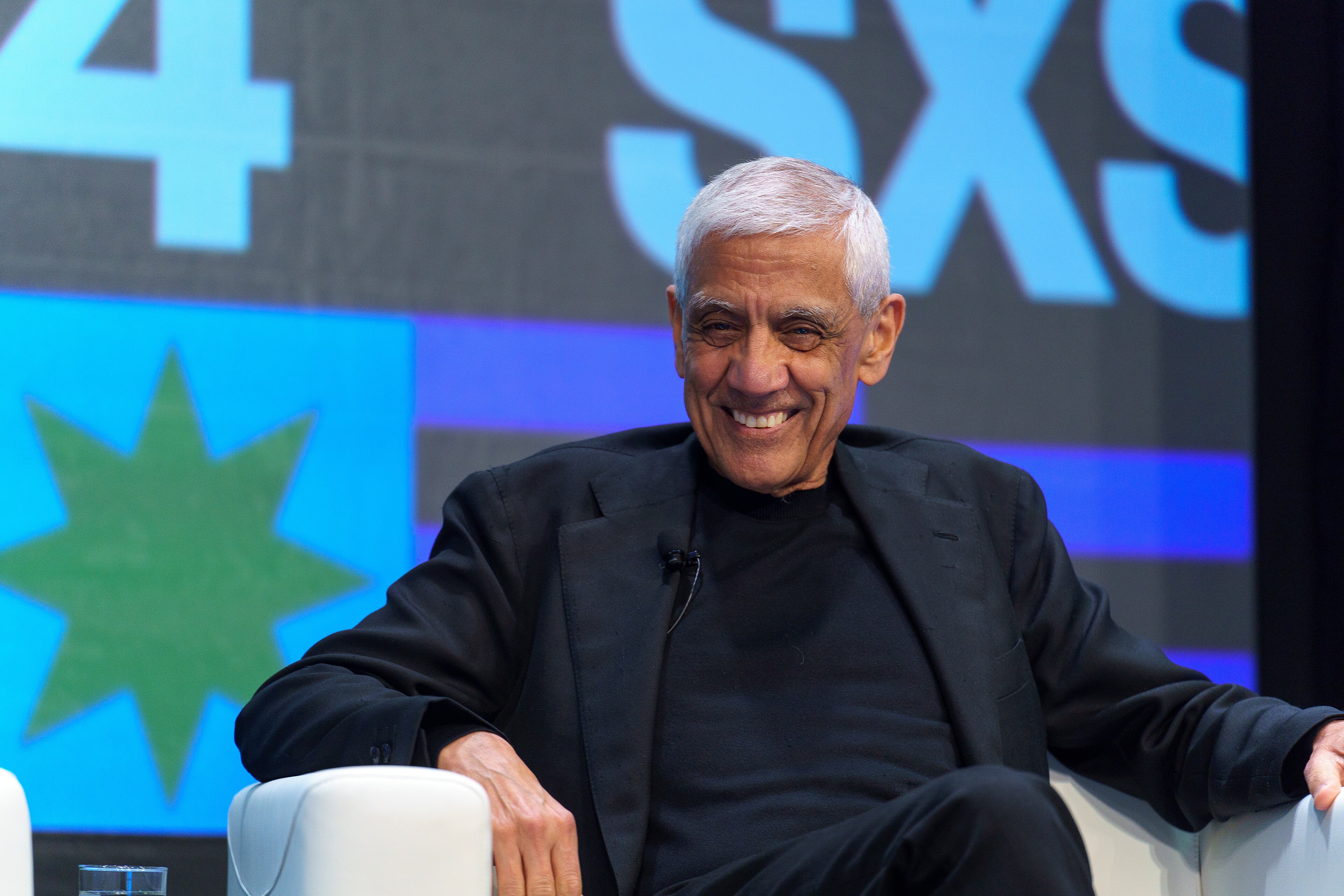
Vinod Khosla
Frontier Insights
Thesis: Bipedal robotics and pervasive AI agents will dismantle the traditional labor economy, with general-purpose humanoids surpassing the automotive industry to exceed 1 billion units by 2040.
Strategy: Khosla bets aggressively on standardization and extreme manufacturing scale—targeting sub-$20k unit costs, five-year agricultural automation, and deep tech leaps in fusion and superhot geothermal to eliminate compute’s looming power constraints.
Risks: Success hinges on navigating catastrophic deep-tech failure rates, severe thermal drilling roadblocks, regulatory lag in high-stakes automation, and near-term grid capacity bottlenecks before commercial clean baseload comes online.
Key Views & Dialogues
AI Entrepreneurs Q&A: How Every Industry Is About to Be Transformed by Humanoids w/ Vinod Khosla & Brett Adcock | EP #160
- 🗓️ Date:
2025-04-02| 🎙️ Show:Moonshots
Figure’s humanoid strategy depends on one general-purpose platform serving most human work, reducing customization and maintenance costs while targeting “twenty thousand dollar levels” and 100,000 units. Indoor workforce deployments are expected first, but homes, farms, and space follow unevenly; security, FDA approval, and distribution remain constraints even as Khosla forecasts AI making scientific research 10–100x more abundant within five years.
View Dialogue Notes & Key Takeaways
Figure’s bet is that humanoid economics improve when one general-purpose hardware platform serves most human work. Adcock rejects customer-specific hardware because high NRE, maintenance burdens, and changed observation spaces impede transfer learning; standardization is the path to “twenty thousand dollar levels,” while Figure’s near-term scale target is 100,000 units.
Deployment should arrive unevenly: indoor workforce work first, then homes, outdoor jobs, and space, though not strictly sequentially. Adcock places this broad rollout within the next 10 years but distinguishes demonstrations from scaled integration; Khosla expects farm capability within five years and considers 1% penetration “the job done,” with broad adoption taking longer.
Khosla sees fusion’s bottleneck less in physics than in siting, transmission, and politics. He is “a little less bullish” on fission because permitting may outlast developing fusion from scratch, yet sees an “easy path” to 5,000 fusion plants by 2050; 50 MW Realta units could occupy substations, while Commonwealth is building a 500 MW reactor.
AI and robots can deliver abundance while widening income disparity enough to make unmodified capitalism unworkable. Khosla forecasts job displacement, productivity, and GDP growth together; rather than prescribing one UBI model, he says countries must decide how to share abundance, pairing techno-optimism with “care and caring.”
The opportunity can be enormous even if most funded companies die. Khosla estimates perhaps 80% of AI investments will lose money, but exponential winners leave aggregate gains positive, with three to five winners per field and perhaps half a dozen robot companies; Adcock calls humanoids “winner take most” and says 95% of such deep-tech efforts go bankrupt.
Figure treats security and civilian positioning as constraints on the product, not public-relations add-ons. Its 2022 mandate rules out military work because the “Terminator vibe” could damage the larger commercial market; Helix kitchen demonstrations ran offline with weights on an onboard GPU, while firmware enforces actions the robot “ultimately can never do.”
Healthcare exposes the gap between model capability and regulated physical autonomy, even as AI could multiply scientific capacity 10–100x within five years. Khosla expects healthcare expertise to become free “well before 2030,” but unsupervised robot surgery to remain more than 10 years away—possibly 15 or 20 depending on the FDA—while AI scientists make research 10x cheaper and 100x more abundant.
🔗 Original source & video: AI Entrepreneurs Q&A: How Every Industry Is About to Be Transformed by Humanoids w/ Vinod Khosla & Brett Adcock | EP #160
AI Venture Capitalist: These Tech Predictions Will Change Everything by 2030 w/ Vinod Khosla | #159
- 🗓️ Date:
2025-04-01| 🎙️ Show:Moonshots
Bipedal robots could exceed the auto industry within 20 years, with one billion by 2040 now called “an underestimate,” while AI makes expertise increasingly abundant and professionals supervise roughly five AI interns. The near-term signal is organizational deployment, with Deep Research producing an 18-page specialist report matching human recommendations; fusion and superhot geothermal could ease AI’s energy constraints, though timelines and cost questions remain.
View Dialogue Notes & Key Takeaways
Khosla’s major physical-economy call is that bipedal robots will exceed the auto industry within 20 years, with one billion by 2040 now “an underestimate.” At the $10,000 price point Diamandis cited, machines working 24/7 could perform more work than today’s manual labor across seven billion people; Diamandis said Elon expects Optimus to become Tesla’s largest business and said he believes that.
AI makes expertise abundant and could reduce professionals’ roles. Over the next five years, Khosla urges every doctor, accountant or other professional to consider supervising roughly five AI interns; whether they mature in three, five or ten years will vary, but the strategic question is already: “If all expertise were free, how would you design a health care system?”
The immediate AI opportunity is organizational deployment, because Khosla says people are using the technology at only “a fraction of your potential.” Deep Research separately returned an 18-page specialist report with the same two disease recommendations, prompting Khosla to ask whether AI is open during every board and executive meeting and receiving the same challenges as human teams.
Consumer agents may transform advertising from emotional persuasion into decision-grade information rather than eliminate it. An AI can filter the pitch for $300 jeans when “$30 Levi’s will do just fine”; if the $20 ChatGPT subscription model holds, Khosla said it would imply more revenue per user than Google or Facebook, and he called the $200 tier “incredibly valuable.”
Programming bifurcates into autonomous software workers and universal creation by natural language. Cognition represents the “software intern” that does programming, while Replit lets non-programmers build applications in English; Khosla’s larger inversion is that “instead of humans learning computers, computers will learn humans.”
Fusion and superhot geothermal support Khosla’s optimism that energy constraints can be overcome. Commonwealth Fusion expects positive net energy output by early 2027, while 400–450-degree geothermal could yield 10 times the power of today’s 200–250-degree wells and become cheaper than natural gas before 2030.
Autonomy is valuable when it expands transport capacity, not merely when it removes drivers. Khosla’s proposed driverless public-transit system could carry more than light rail in a bicycle-lane-width corridor and increase street capacity 10-fold; paired with exploration a kilometer underground for minerals, it embodies his thesis that technology converts apparent constraints into abundance.
🔗 Original source & video: AI Venture Capitalist: These Tech Predictions Will Change Everything by 2030 w/ Vinod Khosla | #159