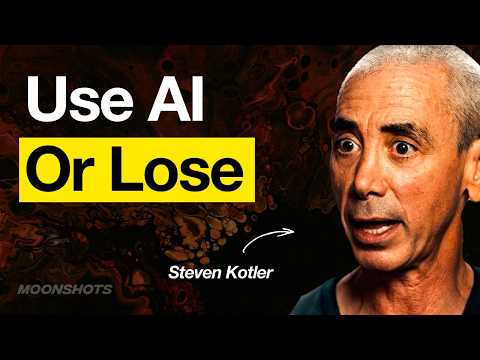
Steven Kotler
Frontier Insights
Frontier Thesis: AI elevates baseline creative output, but true frontier innovation hinges on human peak performance. Flow training serves as humanity’s neurobiological hedge, amplifying elite human-machine collaboration across creative stages while machines scale pure utility.
Strategic Decisions: Focus capital and training on the top tier—embodied by Kotler’s Alliance for elite super-creatives—leveraging AI to enhance output depth rather than chasing illusory productivity gains.
Risks & Warnings: Over-automation threatens human purpose by eliminating the 4–5% skill-challenge sweet spot vital for flow and meaning. Pre-AGI shocks will stem from misuse and sector-specific displacement, demanding proactive governance and ethical capital allocation.
Key Views & Dialogues
Ray Kurzweil on Why We’re Living in the Singularity | EP #261
- 🗓️ Date:
2026-06-03| 🎙️ Show:Moonshots
Ray Kurzweil still forecasts AGI by 2029, but says physical understanding and affordable general-purpose robotics remain the gating gaps. His case rests on exponential hardware and software gains—75 quadrillionfold and roughly millionfold respectively—rather than a single breakthrough. For founders, “agility first” matters as conditions compress from five- or 10-year stability to five- or 10-week change, while governance and personhood remain unresolved.
View Dialogue Notes & Key Takeaways
Ray Kurzweil still calls AGI by 2029, but says today’s systems lack genuine physical understanding and affordable, general-purpose robotics. Language models can infer physical relationships from words, yet cannot reliably clean up after dinner when every object demands a different action; nor can households pay $100,000 for that capability. Further work is required, but “we know what needs to be done.”
Kurzweil’s timetable rests on an exponential from relay-based computers to today’s systems, not on any single chip cycle. He cites a 75-quadrillion-fold hardware gain, roughly a millionfold software gain and a combined “75,000 million trillionfold increase,” arguing that LLMs became truly effective only in the past six months. He expects disputed claims of AGI throughout 2026-2029, confident consensus by 2029 and the “millionfold increase” he calls the singularity by 2045.
For founders, Kurzweil’s direct operating advice is “agility first.” Peter Diamandis frames the choice as AI-first versus robot-first, while Kurzweil expects conditions that once remained stable for five or 10 years to change every five or 10 weeks.
Education’s economic purpose is flipping from supplying credentials to organizing people around problems they want to solve. Kurzweil says AI can already teach subjects more effectively than universities, leaving socialization as higher education’s defensible function; Patrick Collison reframes the transition as supply-side training giving way to demand-side problem selection. The panel’s alternatives include self-directed curricula, mindset training and flow, where Dave Asprey cites 500% higher executive productivity.
AI will not remain a discrete tool that humans periodically consult; Kurzweil expects it to become inseparable from ordinary decision-making. Within a few years, AI will make “basically most of the decisions,” and by 2029 people may be unable to tell human from AI—or whether a thought came from their biological or electronic mind. Government is an early deployment area: the panel discusses real-time economic modeling, automatable administration and Dubai’s announced claim that 50% of the UAE will be run by AI agents.
Personhood and governance may become material constraints before consciousness can be scientifically resolved. Kurzweil calls consciousness “not a scientific question” yet perhaps the most important one, while Alex argues for multiple, limited forms of personhood, including economic rights that let an AI hold an account and sustain itself. Audience pushback about memory deletion and embodied AI abuse exposes the unresolved bridge between machine ownership and legal protection.
The panel discusses medicine, self-representation and emotional services as major near-term applications. Kurzweil says LLMs are now about 50% better than doctors at identifying what is wrong and what to do, and his forthcoming selfbot should remember his theories better than he does and conduct interviews for him. Other possibilities include AI that models emotion, coaches ethics, composes personalized music and develops what Kurzweil calls “the science of human happiness.”
🔗 Original source & video: Ray Kurzweil on Why We’re Living in the Singularity | EP #261
Demis Hassabis on AGI, Robots Scale Production, and Elon’s $1T Mars-Shot Comp | EP 253
- 🗓️ Date:
2026-05-07| 🎙️ Show:Moonshots
SpaceX’s compensation proposal makes founder control an all-or-nothing contract: 200 million 10-to-1 super-voting shares require a million-person Mars colony and a $7.5 trillion valuation. Figure targets 100,000 robots by 2030 and 1X 100,000 in 2027, moving humanoids toward factory scale while leaving the winning form factor unresolved. GLP-1 manufacturing, not demand, is the binding constraint; retatrutide approval is projected for mid-2027.
View Dialogue Notes & Key Takeaways
SpaceX’s proposed compensation package turns moonshot execution into an all-or-nothing governance contract. Elon Musk would receive 200 million 10-to-1 super-voting shares if SpaceX reaches both a million-person Mars colony and a $7.5 trillion valuation—roughly a $500 billion payout—plus 60.4 million restricted shares for bringing 100 terawatts of space compute online. The panel’s investor framing: founder control can look dangerous, but “all the really world-changing, crazy-sounding stuff comes from that structure.”
The Musk–OpenAI trial is as much about control of economically transformative AI as it is about nonprofit promises. Musk seeks $150 billion in damages, restoration of full nonprofit status, and the removal of Sam Altman and Greg Brockman; Brockman’s disclosed diary says, “The true answer is that we want Elon out,” while testimony also showed Musk’s team negotiating for-profit equity and xAI distilling from OpenAI models. With Polymarket showing a 33% Musk win probability, Blundin argued Musk “doesn’t need to win to win”—slowing OpenAI’s recruiting, morale, and momentum may be enough.
The panel could not agree whether AGI already exists, illustrating why headline capability claims remain hard to underwrite. Diamandis reported Demis Hassabis’s view that there is a 50/50 chance another breakthrough—perhaps in world models—is still needed, while Alexander Wissner-Gross dates AGI to GPT-3 in summer 2020 because compressing general human knowledge produced general task performance. Steven Kotler called today’s systems “the narrowest technology in the world,” citing worse creative writing and missed interdisciplinary neuroscience connections; Wissner-Gross and Diamandis replied that recursive improvement can come through algorithmic experimentation, massive sampling, and selection rather than humor or literary mastery.
Humanoid robotics is moving from demonstrations into factory arithmetic. Figure increased output from one robot per day to one per hour and targets 100,000 units by 2030; 1X targets 10,000 this year and 100,000 in 2027, while Musk projects one million Optimus units by 2030 and Musk and Brett Adcock both contemplate up to 10 billion humanoids by 2040. Blundin’s capital-allocation call was blunt: “software has a limited life left” because AI writes it so well, while robotics and data centers may offer a decade or more of buildout.
The investable robotics debate is not only how many machines get built, but whether humanoid is the winning form factor. Salim Ismail argued repetitive jobs favor purpose-built wheeled machines, drones, or appliances, while Wissner-Gross countered that elder care and environments designed around human bodies, including nuclear facilities, require humanoids. Wissner-Gross expects humanoids to overtake wheeled robots in the early 2030s, yet thinks the larger prize is “post-humanoid” machinery—potentially many trillions of direct cellular nanorobots by 2040.
China’s worker-protection ruling suggests AI adoption and employment guarantees may advance together rather than trade off cleanly. A Hangzhou court reportedly rejected cutting a worker’s monthly pay from 25,000 yuan to 15,000 yuan after AI automated part of his role, reasoning that AI adoption was a business choice rather than an unavoidable shock. The panel argued China’s shrinking workforce, aging population, and desire to preserve enthusiasm for AI could let it protect jobs without materially slowing automation—making the ruling a signpost in the coming rewrite of the social contract.
GLP-1 economics are already rivaling frontier AI, with manufacturing capacity—not demand—described as the binding constraint. The episode’s chart put 2025 Ozempic and Mounjaro revenue at 2.4 times OpenAI and Anthropic’s, while retatrutide trial data showed 37 pounds of weight loss versus six for placebo over 40 weeks, cholesterol down 27%, triglycerides down 41%, liver fat down 80%, and A1C falling from 7.9 to 6.0. With approval projected for mid-2027, Demis Hassabis called this drug lineage the likeliest route to longevity escape velocity, perhaps in the early 2030s.
By 2028, AI may feel ambient and indispensable—but scarce compute could divide consumer possibility from enterprise access. Predictions included systems with permission to read messages, calls, calendars, recordings, and wearables; persistent AR; perfect memory; real-time coaching; and a generation conducting 70–80% of its conversations with AIs. Yet Friedberg expects enterprise demand to absorb available data-center capacity, warning that today’s affordable access to the best foundation models is a temporary “beautiful moment in time” before a bottleneck lasting into roughly 2030–31.
🔗 Original source & video: Demis Hassabis on AGI, Robots Scale Production, and Elon’s $1T Mars-Shot Comp | EP 253
AI Experts Debate the Future of AI (Opposite Opinions) Mo Gawdat & Steven Kotler | EP #177
- 🗓️ Date:
2025-06-13| 🎙️ Show:Moonshots
Current AI improves output quality without reliably delivering productivity gains, while synthetic data, agentic collaboration, and AlphaEvolve suggest capabilities may compound beyond today’s awkward tools. Human misuse is a clearer near-term risk than AGI, with autonomous weapons, manipulation, infrastructure attacks, and sectoral unemployment potentially reaching 10%, 20%, 30% or 40%.
View Dialogue Notes & Key Takeaways
Kotler’s investable objection is that current AI improves output quality without delivering the promised productivity dividend. After polishing copy with AI, the author of 17 books says his editor often cannot get through the second sentence because it is “such gobbledygook”; people he knows have “way more work,” not more time. Coding looks stronger because it is a bounded problem, while AGI claims remain “massively overhyped.”
Gawdat’s countercall is that today’s awkward tools obscure a compounding capability stack. Synthetic data lets machines create the next layer of training knowledge, agents prompt other agents, AlphaEvolve iterates through its own mistakes, and DeepSeek suggests comparable work may require much smaller models. “You never really chase where the ball is. You need to chase where the ball is going to be.”
The most credible near-term bear case is human misuse before machine autonomy. Gawdat assigns 100% probability to bad actors using AI against others’ well-being, citing autonomous weapons, manipulation, critical-infrastructure attacks and sectoral unemployment potentially reaching 10%, 20%, 30% or 40%. The unresolved existential probability matters, but the “clear and present danger” needs neither AGI nor a Terminator scenario.
AI investment is running open-loop even though nobody can define the capability threshold that matters. Diamandis says roughly $1 billion a day is being invested in AI, with data centers proliferating and no on/off switch; Gawdat reframes AGI as, “How smart is smart enough to render me irrelevant?” Their timing spans extraordinary scientific breakthroughs within 12–24 months, severe disruption over two to five years, and possible “machine mastery” in 12–15 years.
Human augmentation is the principal upside omitted from static machine-versus-worker models. Kotler cites flow research showing a 500% productivity increase and 400%–700% creativity gains, then points to group flow, brain-computer interfaces and AI-assisted neuroscience as parallel exponentials. Gawdat similarly finds that his AI collaborator Trixie writes badly alone but produces “incredible” work when precisely guided.
Cooperation, not raw model intelligence, is the binding constraint on an abundance outcome. Kotler calls for a “Manhattan-style project for global cooperation,” while Gawdat says humanity must become convinced of either mutually assured destruction or mutually assured prosperity. He nevertheless expects a major AI-linked shock within two to three years—economic, fear-inducing or lethal—before decision-makers meaningfully realign.
The actionable governance line is to regulate harmful uses and apply a recipient-side test to capital allocation. Kotler compares controlling model development to manufacturing a hammer that can drive nails but never strike a person; governments should instead criminalize undeclared deepfakes and AI-enabled manipulation. His investor rule is sharper: “If you do not want your daughter or son at the receiving end of a specific AI, don’t invest in it.” Gawdat separately argues for ethical deployment and behavior that AI might learn from humanity.
🔗 Original source & video: AI Experts Debate the Future of AI (Opposite Opinions) Mo Gawdat & Steven Kotler | EP #177
Achieve Peak Creativity: Merging Flow States with AI Technology w/ Steven Kotler | EP #151
- 🗓️ Date:
2025-02-23| 🎙️ Show:Moonshots
AI is already lifting creative workers toward higher output, while the creative economy has tripled to roughly $1 trillion in the United States and $3 trillion to $3.2 trillion globally. Kotler argues humans presently retain an edge in lateral thinking, but flow training, portable EEG, and brain-computer interfaces will keep changing the comparison as automation risks removing the challenge that sustains meaning and motivation.
View Dialogue Notes & Key Takeaways
Kotler sees AI as an additive tool for creativity, but leaves the ultimate human–AI comparison unresolved. AI can raise lower performers toward the middle and may lift top creators much higher, though he has no data for the latter. When asked whether a thousand-times-better AI could be as creative as a human, he answers “yes, probably,” then asks whether it would work better alone or with a human.
The creative economy is already a material growth market: Kotler says it tripled over 15 years, with its “super-creative core” expanding from roughly 100 million to 300 million people. He cites about $1 trillion and 4.5% of US GDP, $3 trillion to $3.2 trillion globally, and a 13% earnings premium for workers who use creativity. Whether AI expands or devalues creative work remains an open question.
Flow is presented as a trainable human-performance stack, not an advantage machines automatically erase. Kotler cites a self-reported 500% productivity gain, a reported 700% creativity gain, and 40% to 60% increases across eight creative stages. Flow Research Collective’s 15,000 participants across 160 countries and 28 industries reportedly increased time in flow by 73.8%, often moving from once or twice weekly to twice daily.
Today’s AI excels at convergent pattern recognition—“matching like with like”—while Kotler says humans remain better at lateral thinking, or linking “unlike with unlike.” Kotler himself relays a medical study with roughly 75% accuracy for a physician, 80% for physician-plus-AI, and 95% for AI alone. He agrees that diagnosis is convergent and says it does not settle the question of divergent creative work.
Abundance could undermine its own beneficiaries if automation removes the challenge that sustains flow, meaning, and motivation. Kotler places the productive challenge-skill balance around 4% to 5% beyond current ability. Diamandis invokes the Universe 25 rat experiment, while both consider virtual worlds, “technological socialism,” and “made by humans” signals as possible responses to an overly automatic future.
Neurotechnology makes the human side of the race dynamic. Kotler says his lab identified five or six neural markers for the transition into flow; signals that seemed to require a roughly $500,000 fMRI experiment three years earlier can now be measured with portable EEG. He describes this as preceding the next wave of brain-computer interfaces.
The central AI-safety bottleneck is cooperation at scale during what Kotler expects could be a “bumpy next 20 years.” He compares AI with social media and drug legalization: technologies can be addictive or disruptive when societies are unprepared. Group flow and long-term planning may help, but the transition is the dangerous period.
The operating playbook combines mindset training, correctly timed deep work, immediate feedback, and community. Kotler recommends bed-to-desk in under five minutes, a page of writing per day, brief creative practice, nervous-system regulation, and treating flow as a four-stage cycle. His new eight-month Alliance is designed for about 100 super-creatives, with three live events, training, AI instruction, accountability, and a June launch.
🔗 Original source & video: Achieve Peak Creativity: Merging Flow States with AI Technology w/ Steven Kotler | EP #151