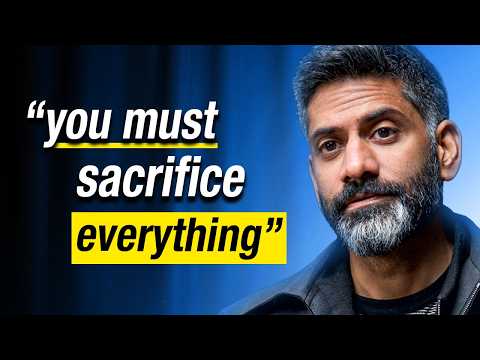
Shiv Rao
Frontier Insights
Thesis: Clinical dialogue—not structured EHR data—is healthcare’s ultimate source of truth. Capturing ambient conversation upstream unlocks clinical documentation, billing, and trial workflows while drastically cutting physician burnout.
Strategy: Abridge built a defensible post-training flywheel powered by millions of physician-edited encounters across 110+ health systems. By keeping clinicians strictly in the loop, pairing targeted proprietary models with regulated workflows, and out-executing incumbents like Microsoft in head-to-head enterprise deals, they secured category leadership.
Risks: High enterprise customer concentration, intense Big Tech platform competition, and the reality that fully autonomous, high-risk clinical action remains a slow, unsolved regulatory frontier.
Key Views & Dialogues
The Five Year Desert to Product Market Fit & a $5.3BN Valuation with Shiv Rao, Founder @ Abridge
- 🗓️ Date:
2026-05-16| 🎙️ Show:20VC
Abridge held its clinical-conversation thesis through a five-year desert, pivoting product, go-to-market, and business model before healthcare’s 2023 opening. Regulated workflow depth, daily user-edit post-training, and notes-to-orders-to-billing underpin the moat, with 40% of outputs already in-house for binary tasks. OpenAI and Anthropic’s enterprise push is a bull signal, but HITRUST, trust, model costs, and the 2-3 year execution window bear watching.
View Dialogue Notes & Key Takeaways
The company’s five-year desert (founded 2018, three months after the Transformer paper; hot only since 2023) distills to one survival rule: hold the thesis, pivot everything else. Shiv Rao was willing to pivot product, go-to-market, and business model, “but I wasn’t willing to move on the thesis” — that clinical conversations are “the most human signal” powering healthcare. Until the market opens, “you just need to not die” — be standing when the sky opens.
On the existential question every vertical AI founder gets: “If you are fighting against them, you’ve already lost.” If foundation-model tailwinds aren’t yours to leverage, you’re screwed. The company’s defense is depth — a regulated, $5.3T industry (18-19% of US GDP) where post-training on daily user edits across doctor types, settings, and languages is the product: “people in 2023 thought that was last mile. That’s actually most of it. The model piece is much less.”
~40% of the company’s in-product model outputs come from in-house models — possibly 60% next month as distilled open-source models replace frontier calls. The rule: binary, ring-the-bell tasks go in-house (faster, cheaper, set-and-forget); never-perfect tasks where the market rewards continuous improvement “ride the frontier wave.” Owning the lower stack gives “agency on the P&L” — a lever he doesn’t need now but “my future self might care more.”
The healthcare GTM trap: it’s not one $5.3T market, and founders who take the “start down-market” advice literally never time their “YOLO shot” up-market — 800K practicing doctors are concentrated in large delivery networks. The company’s opening came in 2023 when burnout (40-50% of doctors; a JAMA study saying 30% of nurses wanted out within 12 months) met LLMs: “when the sky opened, we ran right in.” Now doctors reportedly refuse to join hospitals that don’t have “a bridge.”
The note was never the product — the note is a bill. Clinicians “are compensated for the care that they documented that they deliver,” so the company sequenced notes → orders → billing along jobs nobody wanted, threading CMIO, CIO, and CFO. Result: Microsoft/Nuance (a $20B+ acquisition) and likely Nabler “we don’t see either of those companies much anymore” — not through bundling defense but category creation; Emory doctors now use “a bridge” as a verb.
OpenAI and Anthropic hiring forward-deployed engineers and partnering with PE firms is, to Rao, a clear bull signal for vertical AI: “If that wasn’t a sign that there is absolutely an incredible opportunity… I don’t know what is.” The mess is the moat — “it’s not SOC 2, it’s HITRUST,” behavioral-health data handled differently, enterprise data cleanup that takes real machinery to scale.
Offered frontier-model access six months early versus the best talent pool for six months, Rao takes talent, “no question about it” — great people build your own primitives and the frontier arbitrage “is not the be-all and end-all.” On Goldman’s estimate that agents drive 24X token consumption in five years: directionally right — jobs you’re never good enough at are “bottomless pits,” and Jevons means “a tsunami of healthcare needs” the system can’t deliver.
Founder mode, via investor Jensen (who cold-called Rao at midnight replying to a two-line email): not micromanagement but “tours of duty” — and “your job is to fall in love with whatever the job is,” CRISPR-ing new DNA that loves living on airplanes. Rao is unapologetically a wartime CEO (“who’s a peacetime CEO?”), envisions flattening his 450-person org around “super ICs,” and hires for Josh Wolfe’s “chips on shoulders makes chips in pockets.”
🔗 Original source & video: The Five Year Desert to Product Market Fit & a $5.3BN Valuation with Shiv Rao, Founder @ Abridge
Conversations Are the Source of Truth in Healthcare with Abridge CEO Shiv Rao
- 🗓️ Date:
2025-03-27| 🎙️ Show:No Priors
Abridge is turning clinician-patient conversations into an enterprise wedge for documentation, orders, billing, trials, and decision support, with deployment in more than 110 health systems including Kaiser and Sutter. Millions of conversations, clinician edits, and reported reductions of roughly 60% in cognitive burden and sometimes 50% in burnout strengthen its healthcare-specific data flywheel, while clinician verification and trust remain essential to higher-stakes automation.
View Dialogue Notes & Key Takeaways
Abridge’s core thesis is that conversations—not autonomous clinicians—will remain healthcare delivery’s first signal over the next decade. Those dialogues sit upstream of documentation, orders, billing, trials, and eventually decision support, making clerical automation a wedge into broader workflows. Rao’s goal is to remove work that “crushes their souls at night” while keeping clinicians in the loop.
The company deliberately entered large health systems, where the quality barrier creates both defensibility and concentrated distribution. Rao estimates Abridge is live in more than 110 systems, including Kaiser and Sutter; he says it has never lost a three-to-four-week head-to-head against Microsoft in recent years. Success at the University of Kansas Health System, Emory, and Yale then spread through CIO and CMIO networks—enterprise virality with severe downside because “you don’t get another shot on goal” after a failure.
Burnout created urgency, while ChatGPT converted years of market education into demand. Two out of five doctors reportedly may leave medicine within two to three years, and 27% of nurses within 12 months; Rao estimates replacing a clinician can cost close to $1 million. Abridge spent 2021–22 “eating glass” through demos, but Rao later realized it had been “pre-selling”: after ChatGPT arrived in early 2023, health-system executives called back asking for pilots.
The technical moat is not generic transcription but healthcare-specific recognition, orchestration, and audience-aware output. Rao argues that even 3–5% speech-recognition error rates can matter when doctors pronounce new oncology drugs idiosyncratically. Abridge must handle multilingual, polyglot conversations, then generate within seconds an English clinical note, patient summary, structured fields, and documentation sufficient to get “full credit for the care that you delivered.”
Scale turns clinician edits into a post-training flywheel. Abridge processes millions of conversations every couple of days, combining dialogue with medical records, insurance systems, and clinical textbooks through a “contextual reasoning engine.” Because its drafts remain imperfect, edits feed preference tuning, DPO, reward modeling, and reinforcement learning—the objective, in Rao’s estimation, is candidly to become “less imperfect,” not claim perfection.
Early measured outcomes are unusually strong, but the adoption wedge depends on a clinician remaining in the loop. Rao cites roughly 60% lower cognitive burden within six weeks and sometimes 50% lower burnout within the first few months. His framework favors lower-stakes, high-frequency workflows: they can prove productivity and ROI while clinicians verify drafts, unlike high-stakes autonomous care that health systems may absorb much more slowly.
The next prize is point-of-care intelligence, but Rao still expects seriously ill patients to want a live doctor using these tools. Abridge could surface trial eligibility or compare a patient with 10,000 similar recent cases, suggesting amyloidosis rather than sarcoidosis and a cardiac MRI rather than a CT. Yet Rao’s own use of GPT and Claude was sometimes immediately correct, but maybe just as often became a “dialectical experience” requiring three or four exchanges before reaching the right plan.
🔗 Original source & video: Conversations Are the Source of Truth in Healthcare with Abridge CEO Shiv Rao