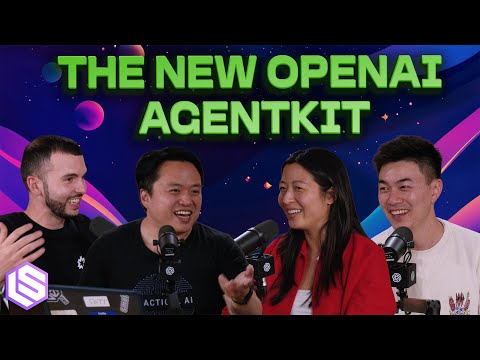
Sherwin Wu
Frontier Insights
Frontier Thesis: OpenAI is evolving ChatGPT and its APIs from standalone inference endpoints into an operating-system-level distribution channel, leveraging 800M WAU and 4M developers to establish an agentic application layer.
Strategic Decisions:
- Platformization: Deploying Apps SDK, AgentKit, and MCP to make ChatGPT the primary discovery and runtime engine.
- Enterprise Moats: Using forward deployed engineering, RL fine-tuning (RFT), and specialized models to turn proprietary client data into enterprise switching costs.
Risks & Warnings: Unresolved unit economics around inference latency and multi-step reasoning, alongside enterprise SLO governance and production evaluation bottlenecks, remain critical vulnerabilities.
Key Views & Dialogues
How OpenAI Builds for 800 Million Weekly Users: Model Specialization and Fine-Tuning
- 🗓️ Date:
2025-11-28| 🎙️ Show:The a16z Show
OpenAI is pursuing a two-sided distribution strategy through ChatGPT’s roughly 800 million weekly users and an API embedded across third-party products, while model-specific user preferences and developer harnesses make commoditization less straightforward. Reinforcement fine-tuning can turn proprietary enterprise data into differentiated capability, but adoption increasingly depends on context engineering, deterministic workflows, and efficient inference as specialized models and usage-based pricing reshape the economics of deployment.
View Dialogue Notes & Key Takeaways
OpenAI’s distribution strategy is deliberately two-sided: ChatGPT reaches roughly 800 million weekly users, while the API may touch an even broader population through third-party products. Sherwin Wu says this follows the founders’ mandate to distribute AI’s benefits across as many surfaces as possible, despite customers’ recurring fear that ChatGPT might enter their market. At its current growth rate, the first-party product is such a force that internal competitive anxiety is limited: “10% of the globe uses it every week.”
Models are proving unusually resistant to commoditization because both users and developers form model-specific dependencies. Users form preferences among GPT-5, GPT-4o, and o3, while developers tune prompts, tools, and application harnesses until they are effectively “building a product around the model.” That combination produces surprisingly high API retention and weakens the classic platform risk that an application abstracts away its underlying supplier.
OpenAI has moved from expecting “one model that rules them all” to increasingly expecting room for a portfolio of specialized models. Cursor illustrates the emerging stack: GPT-5 in Max mode for planning, Composer for fast first passes, and other models for deeper bugs or tab completion. Sherwin expects “a proliferation of other types of model,” though he cautions that today’s view may change again; specialization is not presented as a retreat from AGI, but as evidence that the path is less predictable than assumed.
Reinforcement fine-tuning turns proprietary enterprise data from a retrieval asset into potentially differentiated model capability. Earlier supervised fine-tuning mostly delivered “instruction following plus” and tone changes; RFT can potentially produce a state-of-the-art model for a customer’s narrow use case. OpenAI is piloting discounted inference and potentially free training for customers willing to share valuable datasets—an explicit exchange around the “giant treasure troves of data” sitting inside companies.
The application bottleneck has shifted from clever prompts to context engineering and controlled orchestration. Better reasoning models still need the right tools, data, retrieval timing, and procedural boundaries; Martin Casado’s reductio is that classic RAG uses cosine similarity to choose what gets fed “into a super intelligence.” For enterprises, intelligence does not eliminate workflow structure: many jobs require deterministic SOPs, approved response catalogs, and enforceable limits on what an agent may do.
OpenAI treats agents as intelligence expressed through different interfaces, not as a separate product category. ChatGPT, Codex, Sora, and the API are “different interfaces and different ways of deploying” the same core intelligence; Codex became separate because a CLI suited coding better than ChatGPT. This creates room for startups to embed or build around Codex—the economy Casado jokingly calls “token laundering,” turning natural-language input into metered intelligence.
Usage-based API pricing has held because it maps cleanly to consumption, supports cost-plus margin discipline, and may already approximate outcome pricing. OpenAI sees usage pricing as a possible “one-way ratchet”: once customers pay closer to realized utility, deployment-style pricing becomes hard to restore. Outcome billing remains appealing but difficult across domains such as crop yields; Martin argues that as test-time compute rises with task difficulty and value, token usage may become a workable proxy for outcomes.
Open weights appear additive rather than cannibalistic, while efficient inference remains a meaningful operational moat. Sherwin says OpenAI has “not seen cannibalization at all” from gpt-oss because its customers and use cases differ from those of the major hosted models. Even hypothetically releasing GPT-5’s weights would not reproduce OpenAI’s serving performance: its largest two or three models receive concentrated resources, and the inference and training teams optimize together. Multimodal breadth likewise depends on specialized stacks—shared API infrastructure above separate text, image, and video inference systems.
🔗 Original source & video: How OpenAI Builds for 800 Million Weekly Users: Model Specialization and Fine-Tuning
DevDay 2025: Apps SDK, Agent Kit, MCP, Codex and why Prompting is More Important than Ever
- 🗓️ Date:
2025-10-07| 🎙️ Show:Latent Space
Apps SDK makes ChatGPT an application distribution layer, combining roughly 800 million weekly active users with developer-controlled UI and brand rather than plugin-style dependence. MCP broadens integrations while AgentKit connects visual workflows, SDK deployment, connectors, ChatKit, and evals into a production stack for complex, weeks-long orchestration. The opportunity depends on connector quality, trajectory-level evaluation, prompt optimization, human review, and API reliability, with identity, inference funding, and widget economics unresolved.
View Dialogue Notes & Key Takeaways
Apps SDK turns ChatGPT from a chatbot attached to other products into the distribution layer in which those products run. OpenAI reported 4 million developers, while Sherwin Wu recalled roughly 800 million ChatGPT weekly active users and described it as around the world’s fifth- or sixth-largest website. The lesson from plugins was that distribution alone is insufficient: developers must “really own and steer the experience,” including UI and brand.
OpenAI adopted MCP as an already-emerging, general protocol. Sherwin credited Anthropic with treating MCP as genuinely open, including OpenAI representation on its steering committee, while the discussion placed adoption around March alongside the Agents SDK and Responses API. The unresolved layer is connector quality: first-party sync connectors enable indexing and reranking, while third-party MCP servers cover the long tail but leave performance dependent on each creator’s API shape.
AgentKit is becoming an end-to-end production platform rather than another agent-demo framework. Agent Builder, the Agents SDK, Connector Registry, ChatKit, and eval tooling combine visual workflow design, deployment, testing, and optimization; Christina Huang’s stage demo built a live DevDay assistant within an eight-minute slot. The deeper opportunity is complex orchestration—human decisions lasting “over the course of weeks,” reusable enterprise templates, and eventual movement both from canvas to code and code back into the canvas.
Agent evaluation remains early, but the optimization unit is shifting from a single answer to an entire trajectory. Christina estimated OpenAI has completed “maybe 10% of the progress that we need”: today’s system can grade long traces, but evaluating a 20-minute task requires decomposing and improving individual steps, often with human review. OpenRouter integration also lets the eval product compare non-OpenAI and open-source models in one place.
Prompting is becoming a durable production asset—effectively “zero-gradient” fine-tuning—rather than disappearing as models improve. OpenAI made a major automated prompt-optimization launch around GPT-5 because each model brings new quirks, and intends to connect prompts, agents, and eval feedback into continuous suggested improvements. Sherwin’s reversal is explicit: people once thought “prompting is going to be dead. No”; it has instead become “more and more entrenched.”
ChatKit reduces front-end work, but identity, inference funding, and the widget ecosystem remain unsettled. Its evergreen iframe and widgets borrow the philosophy of Stripe Elements or Checkout: OpenAI maintains new reasoning and modality UX while developers customize the application. Bring-your-own-key is not supported today, copy-pasted keys are “huge security hazards,” and cheaper inference can still increase total spend because demand rises faster.
Codex is already compressing development cycles, while API reliability is becoming a visible product commitment. Christina described interns using “full YOLO mode,” with broad tasks one-shot roughly 30–40% of the time; the visual Agent Builder began less than two months before launch and “wouldn’t be possible without Codex,” though humans still review its work. At serving scale, OpenAI has surpassed the cited 6 billion tokens per minute and now exposes organization-specific throughput and error SLOs—the path from three to five nines requires “exponentially more work.”
🔗 Original source & video: DevDay 2025: Apps SDK, Agent Kit, MCP, Codex and why Prompting is More Important than Ever
Inside OpenAI Enterprise: Forward Deployed Engineering, GPT-5, and More | BG2 Guest Interview
- 🗓️ Date:
2025-09-11| 🎙️ Show:BG2
OpenAI’s enterprise business predates ChatGPT and now embeds Palantir-style forward deployed engineers at T-Mobile, Amgen, and Los Alamos. Across 200 deployments, top-down buy-in, a bottom-up tiger team, and evals first underpin the climb from 46% to 99%. Connectors and RFT could unlock agents and proprietary-data advantages, but GPT-5’s reasoning-token versus latency trade-off remains unresolved.
View Dialogue Notes & Key Takeaways
OpenAI’s enterprise business predates ChatGPT — “the original product for OpenAI actually was not ChatGPT. It was a B2B product. It was the API” — and the company now runs a Palantir-style forward deployed engineer model, embedding at customers like T-Mobile (voice support handled live by OpenAI models), Amgen (a top GPT-5 customer for drug-development paperwork), and Los Alamos (o3 physically installed on the air-gapped Venado supercomputer, shared with Lawrence Livermore and Sandia).
Against the MIT “95% of AI deployments don’t work” headline, Olivier’s pattern from ~200 enterprise deployments: winners have top-down buy-in plus a bottom-up “tiger team,” and evals first — “whenever the customer fails to come up with good evals, it’s a moving target.” Most enterprise knowledge lives “in people’s heads,” not in the SOPs, and hill-climbing from 46% to 99% is “art, sometimes more than science.”
The episode’s sharpest frame: “physical autonomy is ahead of digital autonomy in 2025” despite a higher safety bar — because self-driving had 10-15 years plus roads and stoplights as scaffolding, while “AI agents are just kind of dropped in the middle of nowhere.” Agents date only to the o1-preview reasoning paradigm; “the slope I think is incredibly steep,” and by revenue they may have already crossed Waymo.
GPT-5’s differentiator is “the craft — the style, the tone, the behavior,” not saturated benchmarks: a host said he thought one eval showed hallucinations “basically went to zero,” and the core unresolved trade-off is reasoning tokens vs latency — GPT-5 Pro “one-shots” unsolved problems but takes 10 minutes. The monkey’s-paw lesson: instruction following got so literal that legacy “be concise” prompts broke outputs.
Reinforcement fine-tuning (RFT) — a term Olivier said OpenAI made up — is “an order of magnitude more powerful” than SFT and shifts the pitch from customization to building “a best-in-the-world model” on proprietary data (Rogo in financial services; Accordance hitting SOTA on TaxBench). Olivier’s call: for frontier capability, “RFT will pretty much become the norm.”
The long/short game: Sherwin is short “the entire category of tooling around AI products” — evals products, frameworks, vector stores, and now RL-environment startups — because the stack churns too fast for abstractions to survive a model generation. Olivier is short memorization-based education (“knowledge tokens”) and long healthcare — “probably the industry that will benefit the most from AI.”
Softer signals worth logging: vastly more software engineering ahead even if engineer headcount is ambiguous (“there is a massive software shortage in the world” — OpenAI PMs now ship coded prototypes instead of PRDs); Codex CLI + GPT-5 usage is ripping; and “the blip” (the board coup) left OpenAI antifragile — “a thicker skin and an ability to recover way quicker.”
🔗 Original source & video: Inside OpenAI Enterprise: Forward Deployed Engineering, GPT-5, and More | BG2 Guest Interview