Ryan Petersen
Frontier Insights
Frontier Thesis & Strategy
Petersen is leveraging AI agents to transition Flexport into a structural low-cost leader, running over 100 internal automated workflows to capture labor budgets rather than just software spend. Backed by disciplined capital allocation, $450M in annualized net revenue, and ~30% growth toward breakeven, his path to IPO rests on scaling operational density and forward-deploying AI where mission-critical accuracy justifies the error overhead.
Risks & Warnings
Macro tail risks loom: tariff volatility has collapsed China-US ocean bookings by 60%, straining small business solvency and fragile supply chains (batteries, rare earths). Internally, compute bottlenecks, collapsing SaaS vendor pricing power, remote work diluting corporate culture, and the steep verification costs of non-deterministic models threaten rapid operational scaling.
Key Views & Dialogues
Flexport CEO: Two Questions Every Founder Needs to Ask
- 🗓️ Date:
2026-06-20| 🎙️ Show:20VC
Flexport expects $450M of net revenue run rate this year, roughly breakeven, $600M next, and a 30%-annual-growth target, while shifting toward low-cost leadership and a potential IPO in a couple years. Its $5M LLM spend and roughly 100 agent workflows could reduce labor and SaaS costs, but automation may shift routine work to free open source models and leaves enterprise customers exposed to frontier labs cutting access.
View Dialogue Notes & Key Takeaways
Flexport breaking news: $450M net revenue run rate, basically breakeven this year, up from $350M last year (~30%), with $600M penciled next and a goal of “30% every year for 10 years.” Peterson applies Paul Graham’s two questions — is growth a hack, is the market big enough — and answers “no hacks, it’s actually a grind” plus under 1% share of a market that’s 11% of GDP. IPO comes at “a few hundred million of likely EBITDA… it could happen in a couple years.”
Enterprise AI spend is real but self-limiting: Flexport pays ~$5M/year for LLMs (doubled in a few months, no budget cap on the Anthropic contract), is agentifying ~100 core workflows (5 live, 95 in development) — but “once they’re automated, I should stop spending the money on Anthropic,” and mundane work migrates to “basically free” open source. Stebbings’ math on the bull case: a likely Benioff figure of $300M Anthropic spend is 3.8% of developer salaries; trillion-dollar lab valuations need 18–20%.
The tail risk Peterson actually fears is being cut off, not concentration: a lab deciding its compute “is more valuable for training superintelligence than it is for letting customers use it” — “we all just go back to being idiots we were two years ago.” Forced to pick one at equal price, he takes Anthropic over OpenAI: the enterprise business plus “a cohesive team that’s been together forever.” He recently invested at around 600 or something — “it already ran away.”
The SaaS shakedown is starting: “I think selling SaaS to tech companies is going to be a tough business cuz we can build stuff for ourselves.” His procurement team is building a PowerPoint case study of each SaaS Flexport replaced, then going down the vendor list — cut rates or “I’m just going to have to vibe… replace you guys.” Expected concession: “you get like 20% out of almost everybody.”
VC herding is structural, not stylistic: the job is so good that the game becomes not getting fired, so partners channel-check everything — “most VCs actually collude more with competitors than with their own partners.” Corollaries for founders: never test the market with one or two meetings (cross-firm associate roundups tank you), never share your metrics, and per PG, “hear the no but ignore the why.”
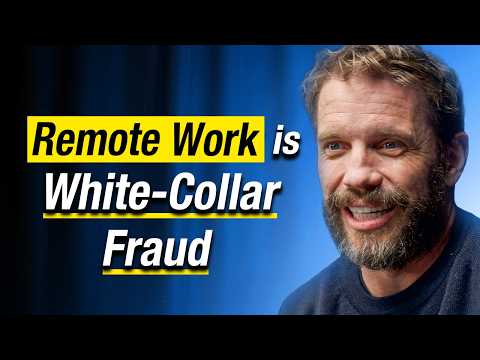
Remote work is “white collar fraud”: done honestly, WFH is labor arbitrage — an off-the-charts-IQ assistant in the Philippines at ~$500/month, “not the guy who’s making 250k a year and lives in Jackson Hole and wants to go skiing for 4 hours a day.” Flexport is 5-day in-office and Peterson is now re-concentrating leadership in SF; moving his CFO there “made the business much better.”
“Revenge and patriotism is a great investment thesis” — wronged second-time founders (he was Rippling’s first investor; he also mentions an unclear Dario/Parker reference) are his best pattern. Angel math after ~200 checks: mark every check to zero at signing; a 3x has “zero relative impact” beside a 500–1000x — so founders shouldn’t grind a decade for 1.5x.
Masa led Flexport’s $1B round after roughly an hour at his Woodside house, having Foxconn called live mid-meeting for diligence. His advice — be 10% cheaper than everyone, and if matched, go 10% cheaper again — was “a terrible strategy. I did not do that. We would have burned so much money.” Yet Peterson’s biggest change of mind in 12 months points Masa’s way: become the low-cost leader — “I think I was lying to myself.”
🔗 Original source & video: Flexport CEO: Two Questions Every Founder Needs to Ask
Trump’s First 100 Days, Tariffs Impact Trade, AI Agents, Amazon Backs Down
- 🗓️ Date:
2025-05-02| 🎙️ Show:All-In
China–US trade has suffered an immediate demand shock, with Flexport reporting a 60% fall in ocean-freight bookings as tariffs reached 154%. The strongest downside runs through small-business solvency and manufacturing dependencies, with apparel layoffs discussed within two to four weeks and relocation constrained by China’s ecosystem advantages. Meanwhile, AI agents are expanding software into labor budgets, but enterprise adoption remains gated by error economics, with a 90% single-pass result inadequate for many regulated workflows.
View Dialogue Notes & Key Takeaways
The panel broadly credited Trump’s first 100 days with sealing the border and pursuing a “reprivatization” of the economy, while treating execution volatility as the central risk. Chamath graded the period B+, Jason B versus a C- for Biden, and Sacks called the border result an A+; Aaron Levie’s bright spot was an unmistakably pro-innovation, pro-open-source AI posture. Chamath also cited committed foreign investment approaching or exceeding $1 trillion, while Sacks distilled the border claim as: “We didn’t need a new law; we just needed a new president.”
China–US trade has already suffered a demand shock, with Flexport seeing ocean-freight bookings fall 60%. Ryan Petersen said China’s initially announced 54% tariff escalated to 154%, while later describing the bear case around a 145% China rate; goods departing after midnight ET on April 9 now incur the duty upon arrival. He nevertheless rejected a point-of-no-return framing: “Don’t judge the cook while he’s cooking.”
The tariff bear case runs through small-business solvency rather than merely higher consumer prices. Petersen argued that companies remaining in China are buying its manufacturing quality and ecosystem, not cheap labor; businesses able to move had already received a powerful incentive from the prior 25% tariffs. Apparel founders were discussing layoffs within two to four weeks, and David Friedberg said layoffs had begun, although Petersen still expected the administration to avert the bleakest outcome.
The central policy dispute was whether strategic decoupling requires economic shock or could be achieved through predictable incentives. Levie advocated a 5% tax rate for building in America, immediate expensing, deregulation, automation and only surgical tariffs, warning against “chaos monkey[ing] the economy.” Chamath and Sacks countered that disruption finally exposed dangerous dependencies in batteries, AI, pharmaceutical APIs and rare earths—and that real-time correction may be the only feasible way to change a system this complex.
Amazon’s aborted tariff disclosure exposed a deeper marketplace-enforcement gap. Jason wanted retailers to itemize import charges and steer customers toward American goods; Sacks saw Trump’s intervention as “whack-a-mole” that could not protect hundreds of other retailers. Jason said he thought roughly 60% of Amazon sellers were Chinese-registered companies without US registration, creating opportunities to understate values, misclassify goods and evade meaningful product-safety enforcement.
AI agents expand software’s addressable market from employee seats into labor and previously unaffordable work. Jason cited prospective OpenAI agent pricing of $2,000–$20,000 monthly and a venture workflow that could compress roughly 5,000 hours spent processing 20,000 applications; Flexport already uses AI to call thousands of drivers drawn from 400,000 app users. Levie’s call was that perhaps 90% of future AI usage will perform work “that we don’t do today,” with only 10% replacing existing activity.
Enterprise adoption will be gated by error economics even as algorithms, chips and data centers compound rapidly. David Friedberg’s best single-pass test—500 documents and 40 requested fields—scored about 90%, inadequate for many regulated workflows without reruns, chunking and tuned reasoning. Sacks projected 3–4x annual progress across algorithms, hardware and deployed compute, while Chamath argued that probabilistic software makes “quality assurance and QA…now the only thing that matters.”
🔗 Original source & video: Trump’s First 100 Days, Tariffs Impact Trade, AI Agents, Amazon Backs Down