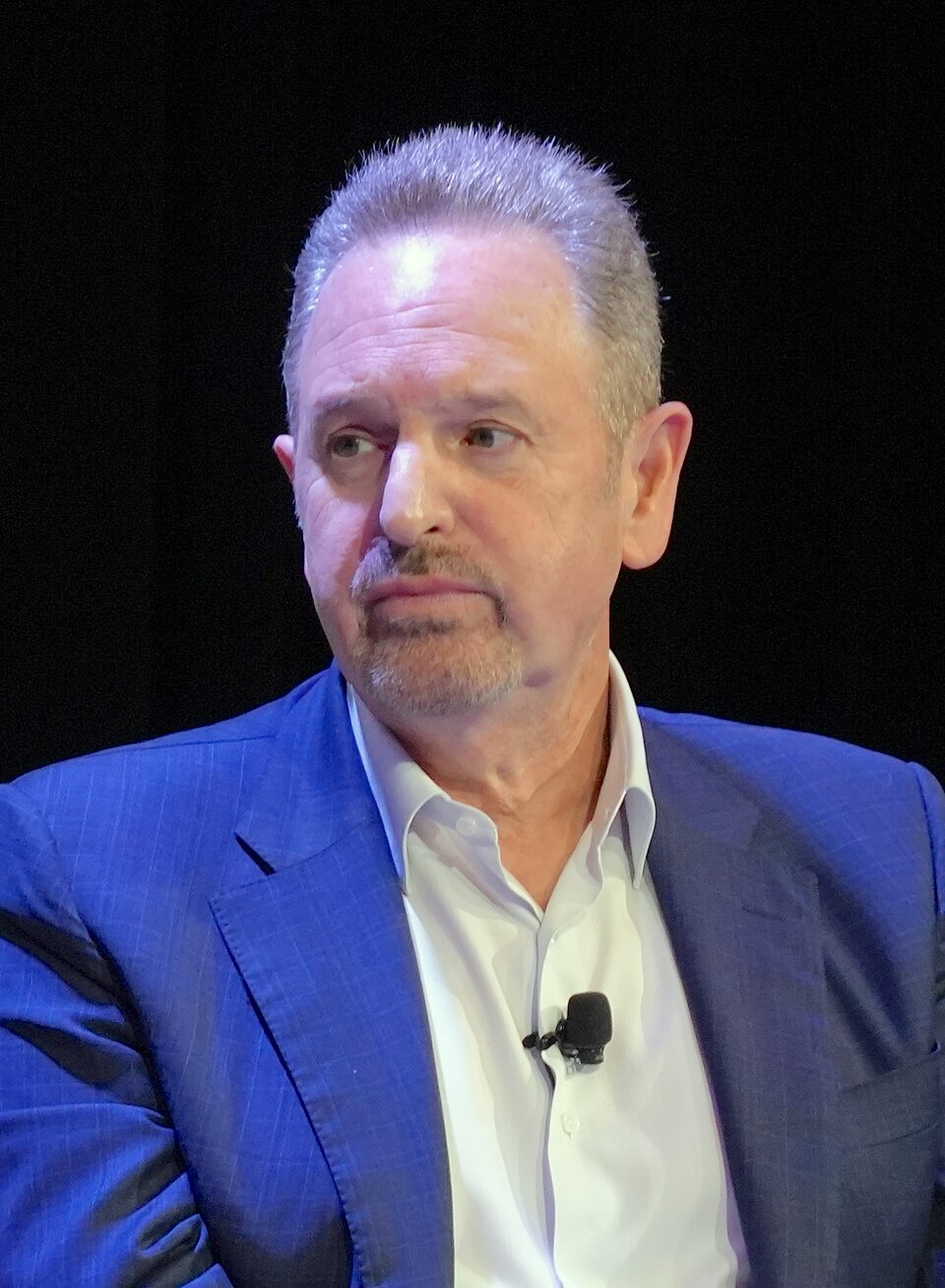
Rene Haas
Frontier Insights
Frontier Thesis & Strategy: Arm sits at the critical nexus between software and accelerators. Leveraging ubiquitous deployment—from Grace Blackwell superchips to edge robotics—Arm is pivoting from pure IP licensing into building physical silicon (e.g., Meta-driven “agentic” AGI CPUs) to capture agentic workloads and internalize design via AI-native EDA.
Risks & Warnings: Supply chain bottlenecks will constrain data center scale-outs for 3–5 years. Meanwhile, mega-capex initiatives like Stargate (leveraged 3:1) introduce severe demand-shock vulnerability if utilization falters, compounded by escalating US-China export controls and fragile onshore manufacturing.
Key Views & Dialogues
Redefining Chip Architecture with Arm CEO Rene Haas
- 🗓️ Date:
2026-09-03| 🎙️ Show:No Priors
Arm moved from IP licensing into physical silicon with the Arm AGI CPU after Meta sought a general-purpose agentic CPU no one else could provide. AI reaches 80% to 90% of engineers, while Arm’s documentation and test benches may make proprietary IP more trainable; supply may remain constrained for 3 to 5 years, with data-center construction a possible next bottleneck.
View Dialogue Notes & Key Takeaways
Arm has crossed from IP licensing into physical silicon, with Meta as the trigger. Meta wanted “a general-purpose agentic CPU” and Arm says no one else could provide it, leading to the Arm AGI CPU, introduced last March and presented at Hot Chips. Ecosystem pushback was milder than expected because more Arm-based software benefits customers broadly; launch congratulations included Jensen, Rani Borkar, Amin and James Hamilton. The move also adds supply-chain operations, memory allocation, back-end, layout, implementation and bring-up capabilities to a business Sarah noted had a 98.5% gross margin.
AI already runs Arm’s engineering floor: 80% to 90% of engineers use it daily, especially on the true long pole of a 24- to 36-month chip cycle—verification, validation, debugging and documentation. Shutting it off would be like rationing 1990s internet access, prompting Sarah’s “there’d be anarchy” and Haas’s “the genie’s out of the bottle.” RTL generation and best-in-class physical design remain less mature because models rely on public data while key information is proprietary. Haas says Arm’s rich IP, documentation and test benches give it an advantage; Elad’s point is that unusable and untestable IP is untrainable and therefore unusable for AI.
Haas sees idea-to-GDSII for straightforward designs as quite possible in 5-plus years, not necessarily 2 to 3. But a request for a design that is 10% faster than Vera Rubin, 20% cheaper and 30% more efficient will not be solved by pressing a button.
Supply is likely to remain constrained for 3 to 5 years at least, so long as the transformer remains the unit of energy for AI training and inference. Data-center construction may become the next bottleneck: many projects are not ahead of schedule or using less labor than expected, and some parts of the US are discussing slowing or restricting development. Haas says that may be preferable to wafer and memory capacity becoming the binding constraint. Setting valuations aside, he says oversupply relative to demand is “not even close.”
SoftBank could provide capital, ecosystem access and a potential home for chip startups. Haas advises young companies in CapEx-intensive industries to form strategic partnerships early with supply-chain participants, private equity and banks because access to capital is a gate. SoftBank Neo is the group’s intent to become a neocloud, potentially giving companies with chip technology an alternative to first winning a design slot at Microsoft or Google. Haas leads the direction of Ampere, Graphcore and Stack AV and helps Masa formulate and execute strategies around robotics, OpenAI, infrastructure and Arm.
Robotics could become “almost like something out of The Jetsons,” across both humanoid and task-specific forms, but costs are high and business models remain unproven. Distribution centers may automate heavily, while Elad points to factory automation, delivery and autonomous trucks as early areas. Haas says Arm will be pervasive in robotics, from sensing and perception at the fingers to the compute in humanoids.
Haas supports more US semiconductor manufacturing and says the export-control race is an infinite game with no winner; he warns that critical technologies could end up outside the US. Elad says that outcome would be bad and argues for staying at the technological forefront. Haas attributes data-center backlash mainly to fear of job loss, which he calls poorly grounded; Elad also points to organized media influence, while Sarah cites an electricians’ union asking that data centers not be banned. On CPUs, Haas says the accelerator focus after ChatGPT obscured the CPU’s continuing role: as workloads move from training toward reinforcement learning and inference, CPUs orchestrate where tokens go, alongside accelerators and memory. That applies from data centers to edge devices, where a 50-watt GPU is impractical.
🔗 Original source & video: Redefining Chip Architecture with Arm CEO Rene Haas
Arm CEO Rene Haas on AI: Nvidia Lessons, Intel’s Decline and the US-China Chip War
- 🗓️ Date:
2025-09-30| 🎙️ Show:All-In
Arm’s leverage in AI comes from supplying the CPU and IP layer around accelerators, with growth opportunities spanning data-center inference, smaller models, energy-constrained endpoints, and robots containing many chips. Haas’s lessons from Nvidia and Intel emphasize rapid pivots, manufacturing discipline, and long-cycle investment, while broad export controls could create competing compute ecosystems and weaken the West’s global technology network.
View Dialogue Notes & Key Takeaways
The episode’s Arm setup was unusually strong. Its September IPO valued it above $54 billion, making it the largest public offering in over two years; the opening framing said the valuation had tripled. Later, the hosts put its market cap at $150 billion after SoftBank’s $32 billion take-private and failed sale attempt.
Arm’s AI leverage is its CPU/IP layer rather than manufacturing. It increasingly supplies the microprocessor connecting accelerators such as Nvidia’s, Google’s and Cerebras’s; Nvidia’s Grace Blackwell uses “72 Arm CPUs.” Haas hinted Arm may go “a little bit further” than it does today, without confirming it will make chips or compete directly with Nvidia.
Haas expects AI compute to split into training, dedicated inference, and a middle tier of smaller models that both learn and infer. Giant models could teach smaller, roughly 20-billion-parameter mixture-of-experts models, while endpoint inference cannot depend on a GPU “that runs at a kilowatt of power.”
Haas said physical AI is already bigger than data centers today and could be huge by unit volume because each robot may contain tens or hundreds of chips. Today’s systems largely repurpose automotive silicon; future systems may need chips specific to actuators, joints and on-device learning.
Haas’s lesson from Jensen Huang is Nvidia’s willingness to pivot quickly. He recalled Huang moving 2,000 of Nvidia’s roughly 6,000 employees from an Intel-linked chipset program into Arm-based SoCs: “What was intended to be a roadmap review turned into, ‘We’re changing the strategy.’”
Intel’s decline illustrates how semiconductor mistakes compound across decade-long cycles. Missing mobile and underinvesting in EUV let TSMC attract Apple, Nvidia and AMD, improve through their volume, and widen the gap: “Once you fall behind in chips, it’s very, very difficult to catch up.”
Rebuilding US semiconductor capacity requires industrial policy, corporate capital and manufacturing culture—not merely fab construction. Haas argued America has lost the “muscle memory” for 24/7 operational excellence and must restore manufacturing’s prestige through universities, corporations and financing sustained for years.
Broad export licensing could create the rival technology ecosystem it is meant to contain. Haas warned that capable countries denied computing architectures “will find a way,” producing “two parallel universes” and putting the Western ecosystem at risk of losing global preference. He said China’s current software ecosystem largely follows the global one, including Android-derived mobile software and ADAS stacks, and argued for keeping that ecosystem open.
Arm remains globally distributed and still needs more engineers. Half its employees are in the UK, with 2,000 in Bangalore and probably over 1,000 in the United States; Haas said AI has reduced finance and legal hiring but not engineering, and argued for more STEM investment.
🔗 Original source & video: Arm CEO Rene Haas on AI: Nvidia Lessons, Intel’s Decline and the US-China Chip War
Stargate, Executive Orders, TikTok, DOGE, Public Valuations | BG2 w/ Bill Gurley & Brad Gerstner
- 🗓️ Date:
2025-01-23| 🎙️ Show:BG2
Stargate’s $500B headline may require only $3B of 2025 equity and $78B through 2028, while 2M potential annual GPU purchases would force hyperscalers to defend capacity and capex. Rene Haas identifies TSMC 3nm/2nm, HBM/DRAM, multi-site training, and cabling labor as bottlenecks, while Bill flags 3:1 leverage and DeepSeek’s possible commoditization or market expansion as unresolved risks.
View Dialogue Notes & Key Takeaways
The Stargate math is smaller than the headline: Brad’s bottoms-up model shows the $500B number needs only ~$3B of equity in 2025 (250K GPUs, ~$13B capex at 25/75–30/70 equity-to-debt) and ~$78B of total equity through 2028 — so Elon (“funding not secured”) and Sam are both right. “Nobody has $500 billion, in fact nobody has a hundred billion to contribute to this on day one” — but nobody needs it, and Abilene is real: Ellison says 10 buildings built, 10 under construction, OpenAI already running workloads there.
Nvidia is most obviously impacted (stock +5% today): a new buyer potentially wanting 2M GPUs a year against a ~6M industry forecast forces Google, Microsoft, and Meta to defend their order-book positions and raise capex. Dylan Patel’s December call is vindicated — “the demand is off the charts, people aren’t making 12-month bets, they’re making three-year bets.”
AI is now a “sport of Kings” and subscale players get folded in: Anthropic has “less than a billion in revenue,” great models but no consumer/enterprise traction, and “every time they buy in for a little bit more at the poker table, somebody else goes over the top.” Google’s $1B into Anthropic “fell through the cracks” the same day.
Structure and risk remain unresolved: Bill sees “maybe an even better-funded version of CoreWeave” running 3:1 debt-to-equity (Equinix ran ~1:1) — “that could be a real painful downside” if capex overruns demand. Arm CEO Rene Haas, dialing in mid-show, says Stargate is a coordinating shell with OpenAI in operational control, and flags TSMC 3nm/2nm capacity, HBM/DRAM, multi-site training, and cabling labor as the real bottlenecks.
DeepSeek suggests export controls backfired: a distilled Chinese model matching benchmarks on deprecated chips leads Bill to a categorical call — “the policy of the American government to try and keep China out of the AI game is futile… I actually think it backfired.” Constraints drove creativity; the result is either foundational-model commoditization or a market-expanding collapse in token costs.
The AI diffusion rule survived Trump’s regulatory freeze because it was already published in the Federal Register — Howard Lutnick or others must act specifically to kill it. The Biden AI EO was revoked (clean-slate approach), and with ~25 states pushing SB-1047 clones, Congress plans federal preemption plus a moratorium power to freeze state laws.
Brad’s on-record prediction: at the State of the Union in the first week of March, Trump commits to balancing the budget in his first term — if the bond market believes it, borrowing costs fall $100–200B/year. Bill’s sober counter: “high impact, still low probability in my brain,” because Washington is “such a bureaucratic place.”
Pro-business isn’t all-in: likely Druckenmiller calls this the biggest anti-to-pro-business reversal of his lifetime but flags high valuations and rates. Watch the ten-year (4.85% → ~4.6%); Brad would cut exposures at 5–5.5%. Netflix’s apparent ~$40B day — guidance raised through a 2–3% FX headwind — supports his “golden moment of margin expansion” thesis for the next 5 years.
🔗 Original source & video: Stargate, Executive Orders, TikTok, DOGE, Public Valuations | BG2 w/ Bill Gurley & Brad Gerstner