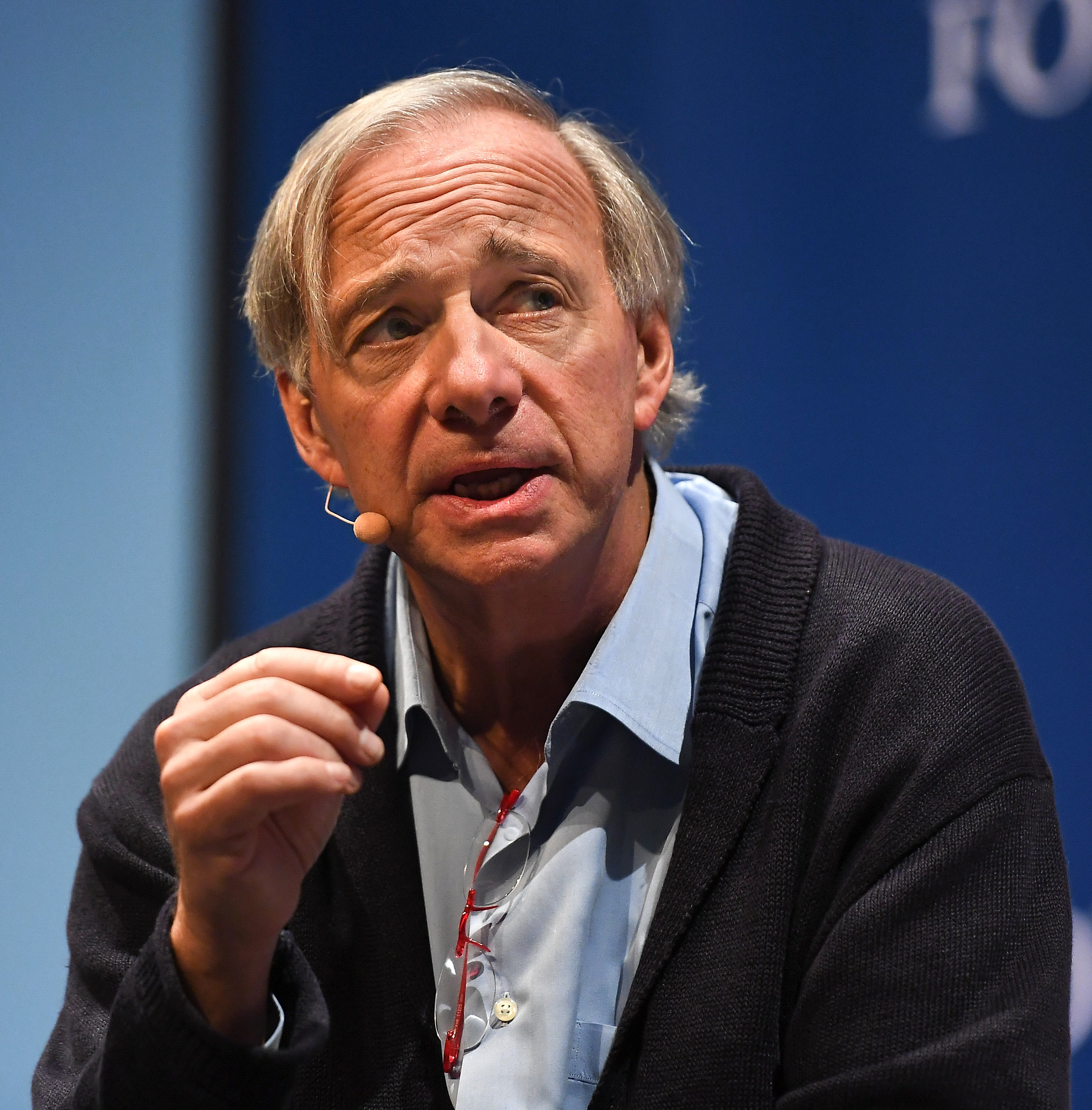
Ray Dalio
Frontier Insights
Thesis: The convergence of disruptive AI and an unsustainable sovereign debt spiral marks a late-cycle inflection echoing 1998’s euphoric fragility. While AI guarantees massive labor disruption, commoditization via open-source and foreign competition will erode corporate margins before net productivity gains materialize.
Strategy: Enforce fiscal austerity to slash the US deficit from ~7.5% to 3% of GDP, averting supply-driven bond market breakdowns. Hedge severe monetary debasement and geopolitical fragmentation with gold over long-dated sovereign debt.
Risks: Soaring interest burdens and dwindling foreign treasury demand risk forced monetization, structural inflation, and compounding social-economic polarization.
Key Views & Dialogues
Ray Dalio: “AI Is Eating Everything - and It Might Eat Itself”
- 🗓️ Date:
2026-03-03| 🎙️ Show:All-In
Dalio sees an unstable U.S. fiscal path—about $7 trillion of spending against $5 trillion of revenue, debt equal to 600% of annual receipts, and $9 trillion to roll—making foreign Treasury demand and eventual Fed balance-sheet expansion central risks. He favors 5%-15% gold for diversification, while Bitcoin remains a smaller, more controllable, tech-correlated market; meanwhile, AI may transform productivity even as competition destroys returns for many AI companies.
View Dialogue Notes & Key Takeaways
Dalio says the U.S. remains on an unstable fiscal path: about $7 trillion of spending against $5 trillion of revenue, with debt equal to 600% of annual receipts. Half of the roughly $2 trillion deficit is interest, $9 trillion must be rolled, and Friedberg cites a 2026 deficit near 6% of GDP versus the roughly 3% level Dalio says would “sort of stabilize” matters. The result is “plaque in the system” that increasingly squeezes out spending.
Treasury buyers are becoming a geopolitical variable, making eventual Fed balance-sheet expansion “likely down the road.” Roughly one-third of buyers are foreign, already heavily exposed to dollar debt and newly alert to conflict or sanctions; meanwhile, shortening issuance maturities lowers today’s long-rate pressure but increases rollover risk.
Dalio’s portfolio prescription remains 5%-15% gold for an investor with no directional view, because it diversifies fiat and crisis risk. Friedberg notes the price rose from about $2,900 to $5,200 since their prior conversation; Dalio says gold moved from an “extremely small number to something that is a less small number” in the wealth-and-money composition and is now almost, though not quite, back to its historical average. Gold is “the most established money,” transferable, supply-constrained and not someone else’s promise.
Bitcoin’s failure to mirror gold—Friedberg cites gold up 80% while Bitcoin fell 25%—comes from a different buyer base and risk profile. Dalio argues transactions can be monitored and potentially controlled, central banks will not want it, quantum computing raises questions, and tech-stock correlation creates forced-selling risk. It remains a relatively small, “controllable market”; “there is only one gold.”
Rate policy is trapped between protecting debtors and retaining creditors because “one man’s debts are another man’s assets.” Rates set too low invite leverage and bubbles; too high squeeze debtors. The K-shaped backdrop makes one economy-wide setting harder: the top is discussing the first trillionaire while Dalio says 60% of Americans read below a sixth-grade level and face AI substitution.
Dalio sees tariffs as a valid but limited fiscal and industrial tool—not a replacement for income tax. He argues economists wrongly exclude taxes from inflation calculations, says foreigners pay part of tariff revenue, and treats trade deficits as the mirror of unsustainable reliance on foreign capital. Full income-tax substitution is “nowhere near” feasible and would be regressive; the larger answer remains a three-part 3%-of-GDP package across taxes, spending and, hopefully, interest rates.
A major risk is political: bad finances, wealth and values gaps, and external threats have pushed the U.S. into what Dalio calls “stage five” of the cycle. “When the causes people are behind are more important to them than the system, the system is in jeopardy”; his remedy is education, civility, an orderly opportunity structure and avoiding civil or international war. He also warns that post-midterm gridlock could make success impossible.
AI can transform productivity while destroying the economics of many AI equities: “the technologies will go on, but the companies won’t necessarily go on.” Dalio says AI “is eating everything and it might eat itself” if competition prevents adequate profits. China might treat nearly comparable AI as free, open-source infrastructure and capture gains through usage, while U.S. companies must earn returns on capital.
🔗 Original source & video: Ray Dalio: “AI Is Eating Everything - and It Might Eat Itself”
Ray Dalio on AI, Job Loss & the Future of the Economy | EP #148
- 🗓️ Date:
2025-02-12| 🎙️ Show:Moonshots
AI is a virtually certain—though debatable—productivity tailwind that could replace workers as cheap capital funds robots and agents. That distribution shock meets debt and geopolitical pressures, while Treasury oversupply could raise rates or weaken the currency; Dalio’s 3% solution is politically negotiated. With markets resembling 1998, he sees 1.5 years of good times but warns that AI’s timing and budget remain unresolved.
View Dialogue Notes & Key Takeaways
Dalio sees AI as a powerful productivity tailwind that is “virtually certain”—though he says even that is debatable—to replace many workers, but not as an automatic cure for America’s fiscal problem. Diamandis fears cheaper capital will fund robots and agents rather than jobs, breaking the familiar chain from employment to wages, consumption and debt service. Dalio’s answer is distributional: higher output per hour is good, but the resulting wealth divide could intensify civil conflict unless society manages how people deal with each other.
The investment question is whether AI arrives fast enough to overpower simultaneous debt, political, geopolitical, climate and demographic headwinds. Dalio expects a revolution larger than the shift from rulers and graph paper to spreadsheets and computerized decision-making, yet refuses to quantify its timing or magnitude, saying he does not know whether it will be 1.2, 1.25 or 1.5 times as large. The 1920s combined record patent activity with the 1929 crash: “We cannot simply say that these innovations will quickly and in time create such a productivity miracle that the other forces don’t matter.”
U.S. markets look to Dalio roughly like 1998: late-cycle, expensive and euphoric. He says that analogy implies about 1.5 years of good times, but tells entrepreneurs not to assume that, over one to five years, there will be no economic downturn, bear market or political disappointment. His valuation rule is blunt: investors can be “much better off buying bad companies at good prices than good companies at bad prices.”
The sovereign-debt risk comes from too many Treasury bonds meeting insufficient demand while interest costs compound. If private buyers retreat, rates rise and worsen debt service; if the Federal Reserve buys the bonds, it prints money and depreciates the currency. Dalio calls credit the economy’s blood and accumulated debt its plaque: once borrowing is required merely to pay interest, the system approaches a “debt death spiral.”
Dalio’s proposed escape is a politically negotiated “3% solution,” not confidence that DOGE alone can fix the budget. With prior Trump tax cuts extended, he estimates the deficit at about 7.5% of GDP and argues it must be brought toward 3% through some mix of spending restraint, tax revenue—not necessarily higher tax rates—and lower interest expense. On DOGE’s effects, his answer is deliberately limited: “I honestly don’t know,” because each cut produces second-order reactions.
Dalio prefers gold to Bitcoin while placing both inside a 10%-15% “anti-money” allocation intended to preserve purchasing power. Bitcoin is monitorable, taxable and vulnerable to government regulation, while physical gold is “the only asset that you can have that’s not somebody else’s liability” and remains a reserve asset when states distrust one another. He owns some Bitcoin, but cannot explain its price movements as readily as gold’s and therefore holds “much more gold.”
Dalio says the U.S. and China are already at war—subversively and technologically, if not yet militarily—and neither governments nor hyperscalers can afford to lose the technology race. He sees the U.S. as advanced in chips, though by how much is uncertain, while China performs better in applications and practical usage; Diamandis adds that chip restrictions force China to build capabilities internally and become more efficient, as he sees with Huawei and DeepSeek. Dalio expects near-term “pushing the edge” without necessarily going over it, while warning that the Treasury market and budget fight could leave investors “not as happy a year from now as we think.”
🔗 Original source & video: Ray Dalio on AI, Job Loss & the Future of the Economy | EP #148
Ray Dalio: US Debt Spiral, How to Avoid Disaster | The All-In Interview
- 🗓️ Date:
2025-01-28| 🎙️ Show:All-In
The U.S. is near the dangerous end of an roughly 80-year debt cycle, with $36.4 trillion of federal debt against $29.1 trillion of GDP and long-term yields rising as short-term rates fall. Dalio’s 3% solution would cut the expected federal deficit from 7.5% of GDP by about $900 billion annually, while AI’s productivity gains may arrive too late to resolve near-term debt stress and distributional conflict.
View Dialogue Notes & Key Takeaways
Dalio’s framework places the U.S. near the dangerous end of a roughly 80-year debt cycle, with $36.4 trillion of federal debt against $29.1 trillion of GDP. The cycle runs from sound money through a debt bubble, a top, deleveraging, and a restart. Debt that generates sufficient income is healthy; debt issued to service existing obligations becomes “plaque in the arteries.” A debt crisis can be addressed through austerity, restructuring, taxation, or central-bank monetization, the last repaying creditors in cheaper money.
The critical market warning is long-term yields rising while the central bank cuts short-term rates, signaling that private buyers no longer want the debt at prevailing prices. Gold and Bitcoin rising, sterling weakening as UK yields rise, and central banks and sovereign wealth funds reducing bond exposure all fit that pattern. Dalio’s U.S. long-term debt-risk gauge is at 100%—its highest historical reading, not a 100% crisis probability—while the near-term gauge remains 0%.
Dalio’s “3% solution” is to cut the expected federal deficit from roughly 7.5% of GDP to 3%, an adjustment of about $900 billion annually, while the economy is still strong. A credible fiscal reduction would itself lower market interest rates; a 100-basis-point decline would materially reduce interest expense. Delay makes the adjustment nonlinear: “The faster you cut, the less you have to cut.”
Investors must measure returns in purchasing power, because nominally rising assets can conceal severe real losses. Dalio says equity prices have sometimes fallen 60%-70% in inflation-adjusted terms, while Friedberg notes that 1966-1984 produced a negative real return. The book’s portfolio guidance emphasizes 10-15 genuinely uncorrelated positions. Dalio owns some Bitcoin but “not nearly as much as gold,” and favors stores of wealth that are international, mobile, relatively private, secure, and comparatively difficult to tax or confiscate.
AI can drive a major productivity transformation and is a strategic war “that no country can lose,” but that does not make today’s expensive technology leaders automatic winners. Dalio sees risk in Nvidia and the hyperscalers, with more opportunity potentially accruing to businesses implementing AI and creating applications. Dalio says China owns 33% of global manufactured goods, more than the United States, Germany, and Japan combined, and could pair inexpensive chips with robotics and manufactured products; however, “a great company that gets expensive is much worse than a bad company that’s really cheap.”
AI productivity is unlikely to arrive soon enough to solve the immediate debt imbalance and may initially add job losses and public-support demands before its gains arrive. Profits, capital gains, deregulation, tariffs, and efficiency might improve revenue, but Dalio rejects making the fiscal plan a “crapshoot.” The legislative window is short—the first 100 days, followed by roughly two years to the midterms—while the distribution of AI’s gains will be intensely political.
Debt stress is converging with internal polarization, U.S.-China rivalry, technological disruption, military spending, and climate costs. Dalio expects greater state-federal fragmentation and a world increasingly governed by “might is right,” though he does not predict a hot civil or military war as inevitable. Within the coming decade, he thinks there will be a “hellacious” period when problems intensify while the cooperation needed to solve them weakens.
🔗 Original source & video: Ray Dalio: US Debt Spiral, How to Avoid Disaster | The All-In Interview