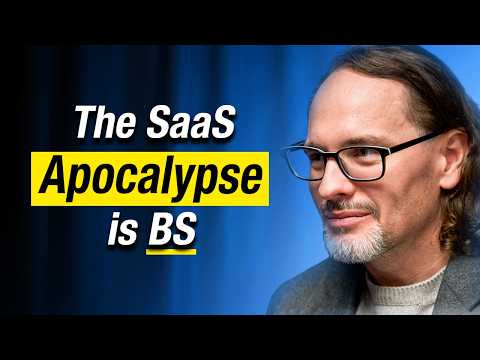
Mitchell Green
Frontier Insights
Frontier Thesis: Mitchell Green views the AI capex boom as an unsustainable bubble that will commoditize foundational models. The durable enterprise winners over the next 2–5 years will not be speculative wrappers, but entrenched public and late-stage software incumbents wielding distribution, high gross retention (>90%), and real free cash flow.
Strategic Playbook: Lead Edge executes a disciplined, concentrated strategy (5–7 deals/year) targeting overlooked infrastructure software. They prioritize entry price, strict dilution control, and real DPI over paper markups, seeking 2–5x returns.
Risks & Warnings: Aggressive stock-based compensation, liquidity crunches, and 2021-era SaaS multiples face brutal reckoning under Rule-of-40 benchmarks. Half of traditional VCs lack the discipline to survive this reset.
Key Views & Dialogues
Why Now is the Best Time to Buy Public Software Companies
- 🗓️ Date:
2026-03-24| 🎙️ Show:Invest Like the Best
Mitchell Green sees public software as a potential risk-adjusted opportunity because distribution, customer success, and switching costs still protect incumbents such as Workday despite AI disruption fears. He expects the AI capex bubble to end badly as models commoditize, with the eventual drawdown creating an entry point, while Lead Edge’s sell discipline and 70% special-situations allocation offer nearer-term liquidity advantages.
View Dialogue Notes & Key Takeaways
The AI capex bubble ends badly — “it’s like the telecom bubble all over again,” and Apple may end up looking like the smart one. Green’s tell: VCs “have to portray the view that software is going to be dead because they have to justify how much money they’re going to spend” — run the assumptions on required earnings and power generation and “it just doesn’t work.” But the crash is the entry point: “That’s when you’re going to buy these companies.” Timing caveat as hedged: no clue when it stops, “it will probably go longer than people think,” and “this Anthropic round was kind of like an IPO.”
Best risk-adjusted returns right now are public software names. People hate the sector (Constellation’s chart is “a ski slope”), which is exactly the Buffett setup — Lead Edge bought ByteDance two years ago when everybody hated China, and Alibaba has doubled off its lows at 15x earnings. The core belief: software’s moat was never R&D but distribution and customer success, so “it is the incumbent’s game to lose” — Workday does $10B revenue, $3B FCF, 98-99% gross retention; Exxon isn’t rebuilding its HR software.
Model commoditization is his biggest AI worry: Google, Amazon, and Microsoft have more training data than new model companies, while Google, Facebook, Amazon, and Apple have a structural cost advantage; Chinese models run at a fraction of the cost, locally — “why would you pay that amount for OpenAI tokens or Anthropic tokens when you can just run DeepSeek?” He called investing in OpenAI at $100B “a little insane personally” — while conceding “I should have invested” if it compounds to a trillion in earnings.
The return machine targets 2-5x in 3-7 years per deal, 2-2.25x net per fund (~20 net IRR), 20-position portfolios, no leverage — “We’re like Cal Ripken. Doubles doubles and triples.” For LP retention, consistency matters more than peak returns. Only one total wipeout ever: 85-90% recurring revenue, 50-60% profitable, ~70% of positions in the pref turns zeros into 0.8x’s or 0.1x’s, which “massively helps return.” Fund seven was just raised at $3.5B.
Sell discipline is the underrated edge: a standing disposition committee meets once or twice a month, and “the fastest way to get fired at Lead Edge is have a company and not tell us when there’s a liquidity opportunity.” Toast: 12% of a $290M fund, sold $180M before the IPO at $40-50 in secondaries — stock now ~$30. The 2020-21 reckoning is industry-wide: funds that underwrote “a 4x in 2 years” are making “a 1.6x in 8 years.”
70% of dollars deployed are special sits and secondaries — when the front door (primary) and side door (secondary) are shut, “we’ll go through the basement window with a pickaxe and buy a derivative”: in Zoom, Sequoia would roll over direct secondary buyers, so Lead Edge bought out LPs of the original Chinese funds. “In a world where LPs and GPs are desperate for liquidity, that part of our business is absolutely booming.”
The famous eight criteria are a strike zone, not a crystal ball. Patrick’s pushback: eight-criteria deals show no correlation with outperformance versus five-criteria deals, so aren’t the criteria necessarily predictive? Green says they need not be predictive: it’s a Ted Williams strike zone that turns 9,000 cold calls into 900 workable names, and “our biggest mistakes have honestly been not swinging at the pitches when they were in our strike zone.”
🔗 Original source & video: Why Now is the Best Time to Buy Public Software Companies
Mitchell Green: Why 50% of VCs Should Not Exist
- 🗓️ Date:
2026-03-07| 🎙️ Show:20VC
Mitchell Green sees the SaaS selloff as an estimates reset, buying Procore, Workday, Appian, and Toast while prioritizing earnings, retention, and balance-sheet strength over AI narratives. He expects AI’s defining winners to emerge over two to five years, favors 25% IRR discipline and secondary liquidity, and sees ByteDance’s power and execution advantages supporting a possible $70 billion-$100 billion earnings path within five years.
View Dialogue Notes & Key Takeaways
Mitchell Green sees the SaaS selloff as an estimates reset, not an extinction event, and is buying Procore, Workday, Appian and Toast. He also likes Clearwater Analytics, although it is being taken private. The host counters that Workday is growing only 6.8% while AI attacks seat-based pricing; Green answers that its AI business is growing quickly and that the company still produces roughly $10 billion of revenue and $3 billion of free cash flow, with distribution, data and a balance sheet challengers lack. Expect “dead money for a little while” as analysts cut forecasts, then potential upside once companies beat reset numbers.
AI will create enormous businesses, but Green thinks many of today’s highly valued first-generation companies will fail before the real winners emerge over the next two to five years. In 1999, nobody would have framed social media as the internet’s eventual multi-trillion-dollar outcome; similarly, AI’s defining company may not resemble another call-center vendor or Workday. His updated view is that AI will be “even bigger than we thought,” particularly through productivity gains across support, distribution, manufacturing and drug development.
Green calls ByteDance “the most advanced AI company in the world” and bets China may win the AI race through power, technical resources, scientific talent and execution speed. ByteDance reportedly grows 25–30% annually with substantial profits; Green thinks it could generate $70 billion, $80 billion or even $100 billion of earnings within five years. China can build power plants quickly and repeatedly engineer products more cheaply, although Green stresses that ByteDance winning would not mean Google, Meta or other Western incumbents lose.
The investable dividing line is cash generation, retention and capital structure—not whether a company carries the AI label. “If you don’t have earnings or EBITDA, there is no floor”; for software, Green treats gross dollar retention around 90% as good, 95% as great and 98% as exceptional. He is equally concerned by excessive stock-based compensation because shareholder value is price multiplied by share count, making dilution a hidden but very real cost.
Green’s return discipline is built around being “in the money” within 18 months at a reasonable multiple, then continuously re-underwriting the position. Lead Edge targets two to five times invested capital over three to seven years, roughly a 25% IRR, rather than underwriting every deal as a power-law moonshot. “Buying is glamorous, selling is the job”: at a sufficiently rich ByteDance valuation—he offers $1.3 trillion as an example—he would sell a meaningful portion despite believing the company could ultimately be worth $2 trillion.
Venture’s liquidity drought is partly self-inflicted: funds held marks without returning enough cash. Green advises young managers to sell 5%, 20% or 30% when windows open, because LPs may withhold commitments from funds that cannot return capital. Secondary sales have represented roughly one-third of Lead Edge’s deals, and Green accepts being called a trader because “the investor is my client.”
Green believes at least 50% of venture investors should not be in the business, with too much capital chasing too few assets at undisciplined prices. He calls billion-dollar valuations for people spinning out of OpenAI or Anthropic with little beyond “an idea and a napkin” complete lunacy, while questioning the math of $10 billion-$15 billion funds that require multiple companies to reach extraordinary earnings scale. His preferred setup is to preserve capital for a major downturn within the next decade, avoid many “Gen 1 AI companies,” and invest aggressively in the stronger businesses created afterward.
🔗 Original source & video: Mitchell Green: Why 50% of VCs Should Not Exist
Mitchell Green, Founder @ Lead Edge Capital: Why Traditional VC is Broken
- 🗓️ Date:
2025-03-28| 🎙️ Show:20VC
Lead Edge’s eight-criteria, cold-call model targets overlooked software, while its ByteDance underwriting at 5x earnings and 25-30% growth assigns the US business zero value. Green argues entry price, 20-30% stock-based-comp dilution, Rule of 40, 90%+ gross dollar retention, and DPI—not marks—will determine which 2021-era companies and managers survive.
View Dialogue Notes & Key Takeaways
Venture learned nothing from 2021. Mitchell Green’s core charge: “I think the venture industry was about to be in for a rude awakening and then AI showed up” — Mitchell’s gloss, “AI was the oxygen that we needed.” The lessons that should have stuck: “entry price matters a lot, don’t overcapitalize companies,” and stock-based comp dilution is massively underestimated (Lead Edge now models 20-30%). Will the tourists wash out? “100%… it might be a slow hole in the canoe, but eventually yes.”
The ByteDance bull case survives a TikTok ban. Lead Edge bought late last year at ~5x earnings growing 25-30%, underwriting the US business at zero (single-digit % of revenue, unprofitable). It’s “China’s first truly global business,” a future “foremost AI company on the planet,” and liquidity comes via Hong Kong like Tencent — versus Facebook at ~$1.5-1.7T on similar earnings with slower growth. “We like to buy stuff when no one else likes to buy things.”
AI infrastructure is 1997 websites; incumbents win the application layer. Prices will plummet the way $50M Sun server websites became $10/month — the DeepSeek-day trade (Nvidia down, software up) was rational. Since the iPhone only three new $100B companies have been built — ByteDance, Pinduoduo, Uber — because “incumbency wins, it’s customer distribution,” and the one-person AI company is “comical at best.”
The model: criteria, not theses. Eight objective criteria, 10,000 cold calls a year, five-plus criteria = ~10% yield → 5-7 deals; less than 10% of the portfolio is Bay Area and 70% of the time Lead Edge is the first institutional money. Specimen: SafeSend, bootstrapped in Ann Arbor, 60% bought in 2021 at ~$130-140M, grown from $13M ARR to $47M revenue, sold to Thomson Reuters — in Silicon Valley “it would have been $500 million.”
Hundreds of 2021-vintage SaaS companies are the living dead — $50-200M revenue, mid-teens growth, effectively already IPO’d on private money. The only exit is Rule of 40 plus 90%+ gross dollar retention, sold to mid-market PE (50-60% of which now buy software). And take the exit: “if you told me today I could take a 7x just to get out of it, I would happily do it.”
DPI over everything: “marks are completely for suckers.” The 3x-net fund some endowments demand is “a complete fallacy”; emerging managers should copy Fabrice Grinda — “invest in the seed or A and sell a bunch in the B or C” — because “you got to stay in business.” The LP diligence question that exposes everyone: how much unlocked public stock did you hold on September 30, 2021, and why didn’t you distribute it?
LPs are more important than founders: “if you do not have LPs, you do not have a business.” Lead Edge made its LP roster (ex-CEOs of Schwab, Kimberly Clark, Colgate) the moat — every intro logged in Salesforce, 97% gross-dollar-retention target on LPs — and Harry agrees it’s “really arrogant” of VCs to deny LPs are customers.
Watchlist extras: AI software gross dollar retention is “just really, really low — actually shocking” (Lovable ~85%, “better than ChatGPT but it’s not 90”); on a 30% drawdown he’d buy Snowflake or Datadog “and put it in a drawer” for 10+ years alongside Microsoft; and MicroStrategy’s debt-funded Bitcoin flywheel “sounds like a house of cards to me.”
🔗 Original source & video: Mitchell Green, Founder @ Lead Edge Capital: Why Traditional VC is Broken