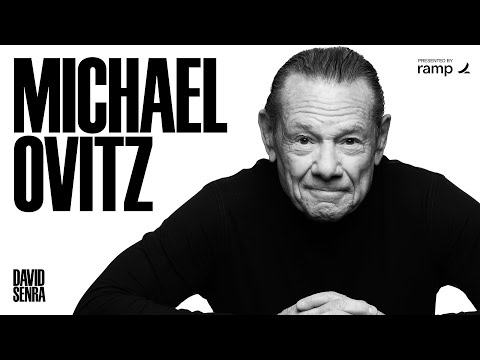
Michael Ovitz
Frontier Insights
Frontier Thesis: Content distribution power is shifting from production tech to irreproducible talent networks and IP. Decades of institutional pattern recognition serve as the ultimate moat for capturing asymmetric upside in tech, media, and AI.
Strategic Decisions: Monopolize premium talent (controlling 75% market share) to maximize pricing leverage over legacy distributors. Aggressively deploy private capital—exemplified by the proposed UMG take-private bid alongside Bill Ackman—to anchor governance and steer AI transformation around established IP.
Risks & Warnings: Unresolved AI monetization frameworks threaten core royalties; founder-dependent, hyper-intensive network moats lack scalable succession; and bottleneck shifts toward scarce original creative genius.
Key Views & Dialogues
Founder of CAA Michael Ovitz: “I Just Knew I Was Going to Outwork Every One of Them”
- 🗓️ Date:
2026-08-09| 🎙️ Show:David Senra
Michael Ovitz and Bill Ackman have made a “very well financed” offer to take Universal Music private, conditioned on Lucian Grainge continuing to run the company, with Ovitz as chair supporting technology and AI. The proposal follows UMG trading “like, you know, 10 points under the IPO price” despite Grainge growing it “geometrically every year,” while family control and unresolved AI monetization remain key risks.
View Dialogue Notes & Key Takeaways
Ovitz confirms he and Bill Ackman — friends for 33 years — have made a public, “very well financed” offer to take Universal Music private, with Lucian Grainge running the show as “a condition precedent to the deal.” The trigger: UMG stock “crept down to like, you know, 10 points under the IPO price” even as Grainge grows the company “geometrically every year” — so Ovitz told Ackman, “Let’s take it private,” friendly-only, with Ovitz as chair supporting Grainge on tech and AI. “Whether we get it or not, I have no idea. It’s frankly up to one shareholder… one family that controls 28% of the stock.”
The underlying music thesis is that music sits at the foundation of everything digital in the AI era — games, film, TV, image capture — and that “music is never going away.” He flags Suno and Udio “taking IP that other people own, even 10 seconds of it,” but pointedly refuses to say how labels will monetize AI training: it’s “a very difficult problem that right now is under analysis by all the music companies.” His company thesis: without someone who understands talent running the company, “that company is going to die.”
At the busiest point of his life, Ovitz says AI makes today more exciting than “the entertainment sweet spot of the late ’70s through the end of the ’90s.” His evidence is speed: Max Levchin once told him a day off felt like missing a week, and now “if I take a day off now, I feel like I’ve missed 3 months”; a researcher friend got “results in 9 months on a cancer cure” from a post-AI trial versus 5-10 years for the four started pre-AI.
“We all had to be specialists until AI. Now, we’re all generalists” — though he says his own generalist nature is not caused by AI: “I’ve been like this my whole life.” AI gives people like him more leverage. Prepping for Matsushita (with $15-20B of balance-sheet liquidity in the late ’80s) took four weeks of stockbrokers’ offices, libraries, and a physical 10-K; for his two current transactions, he spent six-seven hours down a rabbit hole on three AI platforms and now works across consumer, defense, medicine, and biopharma — fields he’s “totally unqualified for.”
His competitive doctrine is monopoly, not competition: “Competition is for losers because you’re competing with yourself, basically.” When four agency partners said they would never represent movie stars and one called him arrogant for saying CAA would have them all, his reply was “I’m not arrogant at all, actually. I just know I’m going to outwork every one of them” — then he mailed them the torn-out Variety full-page ad for every star signed, weekly, for 10 years. The goal: “blow out the competition as fast, as cleanly, as simply, and as brutally as we can.”
CAA’s culture came from Magic Johnson’s showtime fast break — “I didn’t care who scored. I just wanted a score” — plus radical idea intake: 200 chairs tied in a circle every 90 days, 30 seconds each, no passing. A mailroom guy pitched a cable idea and was “promoted on the spot to Asia.” Counter-example: the NCAA playoff he and Phil Knight pitched to 150 college presidents 40 years ago — rejected, validated by a 500-page report, adopted 30 years later; “the amount of money they left on the table was frightening.”
The cross-domain success trait: protect the vision, but hold ground only until proven wrong. He watched “Martin Scorsese take Harvey Weinstein apart in a room like he was a toothpick” over dumb notes, and calls Steve Jobs’s intransigence plus willingness to be talked out of it if he agreed “the best trait any businessman can have.” On losses, Barry Diller’s six words govern: “He won, we lost. Next case.”
🔗 Original source & video: Founder of CAA Michael Ovitz: “I Just Knew I Was Going to Outwork Every One of Them”
CAA Co-founder Michael Ovitz: Failure Is Not an Option
- 🗓️ Date:
2025-11-23| 🎙️ Show:David Senra
Michael Ovitz says his technology-investing edge since 1992 comes from a “frame of reference” built through decades of pattern matching. CAA represented 46 of the top 50 grossing filmmakers and 75% of the talent market, using tiered pricing to increase leverage over studios; whether the founder-led model transfers remains unresolved.
View Dialogue Notes & Key Takeaways
Ovitz’s core edge is “frame of reference” — a lifetime of pattern-matching he describes as his own primitive AI. Senra contrasts his own recall as requiring more work; Ovitz answers that some people have greater innate processing power. Longevity “automatically promotes more meetings, human interactions, and experiences,” and within ten minutes of meeting someone his brain auto-compares them against everyone in and out of their silo — the mechanism behind spotting Nobu (“he filled the room”) and a twenty-something Wolfgang Puck pre-empire, and a general thesis he says he has used in tech investing since 1992.
CAA was built as an explicit monopoly play: “I’m a monopolist… you have to be number one, and you have to have the lion’s share.” He says CAA had 46 of the top 50 grossing filmmakers and 75% of the talent market, and answers the price-fixing question “no and yes” — triple-A clients demanded triple-A pricing, lifting Mike Nichols’ fee $2 million on signing purely by strata placement. Selling CBS Records (later Columbia Records) to Sony first, then Columbia Pictures and Universal, while financing Warner Bros. and saving MGM, also gave CAA leverage: a Japanese owner of a studio could have a relationship with nobody but CAA and its staff.
The operating system was banal and brutal: no lying, relentless follow-up, share everything. “If you don’t have an answer… ‘I don’t know, I’m going to call you back’” was unheard of in 1974; “you didn’t even have to be smart, you had to have good follow-up.” Paying ahead of market plus personal check-ins and a nightly open door meant “we didn’t lose an agent in the whole time I was at CAA. Not one.”
The Coca-Cola account shows the pricing playbook: send back the $3 million check. CAA delivered 35 demographically tailored commercials for the budget of Coke’s usual six; when Coke paid $3 million for a $30,000 black-and-white spot made on an Apple IIe, Ovitz voided the check — “we don’t want you to overpay anyone except us” — and used it to open the fee conversation. The polar bears are still being used 40 years later.
David Rockefeller taught him the ask-less ask — a sales lesson that impressed even Ovitz, a self-described salesperson. Rockefeller took every MoMA trustee to a three-hour dinner while raising money for the new museum and never mentioned giving once; Ovitz donated far more than he’d planned. “I wouldn’t even think to do that” — the Bruce Lee principle of punching without punching.
Fear and failure are treated as non-concepts: “Fear is the killer and enemy of business.” The ideas Ovitz pursued were repeatedly called impossible (“You’ll never sign movie stars” — “I will get all of them”), and at a London dinner he talked a businessman whose business bank had failed out of retreating to Gstaad: “In America, failure is a badge of honor. It means you tried.” The root is the San Fernando Valley — a father making ~$300 a week, “Success or death… I don’t want to go back to the Valley.”
The episode’s examples pair obsessive curiosity with openness to criticism. Akio Morita hired Norio Ohga off a 10-page letter ripping Sony’s first reel-to-reel “to smithereens” and moved him to President of Sony; Michael Crichton, whom Ovitz called seven days a week for 30 years, taught him “curiosity about everything”; Patrick Collison spent two and a half hours interrogating only Ovitz’s mistakes — “What about the things I did right?” “Who cares? That’s expected.”
🔗 Original source & video: CAA Co-founder Michael Ovitz: Failure Is Not an Option
Michael Ovitz - Turning Potential into Prominence - [Invest Like the Best, EP.418]
- 🗓️ Date:
2025-04-08| 🎙️ Show:Invest Like the Best
Ovitz uses time-disciplined pattern recognition—rapport, processing power, motivation, and a “burning desire to learn”—to identify founders such as Alex Karp. CAA’s 90-day “gong show” and Gulfstream’s sales-oriented board show how cadence and relationships become distribution advantages. Blackstone’s stated $450 billion credit fund and Andreessen Horowitz’s founder-independent ambition illustrate institutional compounding, while AI and fragmented media shift scarcity toward original ideas.
View Dialogue Notes & Key Takeaways
Ovitz’s edge is accumulated pattern recognition disciplined by respect for time. His “pilot’s checklist” tests visceral rapport, eyes, processing power, motivation, social capacity, work ethic, and a “burning desire to learn”; a bad selection is not a hiatus but an irrecoverable “loss.” Alex Karp initially looked ill-equipped to run Palantir, yet three and a half hours of wide-ranging conversation convinced Ovitz: “We can build a business around this guy.”
Enduring institutions combine founder energy, relentless expansion, and exceptional people given room to operate. MoMA’s long-shot appointment of Glenn Lowry, Blackstone’s progression from tiny office to a stated $450 billion credit fund, and Andreessen Horowitz’s ambition to outlive its founders share the same mechanism: leaders keep asking “what’s next?” and hire people capable of taking their jobs. Ovitz’s cardinal rule is equally direct: “First person out of the foxhole.”
Momentum is an operating system rather than a motivational slogan. Ovitz still runs daily fundraising meetings; CAA put 250 executives through a 90-second “gong show” every 90 days; and Palantir interviewed roughly 50 engineers to hire one. The enemy is fear: Kevin Systrom’s “fourth pivot was Instagram,” while Ovitz argues that Americans treat failure as “a badge of honor” and keep moving.
Gulfstream showed how governance can become a distribution advantage. Facing a larger-cabin Bombardier, Ted Forstmann recruited Roger Penske, Colin Powell, Henry Kissinger, Bill Acquavella and others—not primarily for financial oversight, but to sell aircraft into their respective networks. The board met monthly with 100% attendance, began meetings by tallying sales, and helped take Gulfstream from near-bankruptcy to a sale to General Dynamics seven years later: “Everything’s relationships.”
CAA’s move into investment banking was a strategic extension of control over entertainment’s coordination layer. After reaching 76% talent share and representing 46 of the top 50 grossing directors, Ovitz saw cash-starved studios needing outside sponsors and cultivated Nomura, Sony, Matsushita, Bertelsmann and Credit Lyonnais. CAA combined access to owners with content expertise bankers lacked, often worked without written engagement letters, and differentiated itself by doing something Ovitz says was unusual in Hollywood: “We told the truth.”
Ovitz invests in founders because he sees venture capital as the same craft he practiced as an agent. Find a person or idea, develop it, finance it, shape the package, recruit the cast, secure distribution, and market it; “there’s not one thing” he does today that differs fundamentally from 1974. Companies have failed, but he says the founders “have never failed me”—they have always come back.
Media’s bottleneck is becoming original ideas and talent development, not merely production technology. Ovitz expects AI to benefit production planning but hedges on machine creativity—“There’s no emotion now. Will they get there? Maybe.”—while streaming fragmentation has weakened common viewing and word of mouth. A service celebrates 3.4 million viewers, yet Letterman once drew five million nightly; meanwhile inexpensive 100-inch screens and 4K projectors make theaters harder to justify.
The scarce asset beneath Ovitz’s relationships, investing, and mentorship is time. Every Sunday for 50 years, he has reviewed the prior week meeting by meeting, carrying forward only people who were intellectually stimulating, doing unfamiliar work, or connected to meaningful gains and losses. He does not want retirement or idle happiness: “Achievement, learning” and helping younger people matter, because “time is my most precious commodity.”
🔗 Original source & video: Michael Ovitz - Turning Potential into Prominence - [Invest Like the Best, EP.418]