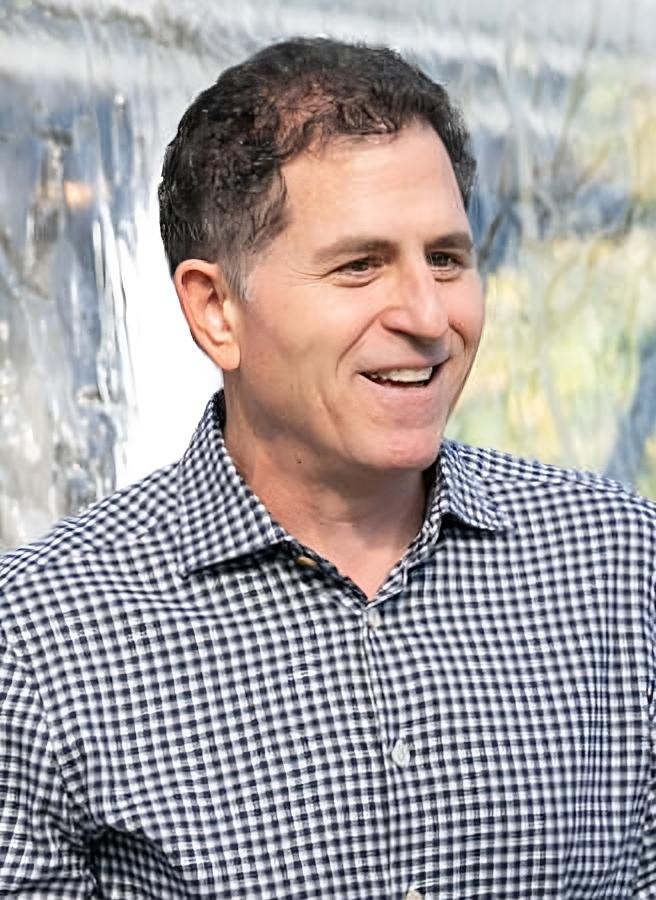
Michael Dell
Frontier Insights
Core Thesis: AI adoption is existential: a 10–20% service-economy productivity unlock justifies $2T–$4T in annual AI capex, expanding intelligence from data center “AI factories” to edge and physical infrastructure.
Strategic Moves: Scaling Dell’s AI factory pipeline from ~$2B toward an estimated $50B, backed by hyper-disciplined working capital (~5-day inventory vs. rivals’ 90) and deeply integrated operational data to capture enterprise compute demand.
Key Risks: Fragmented state-level AI regulations, export curbs, and high-skill immigration friction threaten to choke the productivity flywheel before top-down enterprise integration and ROI fully materialize.
Key Views & Dialogues
Two Legendary Founders: Travis Kalanick & Michael Dell Live from Austin, Texas
- 🗓️ Date:
2026-03-17| 🎙️ Show:All-In
Atoms is extending Kalanick’s physical-computing architecture from food into mining automation through its near-closing Pronto acquisition, targeting more productive, safer, and potentially remote mines. Dell’s AI-infrastructure revenue is scaling toward $50 billion amid excess demand, while enterprise adoption and edge inference remain constrained by re-architecture, leadership, identity, and controls.
View Dialogue Notes & Key Takeaways
Travis Kalanick is rebranding City Storage Systems as Atoms, a physical-automation platform spanning food, mining, and robot mobility. His architecture treats manufacturing, real estate, and logistics as the physical equivalents of CPU, storage, and network: “You’re treating atoms like bits.” The investment thesis is broader than cloud kitchens: the company wants specialized machines that transform industries.
The immediate physical-AI opportunity is “gainfully employed robots,” not humanoid spectacle. Atoms is close to closing its acquisition of San Francisco-based Pronto to automate mining equipment, potentially making existing mines more productive and remote, inhospitable deposits more viable with smaller labor and safety footprints. Kalanick sees Waymo as the autonomy leader but constrained by manufacturing, scale, urgency, and fierceness, while Tesla is attempting “hard mode times 100” with vision without other sensors.
Physical AI still needs its ChatGPT moment—and radical gains in energy efficiency. Kalanick asked “when does the ChatGPT moment happen for vision?” while saying a human operates on roughly 100 watts and the Waymo machine uses about 100 times more energy to drive than a human. Language-like communication among driving, perception, and safety agents could become a powerful compression layer, though he presented that as a possibility rather than a settled solution.
Capital matters only when the market structure turns fundraising into a core competitive competency. In Uber’s era, Kalanick said a rival could receive $1 billion from Masa and take 20% market share “tomorrow,” making capital a genuine strategic weapon. He would not speculate confidently about post-conflict Middle Eastern funding, but said his Middle East business was supposed to go public in January before the Saudi market fell roughly 20% over two months.
Michael Dell’s AI-infrastructure business is scaling from roughly $2 billion to $10 billion, $25 billion, and an expected $50 billion this year. Dell still sees “a lot more demand than supply,” across hyperscalers, sovereign AI, and more than 4,000 enterprise Dell AI factories. Texas compounds that opportunity through abundant land, power, and the ability to build.
Enterprise AI can produce productivity gains of 20% or more in some use cases, but only through top-down re-architecture. Dell said perhaps 10%-15% of large companies have figured this out; the rest are “fumbling around” because adoption is constrained by “culture and leadership and courage,” not technology. Dell’s infrastructure business grew 73% last quarter and was guided toward roughly 100% growth.
Inference is dispersing toward the data rather than remaining exclusively in centralized clouds. Dell’s view is that “the lowest cost token” will be generated on the device, alongside fast-growing edge inference and local open models such as Gemma, OpenAI’s open models, and NVIDIA Nemotron. Autonomous agents increase the opportunity while making identity, authentication, validation, and controls indispensable.
Invest America is an attempt to make ownership—and capitalism’s upside—visible to every eligible child. Michael and Susan Dell announced $6.25 billion, or $250 each for 25 million children ages 2-10 in qualifying ZIP codes. Brad Gerstner described accounts that children under 18 can claim and that, for children born in America from January 1, 2027, will be created automatically; Michael Dell estimated the program could ultimately move $5 trillion to families over 15 years. The core behavioral thesis is more important than the seed money: “I’m in the game. I have a shot.”
🔗 Original source & video: Two Legendary Founders: Travis Kalanick & Michael Dell Live from Austin, Texas
Michael Dell, Dell Technologies | David Senra
- 🗓️ Date:
2025-10-12| 🎙️ Show:David Senra
AI adoption is existential, Michael Dell says, as a faster, more efficient competitor could emerge in every Dell business within five years. Next Best Action uses telemetry, warranty, call-log, and Jira data, while roughly 5 days of inventory versus competitors’ 90 days shows working-capital discipline; monitor whether AI drives customer-data growth.
View Dialogue Notes & Key Takeaways
Michael Dell’s core AI call: he stood before his own company and declared that within five years a competitor would exist in every Dell business — “faster, more efficient, and more capable” — and that survival requires Dell to “become that company.” The hypothesis was simple: every core process — software development, support, sales, supply chain — “can be improved in a dramatic way.” Even if adoption merely neutralizes competitors, “you have to do it. You have no choice.”
The structural edge that helped Dell out-compete Compaq was working-capital and supply-chain math, not just product specs. Dell ran roughly 5 days of inventory against competitors’ ~90 days across distributors and dealers. Because electronic component prices generally decline, 90-day-old inventory costs materially more and ships stale technology; add a negative cash-conversion cycle (paid by customers faster than suppliers were paid) and growth generated cash instead of consuming it. “It was like a massive advantage.”
Dell’s competitive doctrine — never educate your competitors — is a repeated theme with tradeable weight. Rivals “misunderstood it, which was fantastic”; Senra recalls Compaq’s CEO referring to Dell as a “mail-order company” and “garage operation,” which Dell calls “a multiplier for us because they underestimate us.” Senra’s maxim for it: “Bad boys move in silence.”
On founder failure, Dell says you could make the argument that companies are undone by their own fatal mistakes rather than competition. His examples are overzealous expansion, design errors, or failing to understand the landscape. His prescription: “Go make some mistakes nobody’s ever made before. Try to make them in small increments. Fix your mistakes as fast as you find them.” The Osborne effect — announcing product 2 before shipping it and killing product 1’s sales — is his canonical cautionary tale.
Technology adoption cycles are compressing, which changes how incumbents must treat “wild ideas.” The internet took roughly a decade from mid-’90s websites to a real e-commerce boom; today’s waves move “maybe five to ten times faster” because billions of connected people sit on prior foundations. Five years ago, Dell suggests that “probably 99 out of 100” top AI researchers would have denied what LLMs might do — so “you kind of have to hold this idea in your head that any of these wild ideas has a chance of succeeding.”
The concrete AI proof point inside Dell is ‘Next Best Action’ in support: telemetry, warranty data, call logs, Jira databases — “millions and millions of documents” no human could interpret — routed into a tool that helps customers or agents reach the best solution in the fewest steps and summarizes the call. Agents feel like they have “this genius on my shoulders”; the same pattern is being applied to coding and sales, and it creates an opportunity for Dell to help customers unlock the power of their data through its compute, storage, and networking business.
The founder-psychology thread: belief precedes ability, and fear outlasts success. On taking on IBM at 19 with $1,000: “Was I a little full of myself at 19? Sure, I was. I think you have to be to do anything important” — a deliberate blend of naivete and confidence, never arrogance. And 41 years in: the fear of failure remains “a bigger motivator than the love of success. One hundred percent.”
🔗 Original source & video: Michael Dell, Dell Technologies | David Senra
Michael Dell – Invest America Act Becomes Law, AI Talent Wars, Compute Demand, Market Update | BG2
- 🗓️ Date:
2025-07-10| 🎙️ Show:BG2
Michael Dell estimates that a 10% productivity gain across the $114T global economy could be worth $10T+, implying annual AI investment of $2T–$4T; Dell’s server and networking business already grew 58% YoY with a $14B+ backlog. Invest America is now law with $1,000 Treasury-seeded S&P 500 accounts for children born after 1/1/2025, while talent scarcity and policy—70 state AI laws, export licensing, and skilled immigration—remain key constraints on the AI buildout.
View Dialogue Notes & Key Takeaways
Michael Dell puts a number on the AI opportunity: with a $114T global economy that is two-thirds services, a mere 10–20% productivity gain is worth ~$10T+ — meaning AI investment “should be more on the order of two to four trillion dollars per year,” far above current spend. Asked point-blank if the gains exceed the PC and internet eras he witnessed firsthand: “Oh, it’s far bigger. It’s far far bigger… I feel 98% confident.”
Demand evidence from the shop floor: Dell’s server/networking business grew 58% YoY, took $12.1B of AI orders in Q1 against ~$10B of AI server shipments for all of last year (vs ~$2B two years ago), and carries a $14B+ backlog. First GB300s shipped to CoreWeave days before recording; systems being deployed will produce “more than 50 trillion tokens per month.”
Not 2000 redux: Dell’s rebuttal to bubble talk — multiples on earnings and cash flow are “nowhere near” dot-com levels, and token demand “just explodes” as workloads move from basic queries to test-time compute, deep reasoning, and multi-agent systems. His own usage: “like 50 times a day as my thought partner.”
The Meta talent war is rational founder math: Gerstner (a META and OpenAI shareholder) frames Zuckerberg’s $75M–$100M packages and the $15B Scale aqua-hire as “risking 1% of his company” to reboot around AI, funded by “the world’s biggest printing press shooting out billion dollar bills.” Gurley’s caveat: private-market cash-shoveling started this, real startups can’t hire “anyone that’s top thousand in the Bay Area,” and Dell warns the fairness problem inside Meta could be “a distraction.”
Invest America is now law: every child born after 1/1/2025 gets a $1,000 S&P 500 account from Treasury; all 65M kids under 18 can open accounts; families can add $5,000/yr, companies $2,500/yr pre-tax (Dell, Uber, Nvidia, Oracle, Salesforce, T-Mobile have already said they intend to give). Max cost $3.7B/yr — “1/100th of 1% of national revenue” — and per Gerstner revenue-positive in 20–30 years via exit taxes. KPI: 50–60M kids signed up by July 4, 2026.
Deficit framing worth keeping: Dell says the US doesn’t have a “loan to value problem”; the discussion cites ~$36T of debt vs $200T+ of assets — “we have a spending problem.” Gerstner walks the Bessent path to 3% deficit/GDP by ‘27–28 and would rather see Elon fund a balanced budget amendment ($10B behind an Article V push; 32 states have supported one, 34 needed) than a chaotic third party.
Policy is the main downside risk to the bull case: the AI moratorium was stripped from the bill (“70 state laws… not great for AI startups”), Gerstner says he was told no new export licenses have been granted post-Biden-diffusion-rule repeal, and skilled immigration may be going the wrong way. Dell’s PlayStation-at-the-Pentagon story is the parable: naive export controls produce “all kinds of unintended consequences.”
Market read: NASDAQ +32% off the April bottom, VIX back to 15–16, 10-year at 4.2% mid-range, 85% of S&P beats — but huge dispersion (TSLA -20%, AAPL -15% vs NVDA/MSFT/ORCL at highs). Dell bought back 22M shares into the dip ($72 low → $120); asked if markets are higher in 3–5 years: “I would bet they’re higher.”
🔗 Original source & video: Michael Dell – Invest America Act Becomes Law, AI Talent Wars, Compute Demand, Market Update | BG2