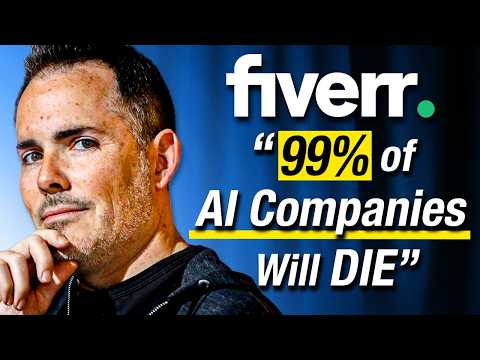
Micha Kaufman
Frontier Insights
Thesis: AI shifts competitive advantage entirely to taste, strategic nuance, and output velocity. Moats built on software cloning or traditional seniority have collapsed; product replication now takes ten days, compressing differentiation down to creator leverage and execution speed.
Strategy: Mandate 100% automation internally while pivoting human capital to non-linear judgment. Fiverr counters commoditization by broadening its catalog to ~800 categories and scaling enterprise deals, deploying tools like Fiverr Go to augment top talent via high-fidelity style replication rather than displacing them.
Risks: Escalating compute costs and imminent capital contraction will kill undercapitalized AI startups; frontier models risk state capture. Meanwhile, model drift, creator IP alignment, and retention threaten monetization.
Key Views & Dialogues
Fiverr CEO & Founder, Micha Kaufman: “If You’re Not Adapting to AI, F* You. You’re Done!”
- 🗓️ Date:
2025-06-09| 🎙️ Show:20VC
AI has compressed startup clone windows from 6–9 months at Fiverr’s launch to “10 days,” making speed, distribution, and resilient teams more decisive than free technology. With 999 of 1,000 AI companies possibly gone within one or two years, regulation, expensive compute, copyright uncertainty, and potential government control remain key market risks.
View Dialogue Notes & Key Takeaways
Micha Kaufman’s wake-up call to Fiverr’s own staff — the email and ensuing discussion — is that every employee should aim to automate 100% of their job, because doing so frees them for the non-automatable work (taste, strategy, nonlinear thinking). And the employer is not responsible for making you better on the way there: the last 10-15 years’ idea that your workplace must upskill you is “an aberration.” “If you’re not going to take the time to make yourself valuable… you’re doomed. I’m not going to help you” — he’ll help only those helping themselves.
“Time to clone” is the metric that changed everything: ~1 year 25 years ago, 6-9 months when Fiverr launched 15 years ago, “10 days, whatever” now — “for simpler stuff it’s nothing.” Fiverr’s 9-month head start was precisely when its brand and community got seeded; when the clone window collapses to near zero, “you leave more to luck,” and incremental products get incremental results.
Free technology confers no moat. OpenAI’s November 2022 go-to-market was “as democratized as possible… you can’t be freer than free” — it elevated the standard but “picked up everyone to the starting line.” So venture judgment reverts to the oldest rule: people. His best-ever investment was a seed company he’d written off (“so many reasons why this company needs to die”) that went public with multiples in the 50s.
Maybe “999 companies out of a thousand” won’t be around in a year or two. Investors may trigger the cleanup by pulling back, while two further forces — regulation and “expensive tech” (AI so costly only large or well-backed players can afford it) — sort the market. Foundation players might be “reduced to the equivalent of paying for GPU cycles… it’s a cloud play essentially” — though the dot-com also gave birth to Amazon.
“Copyright is dead. It’s a notion from 1710 and it’s dead overnight” — AI jumped over attribution entirely, and if creation gets eaten and churned without recognition or the chance to commercialize it, the motivation to create and share “is going to start slowing down and then decreasing.” He hedges it (“I don’t know if this would be the case, but I’m raising a flag”) but the kicker is categorical: “Harry, I have news for you. You are working for AI and so do I.”
Governments may take control of frontier AI: what labs are doing is “like privatizing the Manhattan Project,” and if AI yields the ultimate weapon or cures the worst disease, “do you see government leaving this in private hands? No way, dude.” We’re “pre-expensive AI, pre-AGI, pre-superintelligence — probably not that far” — which is why he calls five-year business predictions “laughable.”
Operationally: velocity over speed (“velocity is speed plus direction”), reduce the cost of failure (one person failing in 3 days beats 10 engineers failing in 3 months), and Fiverr will probably have more engineers in five years, not fewer. The most disrupted function isn’t coding — it’s marketing, where entry-level juniors “have been replaced the fastest, definitely faster than developers.” Every new hire must be an AI native: “I’m not going to teach you.”
🔗 Original source & video: Fiverr CEO & Founder, Micha Kaufman: “If You’re Not Adapting to AI, F* You. You’re Done!”
Fiverr Goes All-In on AI: Empowering Creators, Not Replacing Them, with Micha Kaufman, CEO of Fiverr
- 🗓️ Date:
2025-04-26| 🎙️ Show:The Cognitive Revolution
AI is moving the labor-market baseline downward, making mastery of AI—not seniority—the decisive competitive divide. Fiverr’s broad marketplace and Fiverr Go let creators scale personalized output, but attribution, model control, and the survival of human premiums remain unresolved.
View Dialogue Notes & Key Takeaways
Kaufman’s labor-market call is that AI has shifted the baseline one rung down. Easy tasks disappear, hard tasks become easy, and formerly impossible tasks become the new hard; entry-level, mediocre, and even average performance therefore becomes vulnerable. He hedges the analogy, but expects a dot-com-like shakeout in which “999 companies out of a thousand” doing interchangeable AI work disappear and layoffs potentially snowball.
The decisive divide is AI mastery, not humans versus machines or junior versus senior workers. Kaufman expects both output per unit of time and quality to rise, arguing that “freelancers that are going to master AI…are going to replace those who don’t.” Juniors can still win because they often have current training and stronger hacker instincts; a seasoned candidate who still works “like it’s 2024” may not clear Fiverr’s hiring bar.
Freelancers may be better positioned than salaried employees because market incentives have already trained them to adapt. They sell outputs, feel productivity gains directly, continually learn new tools without an employer’s safety net, and are practiced at finding the next customer or reinventing their offer. Kaufman says Fiverr’s freelancers adopted AI faster than its own team, while displaced full-time employees may find rebuilding “mentally harder.”
Fiverr’s horizontal marketplace gives it a portfolio hedge against category destruction. The platform expanded from roughly 6 categories in 2010 to nearly 800, while moving from bite-sized microbusiness work to multidisciplinary enterprise projects, including transactions around $1 million lasting 6–12 months; Kaufman says perhaps 80%–90% of the Fortune 500 are customers. His bet is that newly invented jobs will appear on Fiverr first because supply can rotate rapidly as old categories vanish.
Fiverr Go is designed to scale creators rather than substitute for them. Its personalized creation models use an individual freelancer’s body of work, preserve control and compensation, and are released only where Fiverr seeks at least 90% fidelity to that creator’s signature; its personal assistant handles intake, qualification, offers, availability, and sales around the clock. Kaufman calls the creation model “a conversion tool” and says the assistant is already converting substantially better than sellers working alone.
Kaufman’s deeper concern is that uncredited model training could destroy the incentive system behind cultural and technological progress. He traces the acceleration of human advancement to the printing press, wider knowledge sharing, recognition, and commercialization, then asks what happens when AI “eats up everything” while returning neither attribution nor reward. His governing question is “who’s in the center?”—humans using AI as a tool, or humans becoming training material for an increasingly autonomous entity.
Human services retain demand through time arbitrage, competitive differentiation, and complexity—not merely solidarity with creators. AI gives everyone superpowers and therefore becomes “ground zero,” leaving taste, judgment, orchestration, and unusually resourceful hacker behavior as the scarce layer. Kaufman expects repetitive operation to disappear naturally, while mission-critical work and distinctive brands may continue paying for human craft because generic AI output is available to everyone.
Inside Fiverr, Kaufman is using direct experimentation to reset velocity expectations. When a team estimated three weeks for a build, he gave himself three hours and returned with a working result despite calling himself a rusty, mediocre developer; he now sees potential to move “five times faster” or pursue five times as much. The memo frightened some employees, but its first 36 hours also triggered demonstrations, KPI discussions, and requests for guidance—evidence, in his view, that radical candor can mobilize an aligned organization.
🔗 Original source & video: Fiverr Goes All-In on AI: Empowering Creators, Not Replacing Them, with Micha Kaufman, CEO of Fiverr