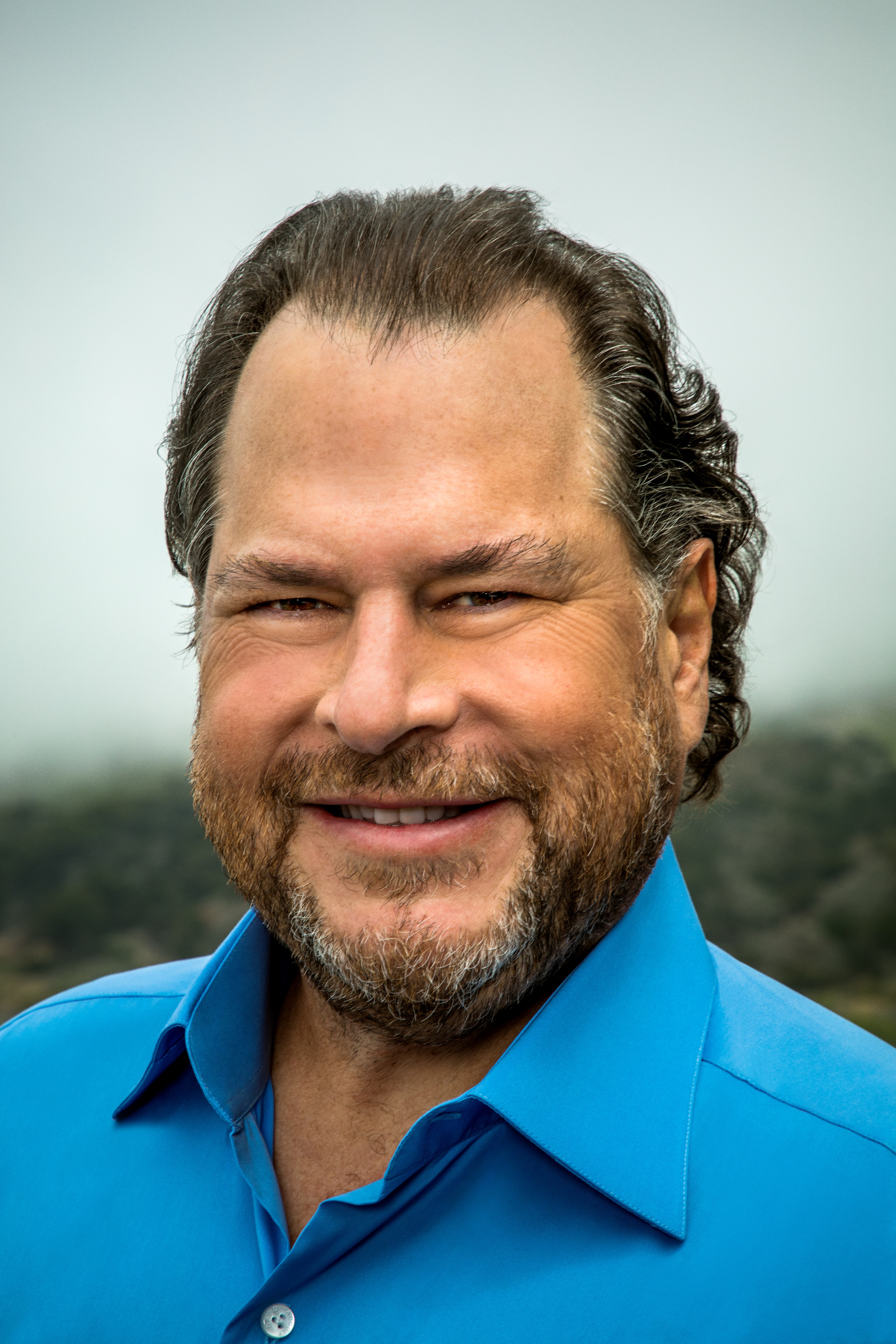
Marc Benioff
Frontier Insights
Frontier Thesis: Foundation models are raw commodities; enterprise value accrues entirely to platforms with proprietary data, customer trust, and workflow distribution.
Strategic Decisions: Benioff is aggressively retooling Salesforce into an agentic layer via Agentforce and Data Cloud, cutting internal support headcounts by nearly half, lifting engineering velocity 30%, and capturing 80% of client AI spend while commoditizing underlying LLM providers.
Risks & Warnings: Agents remain structurally imperfect—Atlas’s ~90% accuracy demands human safety nets, risking mission-critical failure. Externally, macroeconomic volatility, climate-driven power strains, and hype outstripping per-employee ROI threaten enterprise adoption velocity.
Key Views & Dialogues
Trump-Xi Summit, Benioff: “Not My First SaaSpocalypse,” OpenAI vs Apple, Multi-Sensory AI, El Niño
- 🗓️ Date:
2026-05-15| 🎙️ Show:All-In
Trump’s China summit paired more soybeans, oil, LNG, and 200 Boeing jets with possible openings for chips, payments, and financial services, seeking bidirectional dependence. China access remains conditional: Salesforce operates only through Alibaba, while $20,000-$30,000 Chinese EVs could hollow out US automakers overnight. Salesforce’s strong revenue and cash flow, Informatica strategy, and possible $50 billion buyback challenge a SaaS-apocalypse narrative, while El Niño threatens crops and power markets.
View Dialogue Notes & Key Takeaways
The panel framed Trump’s China summit as an attempt to replace conflict with bidirectional economic dependence. Friedberg argued that AI, automation and biotech could expand the global pie enough to avoid the Thucydides Trap; Chamath’s less idealistic version was that Washington and Beijing are probably “figuring out how to divide the pie.” China agreed that the Strait of Hormuz should remain open, without a military commitment, and that Iran should not have a nuclear weapon. The immediate scorecard was concrete: more soybeans, oil and LNG, 200 Boeing jets, and possible openings for chips, financial services and payments.
China exposure remains a negotiated privilege, not an ordinary addressable market. Salesforce has no Chinese employees or offices and operates exclusively through Alibaba, with locally resident data; Benioff called Elon Musk’s non-partnered Tesla presence an extraordinary exception attributable to his being “the greatest salesman in the world.” The upside is enormous order flow, but cheap $20,000-$30,000 Chinese EVs could, Jason warned, hollow out the US auto industry “overnight.”
Benioff, Friedberg and Chamath broadly favored selling China advanced chips, though their rationales differed. Benioff called restrictions “irrelevant at this point” because Chinese models already fast-follow US systems without the highest-end hardware; Chamath wants Nvidia—not Huawei—to capture the demand, alongside reasonable KYC against dangerous uses. Chamath predicted Taiwan could lose its present strategic importance within 18 months as fabs scale and the remaining strategic gap may be only “1 to 2 nanometers,” while Benioff declined the host’s forced defense commitment and predicted reconciliation.
Benioff sees a sweeping software rerating, not evidence that enterprise software demand has disappeared. Salesforce was cited down 37%, ServiceNow 42% and Workday 45%, with roughly $180 billion erased, yet Benioff said the top enterprise vendors were still producing strong quarters around two-times-sales valuations. His operating anchor is more than $46 billion of annual revenue, $16 billion of cash flow and 83,000 employees: “You can’t get drunk on the stock price.”
Chamath’s counter-consensus trade is that low-end SaaS may be finished while trusted enterprise platforms could rebound sharply. An OpenAI deployment deal requiring $4 billion and a guaranteed 17.5% preferred return to build deployment capacity showed him that large-company implementation is not “boop boop boop, put in a prompt.” Once markets ask what return came from $3 trillion of AI spending over four years, model companies may need established vendors with strong retention and C-suite access to “sell my tokens.”
Salesforce is betting that proprietary context becomes more valuable as applications turn headless. The $8 billion-$9 billion Informatica purchase targets harmonized, grounded data; Slack’s messages and Salesforce records can feed agents that answer management questions, escalate support calls and revive the 20 million-30 million people Salesforce historically failed to call back. Benioff expects roughly $300 million of Anthropic usage this year while buying back as much as $50 billion of Salesforce stock.
The AI interface race is shifting from chat windows toward coding, personal context and continuously observing multi-sensory systems. The reported OpenAI-Apple rupture exposed the weakness of an integration that requires explicitly invoking ChatGPT, while Google, Apple and Salesforce each possess valuable context layers. Benioff called multi-sensory models “the next big wave,” but rejected the assumption that continuous observation must permanently multiply token costs by 1,000: routing layers should reserve frontier models for the few tasks that need them.
Friedberg warned that a record El Niño could feed directly into agricultural, power and commodity markets. He estimated about 11 million terawatt-hours of excess ocean heat—roughly 500 years of current human energy use—and gave 99% confidence that the coming year would be the hottest in recent history by far. Failed Indian monsoons or Australian and Brazilian crops could create calorie deficits and unrest, while Anthropic’s separate move to negate layered private-company SPVs highlighted another late-cycle risk Chamath called a “recipe for disaster.”
🔗 Original source & video: Trump-Xi Summit, Benioff: “Not My First SaaSpocalypse,” OpenAI vs Apple, Multi-Sensory AI, El Niño
20VC: Anthropic’s $10BN Round | Klarna’s IPO Broken Down | Inside a16z’s 72 Deal Seed Investment Machine | Martin Casado: Is Consensus Investing the Only Game | Why Satya is Chatting S*** on SaaS Apps Disappearing featuring Marc Benioff
- 🗓️ Date:
2025-08-28| 🎙️ Show:20VC
Salesforce’s agentic deployments cut support headcount from 9,000 to 5,000 and helped Data Cloud plus AI exceed $1 billion in revenue, challenging claims that SaaS collapses into databases. Anthropic’s $10 billion round depends on whether agents generate $20,000 to $40,000 of value per worker, while elevated AI expectations, Klarna’s IPO, and venture concentration leave valuation and financing risks unresolved.
View Dialogue Notes & Key Takeaways
Marc Benioff’s core distinction is that today’s LLMs are powerful enterprise tools, not conscious beings or evidence that AGI is imminent. They combine improving but finite algorithms with relatively finite internet data, can feel intelligent as ELIZA did to him at 16, and create dangerous “hypnosis” when people outsource judgment. His operating conclusion is pragmatic: ignore the talent frenzy and make every Salesforce product agentic.
Salesforce’s own deployment supplies the episode’s strongest evidence that agents already change enterprise economics. An omni-channel supervisor helped cut human support agents from 9,000 to 5,000, with staff rebalanced elsewhere, while agentic sales can finally contact more than 100 million historical leads Salesforce never had enough SDRs to call. Data Cloud plus AI has exceeded $1 billion in revenue and is Salesforce’s fastest-growing cloud product in 26 years.
Benioff rejects the claim that SaaS applications collapse into CRUD databases, instead underwriting a three-layer market of data, applications, and interoperable agents. Humans still need applications in their flow of work, while an open agentic layer can coordinate them through ecosystems such as Slack and AppExchange. The discussion leaves room for third-party interfaces and agents even if Salesforce remains the system of record.
Palantir has become both a competitive benchmark and a valuation provocation for Salesforce. Benioff called Foundry’s integration of data and analytics “very inspiring,” credited forward-deployed engineers as smart pre-contract customer commitment, and said Palantir’s pricing makes Salesforce look cheap. Yet he emphasized the scale gap: roughly $4 billion versus Salesforce’s $41 billion of revenue, while asking, “How do I get that 100 times revenue multiple?”
Anthropic’s expansion of its round from $5 billion to $10 billion, reportedly four-times oversubscribed, is defensible only if foundation-model demand becomes enormous. Revenue moving from roughly $1 billion toward $9 billion or $10 billion creates a trajectory where even severe deceleration could produce $40 billion to $50 billion next year. Rory’s unresolved fork is whether API demand is closer to $50 billion or $500 billion—and whether agents can command $20,000 to $40,000 per worker rather than $2,000.
The model-provider TAM looks less obvious after tracing enterprise agent revenue through to inference costs. Rory’s Salesforce thought experiment turns a 30% uplift on an estimated $12 billion Sales Cloud into $3.6 billion of agent revenue, but only $720 million for model providers at a 20% cost share. Jason Lemkin’s counterexample—roughly $500,000 spent on 11 agents by a tiny team—shows why the round is cheap if unusually high agent-to-software spending ratios persist.
Public-market risk comes from expectations and concentration, not from one volatile trading day. Meta’s core business is throwing off cash while Mark Zuckerberg commits a discussed $60 billion to $70 billion to an AI business whose economics remain unexplained; at elevated multiples, “everything that goes wrong, no matter how tiny, gets magnified.” Conversely, MongoDB’s 27% jump and rebounds at Box, Okta, and Zoom show how modest reacceleration can rerate SaaS names once pessimism is already priced in.
Venture capital is bifurcating between industrial-scale consensus investing and capital-efficient bets the follow-on market may ignore. Andreessen completed 72 seed deals against Sequoia’s 27, treating seed like “cheap milk in the supermarket” that sources a few outliers into which it can invest billions. Martin Casado’s warning lands because 10 deals reportedly absorb 40% of venture capital: non-consensus founders can still win, but must price on fundamentals and assume, “Don’t expect any money.”
🔗 Original source & video: 20VC: Anthropic’s $10BN Round | Klarna’s IPO Broken Down | Inside a16z’s 72 Deal Seed Investment Machine | Martin Casado: Is Consensus Investing the Only Game | Why Satya is Chatting S*** on SaaS Apps Disappearing featuring Marc Benioff
Salesforce Founder Gives the Truth on AI Agents w/ Marc Benioff | EP #141
- 🗓️ Date:
2025-01-16| 🎙️ Show:Moonshots
Agentforce is already producing operating leverage, with engineering productivity up 30% and 31,000 of 36,000 weekly support inquiries routed to digital agents. Salesforce’s applications, workflows, data and 135,000 customers provide distribution, but accuracy remains in the 90s, making workforce reallocation and broader autonomous adoption the key milestones to monitor.
View Dialogue Notes & Key Takeaways
Salesforce is treating Agentforce as immediate operating leverage, not a distant AGI bet: engineering productivity rose 30%, prompting its engineering chief to request no additional engineers for the year. Customer support offers the second proof point—of 36,000 weekly inquiries, Benioff says 31,000 now go to digital agents and 5,000 still go to humans; he also says agents can resolve about 95% of inquiries. The result is workforce reallocation: “a couple thousand” of roughly 9,000 support employees may move elsewhere.
The distribution advantage is Salesforce’s existing stack of applications, workflows, customer data, and enterprise relationships. Benioff reports roughly $38 billion in annual revenue, $12.9 billion in cash flow, 135,000 customers, and two trillion Einstein AI transactions each week. Agentforce already had more than 1,500 paid implementations and 3,000 customers implementing it: “I’ve never seen anything go as fast as this is going.”
Accuracy—not demand—is the near-term constraint on autonomous agents. Benioff says no model is 100% accurate and places Salesforce’s Atlas reasoning engine “in the 90s,” with human agents still handling some cases. When Diamandis pushes toward AGI and hard takeoff, Benioff offers “a little dash of reality”: bounded agents are useful now, while the HAL-style future remains speculative.
Humanoid robots extend the same digital-labor thesis, but current economics remain far from mass-market forecasts. Diamandis cites targets of $30,000 per robot, $300 monthly leases, and $0.40 hourly labor, plus forecasts ranging from 1 billion robots next decade to 10 billion by 2040. Benioff does not endorse the timeline: one leading CEO quoted him $350,000 for a robot that “can’t do very much” and remains a couple of years away.
Benioff rejects a simple “AI decimates jobs” thesis in favor of uneven displacement and rebalancing amid labor scarcity. Salesforce may need fewer support and software-engineering hires while simultaneously recruiting 2,000 salespeople; he expects similar changes across health care, retail, consumer goods, and government. With declining birth rates and shortages of skilled workers, “we’re going to have to build some digitally.”
AI’s energy demand strengthens the case for fusion and smaller nuclear plants, but Benioff argues competitive model training is also consuming energy unnecessarily. He highlights the Big Island’s roughly 60% renewable mix, invests in Commonwealth Fusion Systems, and sees nuclear systems in aircraft carriers and submarines as evidence of high safety rates. His condition is categorical: “Trust and safety have to be number one.”
Regenerative biology and planetary health complete Benioff’s five-part focus list, alongside agents, robots, and energy. After rupturing his Achilles on September 26, 2024, he chose an attempted regenerative path and calls work on Yamanaka factors, PF4, and organoids “real right now.” His climate arithmetic—explicitly hedged as possibly imprecise—treats trees as a “carbon bank,” with each trillion storing about 200 gigatons.
🔗 Original source & video: Salesforce Founder Gives the Truth on AI Agents w/ Marc Benioff | EP #141