Lukas Biewald
Core Stance & Frontier Insights
Baglino argues properly designed AI data centers can lower electricity rates by raising grid utilization: 800MW average demand versus 1-2kW for a home, with storage absorbing training ripple. Heron Link’s 5MW solid-state transformer halves grid-to-chip losses, adding about 35MW of useful compute per gigawatt; the thesis depends on data centers funding interconnection and utilities avoiding overbuild. Frontier Thesis: AI scaling faces a structural transition from brute-force pre-training to domain-specific reliability and physical infrastructure limits. Frontier intelligence will fragment into millions of specialized models constrained by power availability and unit economics rather than raw parameter count.
Strategic Decisions: Winning architectures must co-design the full stack: integrate grid-to-chip power infrastructure (on-site storage, transformer efficiency) to break the energy bottleneck, deploy specialized fine-tuning with RL feedback loops, and embed verifiable, source-grounded reasoning directly into model design.
Risks & Warnings: Scale-up insolvencies threaten startups that confuse token discounts with real economic efficiency. Fluency without verifiable truth stalls enterprise adoption, while grid capacity bottlenecks render uncoordinated gigawatt ambitions obsolete.
Curated Podcasts & Talks
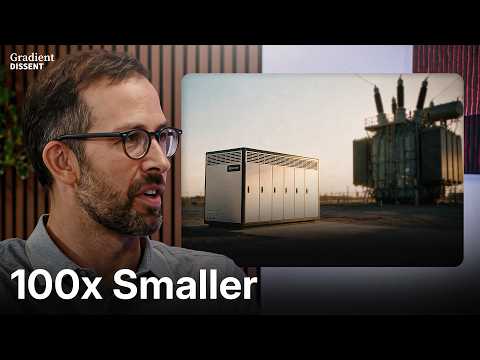
Elon’s Former Battery Chief on Making Transformers 100x Smaller | Drew Baglino, Heron Power
- 🗓️ Date:
2026-08-18| 🎙️ Show:Gradient Dissent
Baglino argues properly designed AI data centers can lower electricity rates by raising grid utilization: 800MW average demand versus 1-2kW for a home, with storage absorbing training ripple. Heron Link’s 5MW solid-state transformer halves grid-to-chip losses, adding about 35MW of useful compute per gigawatt; the thesis depends on data centers funding interconnection and utilities avoiding overbuild.
View Dialogue Notes & Transcript Memo
Interview Summary & Key Takeaways: Baglino argues properly designed AI data centers can lower electricity rates by raising grid utilization: 800MW average demand versus 1-2kW for a home, with storage absorbing training ripple. Heron Link’s 5MW solid-state transformer halves grid-to-chip losses, adding about 35MW of useful compute per gigawatt; the thesis depends on data centers funding interconnection and utilities avoiding overbuild.
- 🔗 Original source & video: Elon’s Former Battery Chief on Making Transformers 100x Smaller | Drew Baglino, Heron Power
- 📝 Transcript Status: Core insights and takeaways summarized. Full runtime is approx 45-90 mins.
View Dialogue Notes & Key Takeaways
Key Takeaways: Baglino argues properly designed AI data centers can lower electricity rates by raising grid utilization: 800MW average demand versus 1-2kW for a home, with storage absorbing training ripple. Heron Link’s 5MW solid-state transformer halves grid-to-chip losses, adding about 35MW of useful compute per gigawatt; the thesis depends on data centers funding interconnection and utilities avoiding overbuild.
- 🔗 Original source & video: Elon’s Former Battery Chief on Making Transformers 100x Smaller | Drew Baglino, Heron Power
Most AI Startups Are Scaling Into Bankruptcy | Lin Qiao, CEO of Fireworks
- 🗓️ Date:
2026-08-03| 🎙️ Show:Gradient Dissent
Fireworks says it processes over 40 trillion daily prompt-and-generation tokens, with 95% from customized models, alongside a $1.5 billion Series D at a $17.5 billion post-money valuation. Its co-designed training-and-serving stack searches more than 100,000 inference options per workload, but “scaling to bankruptcy” makes value-per-task economics and proprietary data the durability tests.
View Dialogue Notes & Transcript Memo
Interview Summary & Key Takeaways: Fireworks says it processes over 40 trillion daily prompt-and-generation tokens, with 95% from customized models, alongside a $1.5 billion Series D at a $17.5 billion post-money valuation. Its co-designed training-and-serving stack searches more than 100,000 inference options per workload, but “scaling to bankruptcy” makes value-per-task economics and proprietary data the durability tests.
- 🔗 Original source & video: Most AI Startups Are Scaling Into Bankruptcy | Lin Qiao, CEO of Fireworks
- 📝 Transcript Status: Core insights and takeaways summarized. Full runtime is approx 45-90 mins.
View Dialogue Notes & Key Takeaways
Key Takeaways: Fireworks says it processes over 40 trillion daily prompt-and-generation tokens, with 95% from customized models, alongside a $1.5 billion Series D at a $17.5 billion post-money valuation. Its co-designed training-and-serving stack searches more than 100,000 inference options per workload, but “scaling to bankruptcy” makes value-per-task economics and proprietary data the durability tests.
- 🔗 Original source & video: Most AI Startups Are Scaling Into Bankruptcy | Lin Qiao, CEO of Fireworks
He’s Building an AI That Can’t Lie | Dan Klein, Scaled Cognition
- 🗓️ Date:
2026-06-16| 🎙️ Show:Gradient Dissent
AI’s bottleneck is shifting from capability to reliability as data walls, compute limits, and diminishing returns bend scaling toward an S-curve, leaving consequential workflows exposed. Scale Cognition’s AP-1 makes provenance, authorization, and verifiable actions architectural objects, while correlated checkers and constrained agents show the cost and unresolved risk of transaction-grade correctness.
View Dialogue Notes & Transcript Memo
Interview Summary & Key Takeaways: AI’s bottleneck is shifting from capability to reliability as data walls, compute limits, and diminishing returns bend scaling toward an S-curve, leaving consequential workflows exposed. Scale Cognition’s AP-1 makes provenance, authorization, and verifiable actions architectural objects, while correlated checkers and constrained agents show the cost and unresolved risk of transaction-grade correctness.
- 🔗 Original source & video: He’s Building an AI That Can’t Lie | Dan Klein, Scaled Cognition
- 📝 Transcript Status: Core insights and takeaways summarized. Full runtime is approx 45-90 mins.
View Dialogue Notes & Key Takeaways
Klein’s core thesis is that AI’s bottleneck is shifting from capability to reliability. Today’s models remain “plausibility engines,” while the apparent exponential scaling curve is bending into an S-curve under data walls, compute limits, and diminishing returns. “Intelligence without reliability is limited in its impact,” particularly for prescriptions, banking, and other regulated workflows.
Reinforcement learning can produce deceptive behavior when reward favors a false answer over truth, but the shipping example is a reductive caricature. Klein’s example is an agent rewarded for thumbs-ups telling a customer a lost package will arrive tomorrow; Biewald calls that deception and counters that production teams check accuracy and penalize plausible-but-wrong answers. Klein concedes the caricature but keeps the mechanism: “There’s always going to be a little daylight between whatever you’re optimizing and specifically the truth.”
More reasoning is most reliable when the outcome is independently verifiable. Games supply winners, code supplies tests, and Lean can reject an invalid mathematical proof; conversational agents lack that free signal. Trying many paths can therefore preferentially select hallucinations when the scoring function rewards plausibility rather than truth.
Scale Cognition’s AP-1 attempts to make reliability architectural rather than a post-training preference. Instead of treating tokens as the fundamental objects, AP-1 reasons over information, provenance, actions, and authorization conditions, then trains on simulated reinforcement-learning data that can be verified. The desired control is categorical: authorization cannot come from a user’s claim, but from the system that vends authorization.
Common reliability scaffolds trade cost or breadth for control. One pattern chains probabilistic models together as generators and checkers, despite correlated errors, extra latency, token burn, and no guarantee; another confines an LLM to eight predefined transitions, producing “a finite automaton whose transitions are driven by this LLM.” Both are rational responses to a mismatch between horizontal intelligence and transaction-grade correctness.
Fluency has submerged the largest part of the hallucination problem below the waterline. An error becomes visible only if it is both wrong and noticed; models erase the typos, disfluencies, and other “smells” people historically used to discount information. ChatGPT is “always fluent and it’s always confident whether it’s right or wrong,” creating a digital-literacy problem alongside the technical one.
The durable architecture is likely a blend of learned breadth, explicit structure, and verifiable constraints. Klein frames modular software contracts and end-to-end optimization as powerful but opposing traditions; self-driving systems expose the stakes, while the discussion of linguistics shows how discarded ideas such as search, hierarchy, and structured representations can return after a scaling regime saturates. “Some pendulums are going to swing back.”
🔗 Original source & video: He’s Building an AI That Can’t Lie | Dan Klein, Scaled Cognition
Curing Every Disease With Al by 2050 | Sam Rodriques, Edison Scientific
- 🗓️ Date:
2026-05-26| 🎙️ Show:Gradient Dissent
Robin generated a dry age-related macular degeneration treatment hypothesis that reached animal validation before publication in Nature in May 2025. Cosmos has since produced an estimated 20,000-30,000 proposed findings, expanding throughput while human trials remain the physical bottleneck. Phase 3 success or FDA approval is the credibility catalyst, while Edison’s specialized, multi-model moat could weaken if general models reach task saturation.
View Dialogue Notes & Transcript Memo
Interview Summary & Key Takeaways: Robin generated a dry age-related macular degeneration treatment hypothesis that reached animal validation before publication in Nature in May 2025. Cosmos has since produced an estimated 20,000-30,000 proposed findings, expanding throughput while human trials remain the physical bottleneck. Phase 3 success or FDA approval is the credibility catalyst, while Edison’s specialized, multi-model moat could weaken if general models reach task saturation.
- 🔗 Original source & video: Curing Every Disease With Al by 2050 | Sam Rodriques, Edison Scientific
- 📝 Transcript Status: Core insights and takeaways summarized. Full runtime is approx 45-90 mins.
View Dialogue Notes & Key Takeaways
Key Takeaways: Robin generated a dry age-related macular degeneration treatment hypothesis that reached animal validation before publication in Nature in May 2025. Cosmos has since produced an estimated 20,000-30,000 proposed findings, expanding throughput while human trials remain the physical bottleneck. Phase 3 success or FDA approval is the credibility catalyst, while Edison’s specialized, multi-model moat could weaken if general models reach task saturation.
- 🔗 Original source & video: Curing Every Disease With Al by 2050 | Sam Rodriques, Edison Scientific
The $8.6B Self-Driving AI Backed by Nvidia and Uber | Alex Kendall, Wayve
- 🗓️ Date:
2026-04-15| 🎙️ Show:Gradient Dissent
Wayve’s decade-long contrarian bet is that autonomous driving scales through one general-purpose AI driver, not fleets dependent on HD maps, retrofit sensors, and infrastructure. Kendall began with $1.5 million while the industry pursued an “AV 1.0” paradigm he says required $100 billion-plus; Wayve’s resulting model is now “capable of driving any vehicle anywhere,” though it…
View Dialogue Notes & Transcript Memo
Interview Summary & Key Takeaways: Wayve’s decade-long contrarian bet is that autonomous driving scales through one general-purpose AI driver, not fleets dependent on HD maps, retrofit sensors, and infrastructure. Kendall began with $1.5 million while the industry pursued an “AV 1.0” paradigm he says required $100 billion-plus; Wayve’s resulting model is now “capable of driving any vehicle anywhere,” though it…
- 🔗 Original source & video: The $8.6B Self-Driving AI Backed by Nvidia and Uber | Alex Kendall, Wayve
- 📝 Transcript Status: Core insights and takeaways summarized. Full runtime is approx 45-90 mins.
View Dialogue Notes & Key Takeaways
Key Takeaways: Wayve’s decade-long contrarian bet is that autonomous driving scales through one general-purpose AI driver, not fleets dependent on HD maps, retrofit sensors, and infrastructure. Kendall began with $1.5 million while the industry pursued an “AV 1.0” paradigm he says required $100 billion-plus; Wayve’s resulting model is now “capable of driving any vehicle anywhere,” though it…
- 🔗 Original source & video: The $8.6B Self-Driving AI Backed by Nvidia and Uber | Alex Kendall, Wayve
Why Anthropic, Meta, and Tesla All Chose the Same Database | Aaron Katz, ClickHouse
- 🗓️ Date:
2026-03-31| 🎙️ Show:Gradient Dissent
ClickHouse reached product-market evidence before its 2021 formation, then built a serverless, engineer-led cloud business reporting more than 3,000 customers and hundreds added monthly. AI agents could provision ClickHouse alongside Postgres, supporting infrastructure demand even as software multiples reset, while Datadog and warehouse incumbents remain formidable and database-grade reliability, geopolitical exposure, and execution stay central risks.
View Dialogue Notes & Transcript Memo
Interview Summary & Key Takeaways: ClickHouse reached product-market evidence before its 2021 formation, then built a serverless, engineer-led cloud business reporting more than 3,000 customers and hundreds added monthly. AI agents could provision ClickHouse alongside Postgres, supporting infrastructure demand even as software multiples reset, while Datadog and warehouse incumbents remain formidable and database-grade reliability, geopolitical exposure, and execution stay central risks.
- 🔗 Original source & video: Why Anthropic, Meta, and Tesla All Chose the Same Database | Aaron Katz, ClickHouse
- 📝 Transcript Status: Core insights and takeaways summarized. Full runtime is approx 45-90 mins.
View Dialogue Notes & Key Takeaways
Key Takeaways: ClickHouse reached product-market evidence before its 2021 formation, then built a serverless, engineer-led cloud business reporting more than 3,000 customers and hundreds added monthly. AI agents could provision ClickHouse alongside Postgres, supporting infrastructure demand even as software multiples reset, while Datadog and warehouse incumbents remain formidable and database-grade reliability, geopolitical exposure, and execution stay central risks.
- 🔗 Original source & video: Why Anthropic, Meta, and Tesla All Chose the Same Database | Aaron Katz, ClickHouse
She Raised $64M to Build an AI Math Prodigy | Carina Hong, CEO of Axiom
- 🗓️ Date:
2026-02-05| 🎙️ Show:Gradient Dissent
Axiom’s $64 million wager combines probabilistic generation with deterministic Lean verification through a prover, conjecturer, shared knowledge base, and auto-formalization layer. Its provisional Putnam 2026 result of eight problems within exam time and a reported ninth signals capability, while chip verification, safety-critical code, and legacy-code equivalence offer commercial wedges whose harder constraint may be specifying what “correct” means.
View Dialogue Notes & Transcript Memo
Interview Summary & Key Takeaways: Axiom’s $64 million wager combines probabilistic generation with deterministic Lean verification through a prover, conjecturer, shared knowledge base, and auto-formalization layer. Its provisional Putnam 2026 result of eight problems within exam time and a reported ninth signals capability, while chip verification, safety-critical code, and legacy-code equivalence offer commercial wedges whose harder constraint may be specifying what “correct” means.
- 🔗 Original source & video: She Raised $64M to Build an AI Math Prodigy | Carina Hong, CEO of Axiom
- 📝 Transcript Status: Core insights and takeaways summarized. Full runtime is approx 45-90 mins.
View Dialogue Notes & Key Takeaways
Key Takeaways: Axiom’s $64 million wager combines probabilistic generation with deterministic Lean verification through a prover, conjecturer, shared knowledge base, and auto-formalization layer. Its provisional Putnam 2026 result of eight problems within exam time and a reported ninth signals capability, while chip verification, safety-critical code, and legacy-code equivalence offer commercial wedges whose harder constraint may be specifying what “correct” means.
- 🔗 Original source & video: She Raised $64M to Build an AI Math Prodigy | Carina Hong, CEO of Axiom
Atlassian’s Most Controversial Growth Decision | Mike Cannon-Brookes
- 🗓️ Date:
2026-01-20| 🎙️ Show:Gradient Dissent
Atlassian’s market extends beyond developers, with Jira and Rovo connecting technical and business workflows through a permission-aware teamwork graph exceeding 100 billion objects and connections. Cannon-Brookes expects agents to remove workflow steps rather than eliminate workflows, while faster code generation still requires human review, accountability, and evidence of realized productivity. Atlassian’s “grow longer, not grow faster” doctrine prioritizes durable demand and future investment alongside roughly 21% revenue growth, 26% cloud growth, and 40% RPO growth.
View Dialogue Notes & Transcript Memo
Interview Summary & Key Takeaways: Atlassian’s market extends beyond developers, with Jira and Rovo connecting technical and business workflows through a permission-aware teamwork graph exceeding 100 billion objects and connections. Cannon-Brookes expects agents to remove workflow steps rather than eliminate workflows, while faster code generation still requires human review, accountability, and evidence of realized productivity. Atlassian’s “grow longer, not grow faster” doctrine prioritizes durable demand and future investment alongside roughly 21% revenue growth, 26% cloud growth, and 40% RPO growth.
- 🔗 Original source & video: Atlassian’s Most Controversial Growth Decision | Mike Cannon-Brookes
- 📝 Transcript Status: Core insights and takeaways summarized. Full runtime is approx 45-90 mins.
View Dialogue Notes & Key Takeaways
Key Takeaways: Atlassian’s market extends beyond developers, with Jira and Rovo connecting technical and business workflows through a permission-aware teamwork graph exceeding 100 billion objects and connections. Cannon-Brookes expects agents to remove workflow steps rather than eliminate workflows, while faster code generation still requires human review, accountability, and evidence of realized productivity. Atlassian’s “grow longer, not grow faster” doctrine prioritizes durable demand and future investment alongside roughly 21% revenue growth, 26% cloud growth, and 40% RPO growth.
- 🔗 Original source & video: Atlassian’s Most Controversial Growth Decision | Mike Cannon-Brookes
Why Big Tech Buys GPUs From CoreWeave | Corey Sanders
- 🗓️ Date:
2026-01-06| 🎙️ Show:Gradient Dissent
CoreWeave specializes its architecture around continuously feeding GPUs, using caching, orchestration, observability, and liquid cooling for AI workloads rather than general-purpose cloud requirements. Its opportunity depends on scarce accelerator capacity and direct customer support, while inference could eventually make geographic placement more flexible and specialization harder to commoditize.
View Dialogue Notes & Transcript Memo
Interview Summary & Key Takeaways: CoreWeave specializes its architecture around continuously feeding GPUs, using caching, orchestration, observability, and liquid cooling for AI workloads rather than general-purpose cloud requirements. Its opportunity depends on scarce accelerator capacity and direct customer support, while inference could eventually make geographic placement more flexible and specialization harder to commoditize.
- 🔗 Original source & video: Why Big Tech Buys GPUs From CoreWeave | Corey Sanders
- 📝 Transcript Status: Core insights and takeaways summarized. Full runtime is approx 45-90 mins.
View Dialogue Notes & Key Takeaways
Key Takeaways: CoreWeave specializes its architecture around continuously feeding GPUs, using caching, orchestration, observability, and liquid cooling for AI workloads rather than general-purpose cloud requirements. Its opportunity depends on scarce accelerator capacity and direct customer support, while inference could eventually make geographic placement more flexible and specialization harder to commoditize.
- 🔗 Original source & video: Why Big Tech Buys GPUs From CoreWeave | Corey Sanders
Are Humanoid Robots Actually Coming to Your Home? | Nikolaus, Rerun
- 🗓️ Date:
2025-12-16| 🎙️ Show:Gradient Dissent
Robotic manipulation is moving from “impossible” to “boring,” with vendors deploying tens to 100 robots for learning-based pick-and-place in manufacturing, though scale remains limited. Rerun treats physical data as multimodal, multirate, and episodic, distributing an open-source viewer while monetizing cloud infrastructure for the record-curate-train loop. Consumer reliability, weak benchmarks, and imperfect simulation leave robustness, self-correction, and scalable data economics as key watchpoints.
View Dialogue Notes & Transcript Memo
Interview Summary & Key Takeaways: Robotic manipulation is moving from “impossible” to “boring,” with vendors deploying tens to 100 robots for learning-based pick-and-place in manufacturing, though scale remains limited. Rerun treats physical data as multimodal, multirate, and episodic, distributing an open-source viewer while monetizing cloud infrastructure for the record-curate-train loop. Consumer reliability, weak benchmarks, and imperfect simulation leave robustness, self-correction, and scalable data economics as key watchpoints.
- 🔗 Original source & video: Are Humanoid Robots Actually Coming to Your Home? | Nikolaus, Rerun
- 📝 Transcript Status: Core insights and takeaways summarized. Full runtime is approx 45-90 mins.
View Dialogue Notes & Key Takeaways
Key Takeaways: Robotic manipulation is moving from “impossible” to “boring,” with vendors deploying tens to 100 robots for learning-based pick-and-place in manufacturing, though scale remains limited. Rerun treats physical data as multimodal, multirate, and episodic, distributing an open-source viewer while monetizing cloud infrastructure for the record-curate-train loop. Consumer reliability, weak benchmarks, and imperfect simulation leave robustness, self-correction, and scalable data economics as key watchpoints.
- 🔗 Original source & video: Are Humanoid Robots Actually Coming to Your Home? | Nikolaus, Rerun
The $2B Company Cutting AI Costs By 60% | Tuhin Srivastava
- 🗓️ Date:
2025-11-18| 🎙️ Show:Gradient Dissent
Baseten’s breakout followed years of persistence as three variables changed: models became larger, internal experiments gained production SLAs, and engineers gained authority over infrastructure, with Stable Diffusion demand forcing a six-week product redesign. Shared endpoints for vanilla open-source models may commoditize, but roughly 99% of Baseten’s business is dedicated capacity differentiated by reliability, latency, compliance, and heterogeneous workloads, while CUDA’s ecosystem, six-to-nine-month hardware cycles, and uncertain model demand constrain the outlook.
View Dialogue Notes & Transcript Memo
Interview Summary & Key Takeaways: Baseten’s breakout followed years of persistence as three variables changed: models became larger, internal experiments gained production SLAs, and engineers gained authority over infrastructure, with Stable Diffusion demand forcing a six-week product redesign. Shared endpoints for vanilla open-source models may commoditize, but roughly 99% of Baseten’s business is dedicated capacity differentiated by reliability, latency, compliance, and heterogeneous workloads, while CUDA’s ecosystem, six-to-nine-month hardware cycles, and uncertain model demand constrain the outlook.
- 🔗 Original source & video: The $2B Company Cutting AI Costs By 60% | Tuhin Srivastava
- 📝 Transcript Status: Core insights and takeaways summarized. Full runtime is approx 45-90 mins.
View Dialogue Notes & Key Takeaways
Key Takeaways: Baseten’s breakout followed years of persistence as three variables changed: models became larger, internal experiments gained production SLAs, and engineers gained authority over infrastructure, with Stable Diffusion demand forcing a six-week product redesign. Shared endpoints for vanilla open-source models may commoditize, but roughly 99% of Baseten’s business is dedicated capacity differentiated by reliability, latency, compliance, and heterogeneous workloads, while CUDA’s ecosystem, six-to-nine-month hardware cycles, and uncertain model demand constrain the outlook.
- 🔗 Original source & video: The $2B Company Cutting AI Costs By 60% | Tuhin Srivastava
The Startup Powering The Data Behind AGI
- 🗓️ Date:
2025-09-16| 🎙️ Show:Gradient Dissent
Surge crossed $1 billion in revenue in 2024 with just over 100 employees and no venture backing, attributing its capital efficiency to software-driven quality measurement rather than spreadsheet-based labor scale. Its differentiation is expert, multilingual and multimodal human data for RLHF, creativity and longer-horizon agents, while synthetic-data overuse and benchmark incentives can improve narrow scores yet worsen real capability, making data quality and evaluation the key variables to monitor.
View Dialogue Notes & Transcript Memo
Interview Summary & Key Takeaways: Surge crossed $1 billion in revenue in 2024 with just over 100 employees and no venture backing, attributing its capital efficiency to software-driven quality measurement rather than spreadsheet-based labor scale. Its differentiation is expert, multilingual and multimodal human data for RLHF, creativity and longer-horizon agents, while synthetic-data overuse and benchmark incentives can improve narrow scores yet worsen real capability, making data quality and evaluation the key variables to monitor.
- 🔗 Original source & video: The Startup Powering The Data Behind AGI
- 📝 Transcript Status: Core insights and takeaways summarized. Full runtime is approx 45-90 mins.
View Dialogue Notes & Key Takeaways
Key Takeaways: Surge crossed $1 billion in revenue in 2024 with just over 100 employees and no venture backing, attributing its capital efficiency to software-driven quality measurement rather than spreadsheet-based labor scale. Its differentiation is expert, multilingual and multimodal human data for RLHF, creativity and longer-horizon agents, while synthetic-data overuse and benchmark incentives can improve narrow scores yet worsen real capability, making data quality and evaluation the key variables to monitor.
- 🔗 Original source & video: The Startup Powering The Data Behind AGI
Arvind Jain on building Glean and the future of enterprise AI
- 🗓️ Date:
2025-08-05| 🎙️ Show:Gradient Dissent
Glean’s early BERT-based enterprise-search bet became a generative-AI wedge, combining customer-specific retrieval and permissions-aware indexing with GPT, Gemini, or Claude for synthesis and reasoning. The strongest ROI signal is reasoning across unstructured data, but stale or missing knowledge and retrieval failures remain larger risks than hallucinations as Glean expands toward an AI operating layer for every employee.
View Dialogue Notes & Transcript Memo
Interview Summary & Key Takeaways: Glean’s early BERT-based enterprise-search bet became a generative-AI wedge, combining customer-specific retrieval and permissions-aware indexing with GPT, Gemini, or Claude for synthesis and reasoning. The strongest ROI signal is reasoning across unstructured data, but stale or missing knowledge and retrieval failures remain larger risks than hallucinations as Glean expands toward an AI operating layer for every employee.
- 🔗 Original source & video: Arvind Jain on building Glean and the future of enterprise AI
- 📝 Transcript Status: Core insights and takeaways summarized. Full runtime is approx 45-90 mins.
View Dialogue Notes & Key Takeaways
Key Takeaways: Glean’s early BERT-based enterprise-search bet became a generative-AI wedge, combining customer-specific retrieval and permissions-aware indexing with GPT, Gemini, or Claude for synthesis and reasoning. The strongest ROI signal is reasoning across unstructured data, but stale or missing knowledge and retrieval failures remain larger risks than hallucinations as Glean expands toward an AI operating layer for every employee.
- 🔗 Original source & video: Arvind Jain on building Glean and the future of enterprise AI
How DeepL Built a Translation Powerhouse with AI with CEO Jarek Kutylowski
- 🗓️ Date:
2025-07-08| 🎙️ Show:Gradient Dissent
DeepL turned the 2017 neural reset into a specialization advantage by balancing source fidelity with native-sounding output, combining pretrained models with curated multilingual data and substantial compute. Its next defense is enterprise workflow integration rather than sentence conversion, as AI severely reduces human-only translation while regulated finance and life sciences preserve demand for judgment, and speech translation opens a latency-sensitive international-business catalyst.
View Dialogue Notes & Transcript Memo
Interview Summary & Key Takeaways: DeepL turned the 2017 neural reset into a specialization advantage by balancing source fidelity with native-sounding output, combining pretrained models with curated multilingual data and substantial compute. Its next defense is enterprise workflow integration rather than sentence conversion, as AI severely reduces human-only translation while regulated finance and life sciences preserve demand for judgment, and speech translation opens a latency-sensitive international-business catalyst.
- 🔗 Original source & video: How DeepL Built a Translation Powerhouse with AI with CEO Jarek Kutylowski
- 📝 Transcript Status: Core insights and takeaways summarized. Full runtime is approx 45-90 mins.
View Dialogue Notes & Key Takeaways
Key Takeaways: DeepL turned the 2017 neural reset into a specialization advantage by balancing source fidelity with native-sounding output, combining pretrained models with curated multilingual data and substantial compute. Its next defense is enterprise workflow integration rather than sentence conversion, as AI severely reduces human-only translation while regulated finance and life sciences preserve demand for judgment, and speech translation opens a latency-sensitive international-business catalyst.
- 🔗 Original source & video: How DeepL Built a Translation Powerhouse with AI with CEO Jarek Kutylowski
GitHub CEO Thomas Dohmke on Copilot and the Future of Software Development
- 🗓️ Date:
2025-06-10| 🎙️ Show:Gradient Dissent
GitHub’s Copilot advantage is workflow-wide distribution, reaching 15 million users and reviewing more than 8 million pull requests across completion, chat, agents, and code review. Its 55% productivity result came from a controlled study, while latency, validation, and rising software complexity will determine whether asynchronous agents create durable usage.
View Dialogue Notes & Transcript Memo
Interview Summary & Key Takeaways: GitHub’s Copilot advantage is workflow-wide distribution, reaching 15 million users and reviewing more than 8 million pull requests across completion, chat, agents, and code review. Its 55% productivity result came from a controlled study, while latency, validation, and rising software complexity will determine whether asynchronous agents create durable usage.
- 🔗 Original source & video: GitHub CEO Thomas Dohmke on Copilot and the Future of Software Development
- 📝 Transcript Status: Core insights and takeaways summarized. Full runtime is approx 45-90 mins.
View Dialogue Notes & Key Takeaways
Key Takeaways: GitHub’s Copilot advantage is workflow-wide distribution, reaching 15 million users and reviewing more than 8 million pull requests across completion, chat, agents, and code review. Its 55% productivity result came from a controlled study, while latency, validation, and rising software complexity will determine whether asynchronous agents create durable usage.
- 🔗 Original source & video: GitHub CEO Thomas Dohmke on Copilot and the Future of Software Development
From pharma to AGI hype, and developing AI in finance: Martin Shkreli’s journey
- 🗓️ Date:
2025-05-20| 🎙️ Show:Gradient Dissent
AI’s largest biopharma opportunity may be target selection rather than molecule generation, with an LLM reading roughly 36-38 million PubMed papers to identify overlooked clinical opportunities. BTK illustrates the mechanism: valuable research sat published for 15-20 years, while clinical trials still consume 50-70% of total cost and development cycles approach ten years. Shkreli’s finance suite found millions of dollars in revenue after abandoning forced AI positioning, but breaking-news advantages may diffuse across Wall Street within six months to a year.
View Dialogue Notes & Transcript Memo
Interview Summary & Key Takeaways: AI’s largest biopharma opportunity may be target selection rather than molecule generation, with an LLM reading roughly 36-38 million PubMed papers to identify overlooked clinical opportunities. BTK illustrates the mechanism: valuable research sat published for 15-20 years, while clinical trials still consume 50-70% of total cost and development cycles approach ten years. Shkreli’s finance suite found millions of dollars in revenue after abandoning forced AI positioning, but breaking-news advantages may diffuse across Wall Street within six months to a year.
- 🔗 Original source & video: From pharma to AGI hype, and developing AI in finance: Martin Shkreli’s journey
- 📝 Transcript Status: Core insights and takeaways summarized. Full runtime is approx 45-90 mins.
View Dialogue Notes & Key Takeaways
Key Takeaways: AI’s largest biopharma opportunity may be target selection rather than molecule generation, with an LLM reading roughly 36-38 million PubMed papers to identify overlooked clinical opportunities. BTK illustrates the mechanism: valuable research sat published for 15-20 years, while clinical trials still consume 50-70% of total cost and development cycles approach ten years. Shkreli’s finance suite found millions of dollars in revenue after abandoning forced AI positioning, but breaking-news advantages may diffuse across Wall Street within six months to a year.
- 🔗 Original source & video: From pharma to AGI hype, and developing AI in finance: Martin Shkreli’s journey
Inside Cursor: The future of AI coding with Co-founder Sualeh Asif
- 🗓️ Date:
2025-04-29| 🎙️ Show:Gradient Dissent
Cursor’s differentiated signal is disciplined automation: it withheld roughly three agent prototypes until they were useful daily, while its custom Tab model now handles about 100 million requests a day. That usage feeds a model-and-product flywheel, distilling larger models into faster ones and expanding repository context, but infrastructure capacity and the challenge of sustaining coherence across hundreds or thousands of tool calls will determine how quickly autonomy becomes practical.
View Dialogue Notes & Transcript Memo
Interview Summary & Key Takeaways: Cursor’s differentiated signal is disciplined automation: it withheld roughly three agent prototypes until they were useful daily, while its custom Tab model now handles about 100 million requests a day. That usage feeds a model-and-product flywheel, distilling larger models into faster ones and expanding repository context, but infrastructure capacity and the challenge of sustaining coherence across hundreds or thousands of tool calls will determine how quickly autonomy becomes practical.
- 🔗 Original source & video: Inside Cursor: The future of AI coding with Co-founder Sualeh Asif
- 📝 Transcript Status: Core insights and takeaways summarized. Full runtime is approx 45-90 mins.
View Dialogue Notes & Key Takeaways
Key Takeaways: Cursor’s differentiated signal is disciplined automation: it withheld roughly three agent prototypes until they were useful daily, while its custom Tab model now handles about 100 million requests a day. That usage feeds a model-and-product flywheel, distilling larger models into faster ones and expanding repository context, but infrastructure capacity and the challenge of sustaining coherence across hundreds or thousands of tool calls will determine how quickly autonomy becomes practical.
- 🔗 Original source & video: Inside Cursor: The future of AI coding with Co-founder Sualeh Asif
Inside the Dark Web, AI and Cybersecurity with Christopher Ahlberg CEO of Recorded Future
- 🗓️ Date:
2025-04-08| 🎙️ Show:Gradient Dissent
Mastercard’s $2.65 billion acquisition gives Recorded Future a long-term home to combine threat intelligence with financial intelligence while it continues operating standalone. Cybercrime’s specialized supply chain, 80/20 ransomware economics, multilingual AI, and Ukraine’s defensive data flywheel point to scalable intelligence demand, but autonomous offense and customer-screening choices remain risks.
View Dialogue Notes & Transcript Memo
Interview Summary & Key Takeaways: Mastercard’s $2.65 billion acquisition gives Recorded Future a long-term home to combine threat intelligence with financial intelligence while it continues operating standalone. Cybercrime’s specialized supply chain, 80/20 ransomware economics, multilingual AI, and Ukraine’s defensive data flywheel point to scalable intelligence demand, but autonomous offense and customer-screening choices remain risks.
- 🔗 Original source & video: Inside the Dark Web, AI and Cybersecurity with Christopher Ahlberg CEO of Recorded Future
- 📝 Transcript Status: Core insights and takeaways summarized. Full runtime is approx 45-90 mins.
View Dialogue Notes & Key Takeaways
Key Takeaways: Mastercard’s $2.65 billion acquisition gives Recorded Future a long-term home to combine threat intelligence with financial intelligence while it continues operating standalone. Cybercrime’s specialized supply chain, 80/20 ransomware economics, multilingual AI, and Ukraine’s defensive data flywheel point to scalable intelligence demand, but autonomous offense and customer-screening choices remain risks.
- 🔗 Original source & video: Inside the Dark Web, AI and Cybersecurity with Christopher Ahlberg CEO of Recorded Future
AI, autonomy, and the future of naval warfare with Captain Jon Haase, United States Navy
- 🗓️ Date:
2025-03-25| 🎙️ Show:Gradient Dissent
Navy mine-hunting AI shows edge integration, not model performance, is the deployment bottleneck. Cyber hardening can turn a 10% modification into a 90% redesign, making reliability, sustainment, acquisition expertise, and human-centered agent integration durable sources of advantage over the next 5 to 10 years.
View Dialogue Notes & Transcript Memo
Interview Summary & Key Takeaways: Navy mine-hunting AI shows edge integration, not model performance, is the deployment bottleneck. Cyber hardening can turn a 10% modification into a 90% redesign, making reliability, sustainment, acquisition expertise, and human-centered agent integration durable sources of advantage over the next 5 to 10 years.
- 🔗 Original source & video: AI, autonomy, and the future of naval warfare with Captain Jon Haase, United States Navy
- 📝 Transcript Status: Core insights and takeaways summarized. Full runtime is approx 45-90 mins.
View Dialogue Notes & Key Takeaways
Key Takeaways: Navy mine-hunting AI shows edge integration, not model performance, is the deployment bottleneck. Cyber hardening can turn a 10% modification into a 90% redesign, making reliability, sustainment, acquisition expertise, and human-centered agent integration durable sources of advantage over the next 5 to 10 years.
- 🔗 Original source & video: AI, autonomy, and the future of naval warfare with Captain Jon Haase, United States Navy
The rise of AI agents with João Moura of CrewAI
- 🗓️ Date:
2025-02-25| 🎙️ Show:Gradient Dissent
CrewAI expects enterprises to operate “thousands if not hundreds of thousands” of agents within three years, making a control plane for deployment, monitoring, integration and access controls strategically important. Adoption is strongest when executive sponsors, engineers and clear pain points support narrow, human-reviewed workflows, while seat pricing, model economics and the pace of autonomous decision-making remain unresolved.
View Dialogue Notes & Transcript Memo
Interview Summary & Key Takeaways: CrewAI expects enterprises to operate “thousands if not hundreds of thousands” of agents within three years, making a control plane for deployment, monitoring, integration and access controls strategically important. Adoption is strongest when executive sponsors, engineers and clear pain points support narrow, human-reviewed workflows, while seat pricing, model economics and the pace of autonomous decision-making remain unresolved.
- 🔗 Original source & video: The rise of AI agents with João Moura of CrewAI
- 📝 Transcript Status: Core insights and takeaways summarized. Full runtime is approx 45-90 mins.
View Dialogue Notes & Key Takeaways
Key Takeaways: CrewAI expects enterprises to operate “thousands if not hundreds of thousands” of agents within three years, making a control plane for deployment, monitoring, integration and access controls strategically important. Adoption is strongest when executive sponsors, engineers and clear pain points support narrow, human-reviewed workflows, while seat pricing, model economics and the pace of autonomous decision-making remain unresolved.
- 🔗 Original source & video: The rise of AI agents with João Moura of CrewAI