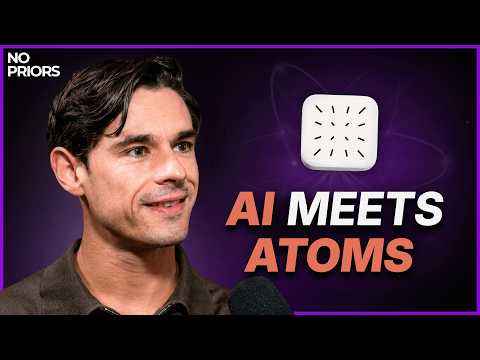
Liam Fedus
Frontier Insights
Core Thesis: Periodic Labs is building an “AI Physicist” by grounding LLMs and symmetry-aware atomic neural networks in real-world experimentation. They treat physical reality as an ungameable reward signal via reinforcement learning to overcome data scarcity and out-of-distribution limits.
Strategic Execution: They pursue a dual-track strategy: high-risk frontier science targeting falsifiable milestones like high-temperature superconductivity, funded near-term by enterprise manufacturing copilots and lab-orchestration software across semiconductors and aerospace. Proprietary mid-training data forms their primary moat.
Risks & Warnings: High capital intensity, long hardware development cycles, and unproven unit economics of de novo physical discovery.
Key Views & Dialogues
AI for Atoms: How Periodic Labs is Revolutionizing Materials Engineering with Co-Founder Liam Fedus
- 🗓️ Date:
2026-04-03| 🎙️ Show:No Priors
Periodic Labs is building an active experimental loop that grounds AI in physical feedback, combining language models for orchestration with symmetry-aware atomic models for materials and process engineering. The initial software layer could improve semiconductors, aerospace, and energy productivity by an order of magnitude or two, but domain-specific data, automation, and discovery economics remain unresolved execution risks.
View Dialogue Notes & Key Takeaways
Periodic Labs’ core wager is that AI’s next major value pool depends on closing the loop between models and physical experiments. Fedus argues that science is not “sitting in a room thinking really hard”; systems must “interface with reality.” Reasoning, test-time inference, error correction, and tool use became foundational as models improved after 2022; 2022-era AI was still too weak for Periodic.
The key data resource is not a static materials corpus but an active stream of grounded experimental feedback. Periodic can leverage “on the order of tens of trillions of tokens” that went into open-source models for a foundational prior, yet published measurements may span many orders of magnitude. An active loop—spotting aberrations, comparing simulations and literature, then driving the next experiments—grounds the system.
Periodic combines language models as an orchestration layer with fast, symmetry-aware neural networks built for atomic systems. The general model reads literature, analyzes experimental modalities, and directs work; specialized models serve as tools and reward functions. Generalization can be strong within quantum-governed domains, but Fedus cautions that it does not automatically cross into abstractions such as fluid dynamics.
The initial business is a software intelligence layer for materials and process engineering, with higher-value discovery economics left open. Periodic is “customer zero,” testing systems that inspect data, debug machinery, improve formulations, and control experiments before pursuing broader advanced-manufacturing opportunities. Asked whether it resembles biotech, Fedus said breakthrough materials “might be more akin to a discovery model,” but the company is starting as software.
Scaling physical science could unlock an “order of magnitude or two” in productivity across semiconductors, aerospace, and energy. Fedus expects improvements in automation to create bottlenecks in intelligence; physical infrastructure has long lead times and calibration risk, although compute remains the primary capital cost. The ambition is to give humanity “agency for atomic rearrangement and synthesis.”
AGI will not lift every domain simultaneously because intelligence is spiky and closed-loop verification is domain-specific. Software self-improvement is happening “now-ish” because unit tests provide cheap, immediate rewards; AI research has a slower GPU-intensive outer loop, while biology and physical science require their own data-generating loops. General robotics is not required for Periodic, but a reliable dexterous humanoid would be “a huge accelerator.”
🔗 Original source & video: AI for Atoms: How Periodic Labs is Revolutionizing Materials Engineering with Co-Founder Liam Fedus
Periodic Labs: Training AI Scientists, with Liam Fedus & Ekin Dogus Cubuk (from a16z)
- 🗓️ Date:
2025-10-02| 🎙️ Show:The Cognitive Revolution
Periodic Labs’ $300 million seed, led by Andreessen Horowitz, backs an AI-scientist thesis where nature supplies the final reward through automated experiments rather than internet-scale training. Scaling may continue while noisy data and missing negative results slow out-of-domain discovery; the about 135 Kelvin superconductivity benchmark provides a measurable north star, while copilots for advanced industries offer a nearer-term land-and-expand business.
View Dialogue Notes & Key Takeaways
Periodic Labs’ $300 million seed, led by Andreessen Horowitz, backs a capital-intensive thesis: an AI scientist must learn by acting on physical reality, not merely by absorbing the internet. Liam Fedus calls experiment a “physically grounded reward function,” with simulations and language models as tools but nature as the final error-corrector: “Nature is our RL environment.” The investable proposition is a lab-built loop of hypotheses, automated experiments, positive and negative outcomes, and improved models.
Scaling laws may continue to hold while still failing to deliver useful scientific discovery on the required timescale. Fedus’s challenge is “what is this y-axis?”: scaling against internet or coding distributions does not manufacture missing physics knowledge, and “that model is not going to then cure cancer.” Ekin Dogus Cubuk adds that out-of-domain performance can improve as a power law yet have such a shallow slope that reaching the target might take centuries.
The existing scientific corpus is not just too small; it is noisy, selectively published, and missing the iterations that teach scientific judgment. Reported physical properties can span orders of magnitude, formation-enthalpy errors can defeat prediction, and superconductivity datasets have a high noise floor. Because negative results are rarely published, a model trained on literature can at best reproduce a distorted distribution rather than learn why an experiment failed.
High-temperature superconductivity gives Periodic a measurable north star and forces it to build the entire autonomous-science stack. The stated ambient-pressure benchmark is about 135 Kelvin; exceeding it would provide an unambiguous score, while a hypothetical 200 Kelvin superconductor would, Cubuk argues, update humanity’s view of the universe even before commercialization. Getting there requires autonomous synthesis, characterization, simulation, and experiment selection—capabilities that can be tested for transfer into magnetism and other physical domains.
The near-term business is an intelligence layer for advanced manufacturing, not a wait for a miraculous superconductor. Fedus targets copilots for researchers and engineers in semiconductors, space, defense, and other industries with “massive R&D budgets,” reducing iteration time across literature review, simulation, design, and experiment. Deployment follows a land-and-expand motion: solve one critical, well-scoped problem with clear evaluations rather than promise to transform an entire fabrication line on day one.
Periodic’s model strategy goes beyond retrieval by encoding private scientific and industrial knowledge through mid-training and high-compute reinforcement learning. Mid-training means continuing pre-training on knowledge absent from the base model—from crystal structures and simulation outputs to descriptions of how materials were made—then connecting those distributions so one dataset improves performance on another. That deeper encoding creates an enterprise challenge too: knowledge may need to be bucketed into separate systems when some data is accessible only to senior leadership.
The organizational moat is a roughly 30-person, cross-disciplinary team built around curiosity, translation, and urgency rather than credentials. Weekly teaching sessions let ML researchers explain RL and data cleaning while physicists and chemists teach quantum mechanics and scientific history; the cultural rule is “no stupid questions.” Advanced degrees are explicitly unnecessary because even the best specialist knows far less than the combined physics, chemistry, synthesis, and characterization the mission demands—and the founders want progress “ASAP,” not in 10 years.
🔗 Original source & video: Periodic Labs: Training AI Scientists, with Liam Fedus & Ekin Dogus Cubuk (from a16z)
Building an AI Physicist: ChatGPT Co-Creator’s Next Venture
- 🗓️ Date:
2025-09-30| 🎙️ Show:The a16z Show
Periodic Labs is betting that “Nature is our RL environment,” using experiments to supply the ground truth and reward signals that internet-trained models lack for physics and chemistry. High-temperature superconductivity offers a falsifiable benchmark, while an intelligence layer for industrial R&D could commercialize the stack through scoped deployments, mid-training, simulation, autonomous synthesis, and experimental iteration.
View Dialogue Notes & Key Takeaways
Periodic Labs’ central wager is that nature should become the next reward function for AI. Early ChatGPT learned helpfulness from human preferences and later gained mathematical and coding correctness through verifiable graders; advancing physics requires the same optimization pressure against real experiments. Cubuk’s formulation is the thesis in one line: “Nature is our RL environment.”
More compute will improve models, but it cannot manufacture missing scientific knowledge or efficient out-of-domain learning. Fedus accepts that scaling laws continue to hold, then asks, “What is this y-axis?” A coding model can recursively improve at passing unit tests, but “that model is not going to then cure cancer”; Cubuk adds that an out-of-domain power law may have such a shallow slope that progress would take “centuries.”
Periodic is building the data engine that the scientific literature cannot provide. Published measurements can span orders of magnitude, negative results are rarely reported, and synthesis or superconductivity datasets may have noise floors too high to train predictive models. Because “these systems aren’t magic,” experiment must collapse uncertainty and continually move the training distribution toward the target.
High-temperature superconductivity is both a falsifiable benchmark and a forcing function for the full autonomous-science stack. The ambient-pressure mark cited is roughly 135 Kelvin; the founders say exceeding it would likely require autonomous synthesis, characterization, simulation, and experimental iteration. A hypothetical 200 Kelvin superconductor would matter even before commercialization because observing quantum effects at that temperature would be “such an update to people’s view of how they see the universe.”
The commercial wedge is an intelligence layer for engineers and researchers in space, defense, semiconductors, and advanced manufacturing. Periodic wants systems that automate simulations, connect design pipelines, and reduce physical R&D iteration time across “massive R&D budgets.” Fedus explicitly links mission and economics: “Technology and capital are intertwined,” so the lab plans a scoped “land and expand” motion rather than attempting to transform a production line on day one.
Mid-training—not retrieval alone—is how Periodic expects to turn general models into physics and chemistry experts. It plans to continue pre-training on crystal structures, synthesis recipes, simulations, experiments, and customer knowledge, then use high-compute reinforcement learning and specialized tools. The organizational design mirrors this composition: a roughly 30-person “N of one” team spanning LLMs, experiments, simulations, automation, and theory, reinforced by academic advisers and grants.
🔗 Original source & video: Building an AI Physicist: ChatGPT Co-Creator’s Next Venture