Jack Hidary
Frontier Insights
Frontier Thesis: AGI’s true scaling bottleneck is physical, shifting from raw compute to power infrastructure. Within 7–9 years, advanced energy (SMRs, solar, storage) will unlock unprecedented energy abundance, fundamentally repricing labor, desalination, and quantum-safe infrastructure. Concurrently, AI architectures are bifurcating into hyper-efficient edge intelligence and verticalized, professional foundation models.
Strategic Imperatives: Decouple compute from legacy grids by colocating data centers at cheap, distributed power sources; aggressively re-architect enterprise workflows from the executive suite down, moving beyond the abysmal 11% production deployment rate.
Critical Risks: Near-term grid constraints stalling model velocity, and governance distortion driven by sovereign equity stakes.
Key Views & Dialogues
Unlocking AGI: How Life Changes for Everyone w/ Jack Hidary, Salim Ismail & Dave Blundin | EP #213
- 🗓️ Date:
2025-12-06| 🎙️ Show:Moonshots
AI infrastructure is entering a temporary energy bottleneck, with gas-turbine lead times around 4.5 years before SMRs, solar, and new factories may expand supply within seven to nine years. Cheaper power could relocate data centers toward Saudi energy resources and reprice desalination, healthcare, transport, and oil-dependent economies, while humanoid factories and quantum security remain key catalysts.
View Dialogue Notes & Key Takeaways
The panel frames AI and data-center expansion as constrained by energy hardware, but expects scarcity to flip toward abundance within roughly a decade. Diamandis contrasts China’s 429 GW of new power in 2024 with 51 GW in the US; Hidary says gas-turbine lead times have reached 4.5 years, even as SMRs, new turbine factories, and solar-material breakthroughs could change the curve in seven to nine years. “We’re in a very odd limited period of scarcity.”
If compute can travel to energy, Saudi Arabia’s reportedly three-times-cheaper solar and underused hydrocarbon resources could attract data centers whose sunk capital makes them sticky. Blundin’s reversal is that energy historically moved to populations, whereas “AI can come to the energy.” Once a massive data center is installed, he argues, it will not relocate merely because fusion later becomes available.
Abundant energy would reprice water, healthcare, transport, food, and oil-dependent sovereign economies—not merely electricity. Hidary says desalination could become far cheaper and make fresh water available; Ismail says 50% of African hospital beds are occupied because of bad-water-related infections and diseases. Hidary contrasts roughly $50-a-barrel marginal extraction in Canada with $7 in the Gulf and offers a thesis that Russia’s oil-and-gas exports could lose much of their value. “Energy tips everything.”
Humanoids look investable first in factories, logistics, and hospitals, while the household remains the contested end market. Diamandis says five robot-building-robot factories—two in the US and three in China—are under construction, with completion expected over six to 18 months; he also says about 20% of US hospitals use basic robotic helpers. Ismail’s reality check: “Can we please get the Roomba working” before forecasting robots in every room?
China’s robotics race is simultaneously an export strategy and a response to its shrinking labor pool. Diamandis cites Chinese robot-import growth of 1,700% in Poland, 275% in Mexico, 135% in Russia, and 114% in Vietnam, while advanced markets import less. Hidary predicts Chinese robots will ultimately serve even Japan’s aging population and could repeat BYD’s disruption of European automakers.
Hidary’s 2030 quantum forecast carries two opposing catalysts: commercially useful simulation and a cybersecurity rupture. Quantum could model drugs, materials, and fusion plasma at the subatomic level, but it could also break current public-key protections used by phones, WhatsApp, and blockchains. His warning is blunt: “I thought I was encrypted. You were encrypted—just now we can read it.”
Government stakes may lift strategic-technology valuations while creating a precedent the panel distrusts. With Intel shares rising after a reported 10% US government position and quantum stocks gaining 15–20% on similar speculation, Blundin calls the specific investments “fantastic” but the governing precedent “terrible.” Hidary prefers a national quantum-compute reserve; separately, he sees a path from Aramco’s $1.8 trillion market cap to a $5 trillion energy-and-compute company, while Ismail calls the valuation question irrelevant under true abundance.
🔗 Original source & video: Unlocking AGI: How Life Changes for Everyone w/ Jack Hidary, Salim Ismail & Dave Blundin | EP #213
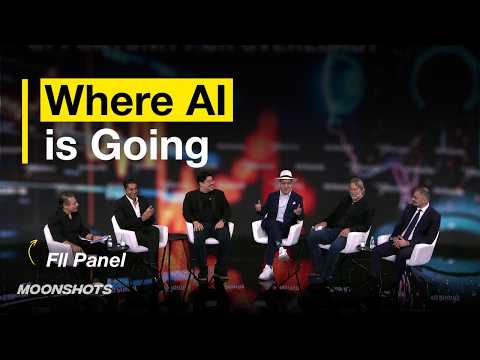
AI Leaders Reveal the Next Wave of AI Breakthroughs (At FII Miami 2025) | EP #150
- 🗓️ Date:
2025-02-20| 🎙️ Show:Moonshots
Stability AI is converting Stable Diffusion’s 270 million downloads into 50–60 specialized production models for film, TV, gaming and advertising, with convincing on-demand video estimated in six to 12 months. Liquid AI’s private, on-device systems promise “$0” hosting costs across phones, cars, satellites and jets. Tenstorrent targets systems 5–10 times cheaper through open infrastructure, while enterprise adoption remains the risk: only 11% of use cases reached production, and generative AI reached “maybe 7% at the best.”
View Dialogue Notes & Key Takeaways
Stability AI is shifting Stable Diffusion’s distribution lead—launched in August 2022, with 270 million downloads versus 9 million for the next model—into specialized production tools for film, TV, gaming and advertising. Prem Akkaraju said roughly two dozen of a planned 50–60 “ultra-narrow AI” models address workflows such as rig removal, paint and rotoscoping, and camera match-plate construction. He estimated convincing on-demand video within six to 12 months and argued that Hollywood is “confusing headwind with tailwind”; he pointed to tools appearing in Avatar 3, 4 and 5.
Liquid AI’s bet is that private, on-device intelligence can expand the market beyond GPU-equipped clouds. Ramin Hasani described a non-transformer architecture derived from liquid neural networks that can deliver ChatGPT-like experiences locally on phones and laptops, while also powering cars, satellites and jets. Once deployed on a device, he said, hosting costs “$0”; future robots could have local AI brains rather than rely on the cloud. Peter said Liquid AI had gone from zero to a $2 billion valuation in about two years, and noted a quarter-billion-dollar round led in part by G42.
SandboxAQ is targeting quantitative industries where language models cannot perform the underlying physics. Jack Hidary said the company has raised $850 million and argued that drug and materials discovery needs models “trained on molecules and atoms,” with quantum equations translated into GPU-compatible matrix algebra. Quantum computers may join GPUs in a hybrid GPU/QPU cloud in five to seven years, but useful large quantitative models, or LQMs, run on GPUs today; Aramco is its newest announced customer.
Tenstorrent is attacking AI’s compute cost and lock-in with native tensor processors and an open software stack. Peter noted its recent $700 million Series D. Jim Keller’s target is systems 5–10 times cheaper than current systems, spanning small television-chip configurations through large-model training machines. His thesis is that AI need not be “unbelievably expensive, unbelievably big, [or] unbelievably proprietary,” and that open infrastructure will broaden adoption and innovation.
Enterprise AI remains more pilot theater than production, according to figures Sukharevsky cited. He said only 11% of use cases reached production over the past five years, with generative AI at “maybe 7% at the best,” because companies insert technology into broken processes instead of redesigning them. QuantumBlack, he said, has 5,000 people in 50 countries, five R&D centers and roughly 43 products deployed globally. Senior sponsorship, data, architecture and organizational politics are central constraints.
The panel offered two execution prescriptions: focused teams that start with concrete gains, and institution-wide commitment. Hidary cited an 11-person team solving GPS-denied navigation with AI and quantum sensors and urged responsible, faster adoption to tackle diseases and battery storage. Keller asked his software organization to double productivity and first produce code with fewer bugs. Sukharevsky agreed with Peter’s warning that companies failing to use AI may be out of business by decade’s end, but said transformation requires top-level commitment: “you cannot go small—you need to go big to succeed.”
🔗 Original source & video: AI Leaders Reveal the Next Wave of AI Breakthroughs (At FII Miami 2025) | EP #150