Guido Appenzeller
Frontier Insights
Thesis: AI value is shifting from raw training scale to infrastructure power, economic routing, and geopolitical sovereignty.
Strategic Decisions:
- Monopolize the full-stack architecture: align x86 with Nvidia silicon to squeeze Arm/AMD.
- Build at the gigawatt scale (500 MW atomic units) backed by hundreds of billions in cloud and sovereign capex.
- Monetize via dynamic inference routing, turning high-value agent queries into direct transaction revenue.
Risks & Warnings: Execution hinges on scarce energized datacenters and HBM yields. Meanwhile, lagging sovereign adoption risks ceding global model dominance to China’s domestic alternatives.
Key Views & Dialogues
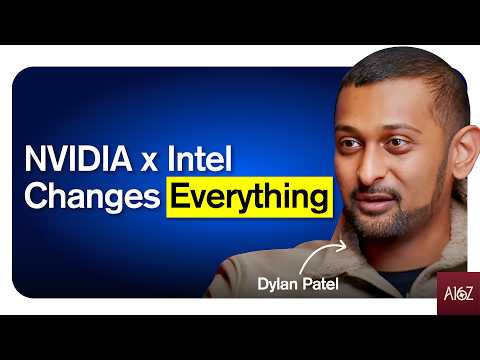
Dylan Patel on the AI Chip Race - NVIDIA, Intel & the US Government vs. China
- 🗓️ Date:
2025-09-22| 🎙️ Show:The a16z Show
Nvidia’s $5 billion Intel investment, following SoftBank’s $2 billion and the U.S. government’s $10 billion, could lower Intel’s cost of capital and redraw PC and data-center competition, though Patel says Intel still needs roughly $50 billion. Huawei has credible 7 nm designs and ambitious custom-HBM products, but HBM3 yields, etch capacity, and domestic volume remain unresolved as Nvidia’s upside depends on $450–500 billion of hyperscaler capex rather than further share gains.
View Dialogue Notes & Key Takeaways
The Nvidia–Intel tie-up is a strategic endorsement that could lower Intel’s cost of capital while redrawing the PC and data-center map. Nvidia committed $5 billion after SoftBank’s $2 billion and the U.S. government’s $10 billion, but Dylan Patel still thinks Intel needs roughly $50 billion; Jensen Huang supplies a semiconductor “Buffett effect” before a larger capital raise. Guido Appenzeller called the integrated x86-plus-Nvidia product compelling and warned that when “two arch nemeses suddenly team up,” AMD and Arm face the worst possible news.
Huawei is technologically credible, but manufacturing volume—especially high-bandwidth memory—remains the load-bearing constraint. Huawei reached market with a 7 nm Ascend AI chip in 2020, later obtained roughly 2.9 million TSMC-made chips through intermediaries, and now proposes separate prefill and decode products with custom HBM. China can probably produce substantial 7 nm logic and perhaps reach 5 nm with existing equipment, yet Patel stressed that design is not production: HBM3 yields, etch capacity and the transition from stockpiles to domestic scale remain unresolved.
China’s rejection of Nvidia chips is simultaneously industrial policy, a risky capacity bet and potentially negotiating leverage. ByteDance and other model builders still prefer Nvidia because it is “way better,” but Beijing can compel domestic adoption while Huawei publicizes an ambitious roadmap—a maneuver Patel called “10,000 IQ,” with Washington “playing checkers while they’re playing chess.” China may temporarily backtrack if domestic supply cannot ramp fast enough, forcing a choice between sovereignty and deploying “super powerful AI” at U.S.-competitive volume.
The near-term Nvidia bull case rests on AI capex running materially above Wall Street’s model, not on further market-share gains. Bank consensus puts six hyperscalers at roughly $360 billion of capex next year; Patel’s data-center and supply-chain work points to $450–500 billion, with Nvidia largely growing alongside the market while defending share. OpenAI alone signed more than $300 billion with Oracle, and the industry bull case becomes “multiple trillions a year on AI infrastructure”—though Patel refuses to forecast beyond five years because “the fifth year is sort of YOLO.”
Nvidia’s moat is a repeated willingness to risk inventory, redesign late and ship working silicon before competitors finish revising theirs. Jensen allegedly ordered Xbox volume before Microsoft formally awarded the business, placed non-cancellable capacity bets above customers’ own plans, and added Volta’s tensor cores only months before fabrication. Nvidia commonly ships A0 silicon while one Intel data-center processor reached E2—roughly 15 revisions—capturing the cultural difference between “I hate spreadsheets. I just know” and quarter-by-quarter caution.
Amazon and Oracle can both gain AI-cloud share without having the best accelerator, because powered capacity and balance-sheet willingness are scarce. Patel expects AWS revenue growth to trough and reaccelerate above 20% as Anthropic, Trainium and GPU deployments fill Amazon’s spare capacity; Trainium remains “very hard to use,” but a lab serving a few high-volume models can hand-optimize it. Oracle’s hardware-neutral engineering and willingness to underwrite OpenAI’s demand make it the bolder counterparty, although whether OpenAI can pay more than $80 billion annually in 2028–29 remains the central risk.
GB200 economics are workload-dependent, and reliability can erase headline performance for teams lacking sophisticated infrastructure. Against roughly 1.6x H100 total cost, GB200 may offer only about 2x performance in some training cases but north of 6–7x per GPU for DeepSeek inference; the problem is that one failure now sits inside a 72-GPU NVLink domain. Some clouds consequently promise about 99% availability for 64 GPUs but only 95% for all 72, making “the blast radius of a failure” as important as benchmark speed.
The GPU market is tightening again while Nvidia’s next strategic problem becomes what to do with potentially $250 billion of annual free cash flow. Patel also used an ambiguous “$200 million” figure in the same sentence. Hopper capacity at several major neoclouds sold out as reasoning-model inference surged, Blackwell deployment took longer than Hopper, and prices bottomed months ago before creeping upward—small allocations remain easy, large immediate clusters do not. Patel’s preferred outlet is data centers and power, the bottlenecks to GPU growth, but even that may not absorb the cash without turning Nvidia into a culturally different company.
🔗 Original source & video: Dylan Patel on the AI Chip Race - NVIDIA, Intel & the US Government vs. China
Dylan Patel on GPT-5’s Router Moment, GPUs vs TPUs, Monetization
- 🗓️ Date:
2025-08-18| 🎙️ Show:The a16z Show
GPT-5’s router is an economic release, directing simple queries to mini models while reserving “ungodly amounts of compute” for transactions OpenAI could monetize through agentic commerce. Flat-rate subscriptions face heavy-user losses, while custom silicon threatens Nvidia mainly if demand stays concentrated among hyperscalers; powered sites, grid equipment, and Intel’s capital needs remain near-term constraints on broader deployment.
View Dialogue Notes & Key Takeaways
GPT-5 is less a frontier-compute leap than an “economic release” built around routing. Dylan Patel argues that power users lost access to GPT-4.5 and o3—with o3 thinking roughly 30 seconds on average versus GPT-5’s 5-10 seconds—while free users sometimes receive reasoning they never had before. The router lets OpenAI choose regular, mini, or thinking models and “gracefully degrade” service, trading maximum capability for dramatically greater token capacity.
The router’s larger prize is matching inference spend to each query’s monetizable value. A “why is the sky blue?” request can go to mini, while a search for the best DUI lawyer, flight, or product can receive “ungodly amounts of compute” because OpenAI could complete the transaction and take a cut. With an estimated 10% of Etsy traffic already coming from ChatGPT, Dylan sees agentic commerce—not result-degrading ads—as the route to monetizing free users.
Flat-rate AI subscriptions are colliding with 20x differences in consumer usage. Anthropic and coding products have tightened rate limits after heavy users exploited “negative gross margin” plans; one developer reportedly rearranged sleep into sailors’ power naps, while a Reddit leaderboard included usage worth roughly $30,000 a month. Enterprises may support commitments or averaged flat fees, but consumers increasingly point toward usage pricing—even as products use subscriptions and superior review interfaces to create stickiness.
AI may already create more value than its infrastructure costs, but the labs capture only a fraction of it. Dylan Patel’s coding thought experiment—30 million developers, productivity doubled, $100,000 of value each—produces $3 trillion of potential GDP value from one use case, while Dylan believes OpenAI captures “not even 10%” of the value ChatGPT has created. That mismatch need not stop capex: hyperscalers could grow spending another 20-30%, with CoreWeave, Oracle, infrastructure funds, and sovereign capital adding less immediately economic capacity.
Custom silicon is Nvidia’s largest threat only if AI demand remains concentrated among a few giant buyers. Google is making millions of highly utilized TPUs, Amazon millions of Trainium chips, and Meta is sharply increasing internal-silicon orders; Dylan thinks Google should physically sell TPUs, not merely rent them. If open models and cheap deployment disperse demand, however, Nvidia’s universal ecosystem strengthens—and independent challengers must be “like 5x better” before supply-chain, software, and margin disadvantages erase the lead.
American AI deployment is constrained less by electricity’s cost than by powered sites, grid equipment, and construction speed. Dylan puts roughly 80% of a Blackwell data center’s cost in GPUs, networking, buildings, and power-conversion capital, leaving only 20% for land, electricity, cooling, backup power, and related items. That makes paying extra to launch three months earlier rational; meanwhile, China’s current constraint is capital and chip quality rather than power, despite its ability to scale generation faster.
Intel needs immediate operational surgery and capital, while several platform incumbents need product urgency. Dylan says Intel’s five-to-six-year design cycles and as many as 14 silicon revisions must fall toward two-to-three years and one-to-three revisions; without a major cash infusion or severe cost cuts, it could “literally” go bankrupt before a formal separation is completed. His broader calls: Nvidia should reinvest its projected $100 billion-plus cash pile into infrastructure, Google should open TPUs, Apple should spend perhaps $50 billion on AI infrastructure, and Erik says Microsoft must “shake the crap out of the company” despite its extraordinary starting position.
🔗 Original source & video: Dylan Patel on GPT-5’s Router Moment, GPUs vs TPUs, Monetization
Sovereign AI: Why Nations Are Building Their Own Models
- 🗓️ Date:
2025-05-24| 🎙️ Show:The a16z Show
HUMAIN’s announced $100 billion-$250 billion buildout signals that sovereign AI is challenging the cloud-era concentration of workloads in the US and China, with roughly 500 megawatts as its “atomic unit.” High-density AI factories require GPUs, liquid cooling and committed power, while domestic model control is becoming cultural and information infrastructure, raising a strategic choice between exporting US-allied capacity and leaving countries reliant on DeepSeek.
View Dialogue Notes & Key Takeaways
Sovereign AI is breaking the cloud-era assumption that global workloads will concentrate in the US and China. The kingdom announced HUMAIN, a local hyperscaler or AI platform intended to run most AI workloads domestically, within an announced cluster buildout somewhere around $100 billion-$250 billion; roughly 500 megawatts appears to be the “atomic unit.” The goal is “infrastructure independence,” including autonomy over models and deployment.
“AI factories” are technically distinct from conventional data centers. GPUs are the major active-component difference, while high-density clusters require rack-level liquid cooling, an energy supply close to a power plant, and early energy commitments. Enterprises may also bypass elaborate cloud stacks for Kubernetes plus selected Snowflake- or database-type services.
Models have become cultural and information infrastructure, making foreign dependence a national vulnerability. Training data embeds values, while post-training steers what models answer or refuse; meanwhile, foundation models already touch defense, healthcare, finance, and the daily decisions of ChatGPT’s roughly 500 million monthly active users. As models replace search and grade schoolwork, whoever controls them could shape accepted history and truth.
AI data centers resemble industrial-era oil reserves—with the crucial difference that countries can construct them. Capital and political will can create the compute base upon which domestic industries, development, and exports are built.
The US faces a choice between helping allies build sovereign capacity and leaving the field to Chinese models. Midha’s preferred analogy is a “Marshall Plan for AI”: the original reconstruction looked like a capital export but produced a 70-year US-Europe trade corridor and kept China out of that equation. At the model layer, he reduces the diplomatic choice to “DeepSeek or Llama?”
Appenzeller rejects comprehensive government control while preserving a targeted government role. Government can fund fundamental research and set sound regulation, but competitive companies must supply the detailed innovation; even the Manhattan Project leaked, making total control “a pipe dream.” DeepSeek’s MIT-licensed release—26 days after OpenAI’s frontier release—supports his strategy of building and exporting the best technology, ideally from the US and its allies, while Midha calls the resulting approach “foundation model diplomacy.”
🔗 Original source & video: Sovereign AI: Why Nations Are Building Their Own Models