Everett Randle
Frontier Insights
Core Thesis & Strategy: AI is invalidating traditional SaaS metrics: top-line revenue without unit economics merely scales impairment risk. Benchmark underwrites investments based on terminal economics and absolute gross profit per customer rather than bloated fund deployment. Value shifts from software seats to intelligence output and inference monetization, with coding assistants validating multi-billion-dollar ARR potential. Strategic winners will capture end-to-end workflow differentiation rather than thin wrapper interfaces.
Risks & Warnings: If frontier model capabilities plateau and open-source models hit 95% parity, foundational lab pricing power and premium margins will collapse.
Key Views & Dialogues
Benchmark’s AI Bets: Cerebras, Sierra, Legora, Fireworks, Starcloud, Gumloop..
- 🗓️ Date:
2026-06-29| 🎙️ Show:Sourcery
AI is breaking the spreadsheet playbook: billion-dollar businesses can still lack unit economics or durable differentiation, and scale may increase impairment risk. Inference monetization can drive revenue from 1 to 30 to 300, while agents shift purchases toward intelligence or economic output. Frontier labs retain pricing power if recursive self-improvement works, but face a 95%-as-good open-source squeeze if capabilities plateau.
View Dialogue Notes & Key Takeaways
The old inverse relationship between scale and risk no longer cleanly applies in AI, and the spreadsheet-investing playbook is breaking down. Randle notes exceptions for hard tech and some capital-intensive consumer internet businesses, but says AI now produces “businesses that are well over a billion dollars in revenue that haven’t proven out their unit economics” or durable differentiation. Impairment risk stays flat—maybe even rises—with scale. In the most popular AI categories, the old SaaS rules—70–90% gross margins, no services load, capital-light operations, and Rule-of-40 legibility—are almost inverted: “FDE is the new PLG,” and high gross margins can signal “no one’s using your AI features.”
Inference is the business-model unlock behind many parabolic AI revenue curves. Randle’s advice to a monetization-stuck portfolio company: stop sitting on the riverbank—“over there, there’s a fucking waterfall… the waterfall’s inference.” Charging a margin on inference instead of dollars-times-heads is why companies can go “one to 30 to 300” instead of one-to-three-to-nine; agents represent a major product and business-model shift since SaaS. Developers were spending $3,000 per month each on Cloud Code—$36,000 per developer—turning a $50K SaaS ACV into a potential $20 million line item, or for some, $500 million a month.
The frontier-lab outlook depends on two scenarios. If recursive self-improvement delivers “geniuses in a data center,” labs retain pricing power and may reaccelerate. If capabilities hit a ceiling and distillation makes open source 95% as good, “that’s a really scary situation for the frontier labs”—though not a death knell, because most of ChatGPT’s 900 million weekly active users “wouldn’t be able to tell you” if the model were swapped for 5.2 or something similar.
Anthropic’s financing could create an unprecedented liquidity shock. Randle says that if Anthropic reaches a $1 trillion–$1.5 trillion public valuation, its $30 billion round at a $380 billion valuation would gross-return 35 times the Snowflake pre-IPO round in a single deal. He knows people with $3–4 billion invested in Anthropic. San Francisco housing already clears at “2x asking price… all cash” or lab equity, and he is unsure the ecosystem understands the impact of that much liquidity.
Late-stage rounds can now have more upside than a Series C, while AI’s day-one capital needs remake venture. SpaceX, Randle’s first Kleiner investment at a valuation above $100 billion, was transformed by Starlink into a company whose S-1 business is mostly consumer and B2B broadband rather than launches. A neo-lab might need $2 billion of compute before knowing whether its thesis works, unlike Airbnb’s roughly $500K YC seed. Firms such as General Catalyst and Andreessen Horowitz increasingly operate as alternative asset managers, with venture as a product rather than the firm itself.
Benchmark’s counter-strategy is founder-out, never theme-in. Its seemingly thematic portfolio—Lagora, Sierra, LangChain, Fireworks, HeyGen, Gumloop, and StarCloud—was not built from category selection. Chetan closed StarCloud weeks before Elon publicly professed enthusiasm for orbital data centers; the investment centered on Philip and his team, who already had a GPU working in space. “Great founders are always in style,” and it “would kind of suck to be the SaaS fund right now.”
Open source and frontier models are not zero-sum—at least yet. Randle’s AI mom test says that 100% of his nontechnical mother’s AI needs can now be handled without a frontier model. He recalls Cognition publishing work on post-training an open-source model for low-complexity tasks, though he is unsure whether that is exactly what it did; the savings could reach 95%. Frontier demand is also growing rapidly after the Opus 4.5 coding breakthrough. Eric Vishria’s framing is yes to on-device inference, open-source inference, and proprietary models.
🔗 Original source & video: Benchmark’s AI Bets: Cerebras, Sierra, Legora, Fireworks, Starcloud, Gumloop..
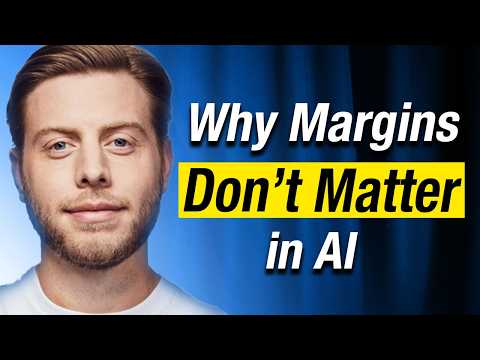
Benchmark’s GP, Everett Randle on Why Mega Funds Will Not Produce Good Returns
- 🗓️ Date:
2025-11-10| 🎙️ Show:20VC
AI applications challenge SaaS’s 80%-margin scorecard because inference can sit in COGS, making terminal margins, gross-profit multiples, and absolute gross profit per customer more informative. Coding has grown from essentially zero to $6–7 billion of ARR in roughly 2.5 years, while Cursor, Claude Code, and Codex improve through usage even as market share fragments. Randle favors OpenAI at $500 billion over Anthropic at $350 billion because ChatGPT’s trajectory appears difficult to stop, while Benchmark’s small funds prioritize concentrated multiples over mega-round participation.
View Dialogue Notes & Key Takeaways
AI application economics break SaaS’s familiar 80%-margin scorecard. Randle argues investors should underwrite terminal 5–7-year margins, gross-profit multiples, and absolute gross profit per customer: an AI product at 50% margin can be superior to SaaS at 75% if it produces $500,000 versus $200,000 of gross profit. His blunt call: “We should not be placing that much emphasis on margins today,” especially because high inference COGS can reflect genuine AI usage. AWS is his analogy—lower margins can coexist with much larger customer spend.
Coding is already a “golden category,” even if Cursor’s market share keeps falling. Randle estimates code generation grew from essentially zero to $6–7 billion of ARR in roughly 2.5 years and could add another $4–5 billion this year; Cursor may have fallen from roughly 80% share to 25–30%, yet still be addressing a vastly larger market. Products with the most usage—Cursor, Claude Code and Codex among them—also improve fastest through deployment and can “leave everybody in the dust.” But growth is real only when an app clears the labs’ baseline: Jasper grew rapidly and then shrank when GPT-4 made its output look too similar to ChatGPT’s $20 offering, recovering only through more differentiated workflow software.
At the latest stated prices, Randle would take OpenAI at $500 billion over Anthropic at $350 billion. Anthropic remains slightly ahead in coding and probably B2B commercialization, while OpenAI has recovered ground with Codex; the decisive asset is ChatGPT, whose growth trajectory Randle finds almost impossible to stop. Having passed on OpenAI at $32 billion over nonprofit structure and dilution concerns, he now predicts it could be a trillion-dollar company next year: “I missed the forest for the trees.”
Benchmark’s small fund is designed to maximize multiples, not win every mega-round. Randle says the five best investments in its last fund, marked at last-round prices, stand at roughly one 60x, two 30xs and two 20xs—returns no post-ChatGPT OpenAI round matches. Benchmark therefore need not buy every lab financing; its two north stars are being the founder’s closest, highest-ROI partner and generating the highest money-on-money return in an LP’s venture portfolio. A customary 20% ownership target is an input rather than the goal: lower ownership in Mercor can still produce exceptional returns if Benchmark remains its most consequential venture partner.
Mega-funds may make immense absolute profits while still failing venture’s return test. Randle’s argument is structural: “You ship your fund size,” so $7–10 billion vehicles must write enormous checks, and those checks inevitably become the main product and organizational priority. He doubts their managers can credibly promise 5x net across the relevant basket of funds; Harry’s pushback is that unprecedented outcomes may still rescue the model, which Randle accepts in dollars but not necessarily in multiples. Tiger may finish far better than its reputation suggests, given positions in Databricks and OpenAI and preferred-stock protections on some losers, but Randle still expects many AI companies to go to zero or fall 90% while rare winners compound for decades.
AI’s moat remains technology, not merely distribution. Distribution earns a company the opportunity to build, but Randle says exceptional AI products require scarce talent, nuanced model pipelines and workflow design—not “bringing in the OpenAI API” beside a text box. The labs establish a $20 or $200-per-month experience baseline, so application companies charging more must create deeply differentiated workflow value that survives the next model release.
Commodity AI infrastructure can overwhelm quality concerns. Randle changed his mind on AI clouds, initially dismissing CoreWeave as a commodity middleman before astronomical inference demand overwhelmed that objection. He cited CoreWeave at roughly $60 billion and Nebius at roughly $30 billion in public-market value, with more than $100 billion across the public sector. He still expects CoreWeave and similar companies could eventually fall 70%, but says demand can justify investing with momentum.
Price matters only against the company’s own upside. Randle ranks people, product, market: people are the upstream engine, product is the strongest evidence of their quality, and market is most fungible because companies can pivot. SpaceX at $150 billion, Rippling at a $250 million Series A and Figma at $400 million on $4 million of ARR taught him to remove intimidating zeros and underwrite TAM, competitive position and upside rather than market convention. Models provide a base-rate yardstick—perhaps the path others underwrite for a 3–5x—but detailed forecasts become false precision; the real test is whether the qualitative view says the company will “absolutely smoke these projections.”
Benchmark’s greatest risk is stasis, not one missed cycle. Randle calls stasis the biggest threat over the next two decades: Benchmark must evolve with the asset class while preserving its two north stars and continuing to reach the very best founders. His long-run optimism rests on AI lifting GDP per capita as population growth slows—“continuing growing the pie” as the foundation for a functional, less zero-sum society.
🔗 Original source & video: Benchmark’s GP, Everett Randle on Why Mega Funds Will Not Produce Good Returns