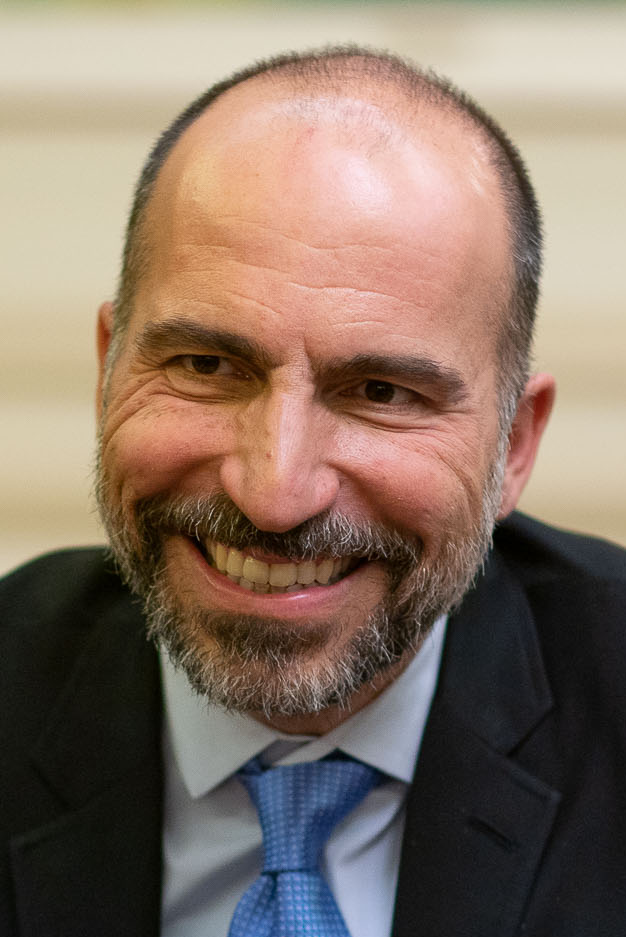
Dara Khosrowshahi
Frontier Insights
Core Thesis
Uber is positioning itself as the indispensable global demand and orchestration layer for autonomous mobility, converting AV developers into partners rather than vertical competitors. High platform utilization—yielding over 30% higher vehicle efficiency—drives unit economics across a $1T+ TAM.
Strategic Moves
Aggregating 20+ AV partners across a hybrid human-robot network, Uber absorbs initial fleet deployment risks before offloading assets to financial buyers, building defensibility through demand density, fleet operations, and insurance infrastructure.
Key Risks
Execution hinges on LiDAR deflation, Chinese manufacturing disruption, and managing severe societal blowback from eventual driver displacement over the next decade.
Key Views & Dialogues
Uber CEO on AI, Autonomous Vehicles, and the Future of Transportation
- 🗓️ Date:
2026-06-03| 🎙️ Show:Invest Like the Best
Uber is making AV supply its moat through 30+ partnerships, financing, depots, charging, and insurance; network vehicles are 30% or more busier, improving fleet ROI. The upside is a potential trillion-dollar marketplace, but AI budget overruns, Chinese manufacturing advantages, social backlash, and execution in Uber One and hotels remain risks.
View Dialogue Notes & Key Takeaways
Khosrowshahi’s core AV thesis: supply is key to winning, and Uber is building the ecosystem to do it — 30+ partnerships (likely Waymo, likely Nuro, Lucid, Nvidia, likely Waabi, likely Wayve, likely WeRide, likely Pony.ai), depots, charging, fleet financing (a just-announced $1B financing line, likely with Santander, for EV/AV fleets), and autonomous insurance. The proof point: AVs on Uber’s network are “30% or more busy” than vehicles not using the network in trips and revenue per vehicle per day — “that 30%… can make a huge difference in terms of your ROI of investing in these expensive cars.”
He sizes autonomy as “another trillion dollar marketplace,” with the same underestimation error as early Uber: “people were sizing the market based on the taxi market. We’re multiple times bigger than the taxi market.” Hardware costs usually fall 30-40% per generation; the Lucid midsize being built with likely Nuro “would be a $60-$70,000 car,” and each AV probably drives 3-4x what a human does.
Uber blew through its full-year AI budget in one quarter and is responding by metering headcount growth as engineer throughput goes “superhuman.” The playbook: frontier models (OpenAI or a cloud model) for exploration — “exploration is go go go” — then swap in cheaper or open-source models once experiences scale. Context: $10B+ free cash flow on over 10 billion trips a year — “we are not a high margin business.”
On the AV foundry question: Khosrowshahi expects traditional OEMs to get to L4-ready systems in 2-4 years, but “the Chinese capabilities in terms of manufacturing both in terms of quality and cost at this point is unrivaled” — a Western low-cost Foxcon equivalent “is being worked on but we’re not there yet.”
His premortem isn’t Uber-specific — it’s public backlash against AI and AVs: “we’ve got to go at the pace that society is prepared for us to move otherwise there will be a backlash.” Early counter-evidence: in Austin and Atlanta, where likely Waymo partnerships run, drivers are earning more and driver sign-ups are rising because AVs “are actually adding incremental demand to the platform.”
The super-app flywheel is compounding: Uber One is at 50 million members growing 50% year-on-year, 13% of Eats bookings come from the mobility app, Reserve went from nonexistent to a $5B+ run rate at 99%+ reliability, and the new Expedia hotels deal hands “the vast majority of the economics” back to members. Membership follows the Amazon Prime pattern: lose money on a member in year one, make it back in years 2-4 — “solidly profitable now.”
Capital allocation, asked “are you Amazon or are you Apple?”: “somewhere in between” — organic growth first (Eats went from under $1B gross bookings to over $100B under his tenure), then AV commitments in the tens of thousands of vehicles (financialized), with buybacks from what’s left. “If you’re building the company right, you’ll do both.”
Management edge, via Barry Diller: go to the source, because “it’s the filtering that gets the edge out of the story… it’s often the edge that gives you an edge.” Companies are organisms that “evolve by mutating” — he hunts troublemakers as mutations, and says AI has accelerated the internal rate of change “by 5x.”
🔗 Original source & video: Uber CEO on AI, Autonomous Vehicles, and the Future of Transportation
Uber’s Robotaxi Playbook, End of Human Driving & $10B Bet on Robots | Dara Khosrowshahi (Uber CEO)
- 🗓️ Date:
2026-04-02| 🎙️ Show:Moonshots
AV demand is arriving before mass production at regular-car prices: in Atlanta and Austin, 80% of riders accept an autonomous match and 20% decline. Dara Khosrowshahi told a 13-year-old that, three years from now, they would still likely want a license because AVs remain “much more expensive than a regular car,” but says that 10…
View Dialogue Notes & Key Takeaways
AV demand is arriving before mass production at regular-car prices: in Atlanta and Austin, 80% of riders accept an autonomous match and 20% decline. Dara Khosrowshahi told a 13-year-old that, three years from now, they would still likely want a license because AVs remain “much more expensive than a regular car,” but says that 10 years from now they will not have to drive and will have plenty of choices; within 25 years, humans will be “demonstrably less safe.”
Uber’s potential AV operating edge is network orchestration at roughly 10 million drivers and 40 million trips every day. Its dispatch system looks five or six seconds ahead rather than simply choosing the nearest vehicle; Dara is “kind of psyched for machines” because they should be more predictable and have higher acceptance rates than humans.
Autonomous volume remains economically small, leaving insurance pricing and responsibility unsettled. Dara estimated that all AV trips worldwide last year represented less than 1% of the rides Uber added, so insurers still lack the “law of large numbers”; the model may involve the AV provider, platform or a combination, and “all of that is TBD.”
Uber’s answer to potential Chinese AV disruption is partnership, not retreat from the ecosystem. After Expedia “got our asses kicked” in China, Dara endorsed Uber’s exit but highlighted its unmonetized DiDi stake and work with BYD, Pony.ai, WeRide and hopefully Baidu: “Building bridges to China is the right way forward for us.”
Dara expects automation to augment more work than it eliminates over the next decade, but leaves the speed of social adaptation open. Companies may automate 20% or 30% of office tasks without reaching 100%, while Uber aims to expand from roughly 10 million people on its platform now to 20 million by 2035; the unresolved risk is that change is occurring “faster than even I expected.”
Management argues that Uber’s larger cash engine should increase—not suppress—its appetite for failure. The company was losing $4 billion when Dara joined but says it will generate $10 billion of cash flow this year, leading him to insist that as companies grow, their tendency to become conservative is exactly backward: “The exact opposite should be true.”
Uber’s expansion filter is whether a new business “rhymes” with an existing capability. Rides led to Eats, Freight and air mobility, while AI model design, labeling and testing fit because Uber is also a flexible-work platform; if an idea does not rhyme, Dara says a startup is better equipped to pursue it.
The physical transition will be slower than the software narrative implies. Dara expects AV growth to move Uber’s network toward EVs because “AVs are EVs,” but inadequate US charging infrastructure remains a constraint and his combustion-engine horizon is still 20 years; eventually, autonomy should make transportation cheaper and extend safe service into today’s transportation deserts.
🔗 Original source & video: Uber’s Robotaxi Playbook, End of Human Driving & $10B Bet on Robots | Dara Khosrowshahi (Uber CEO)
Uber vs. Tesla, Robotaxi Timelines, and the End of Human Driving | Uber CEO Dara Khosrowshahi | #243
- 🗓️ Date:
2026-03-31| 🎙️ Show:Moonshots
Uber’s robotaxi strategy is to aggregate demand and orchestrate the ecosystem, not insist on one autonomous stack. Dara Khosrowshahi expects hybrid fleets of human and robot drivers, with Waymo as a leading partner and more than 20 autonomy partners; Uber targets 15 cities by year-end and, by 2029, more facilitated autonomous and robotaxi rides than…
View Dialogue Notes & Key Takeaways
Uber’s robotaxi strategy is to aggregate demand and orchestrate the ecosystem, not insist on one autonomous stack. Dara Khosrowshahi expects hybrid fleets of human and robot drivers, with Waymo as a leading partner and more than 20 autonomy partners; Uber targets 15 cities by year-end and, by 2029, more facilitated autonomous and robotaxi rides than anyone else.
The operating moat is everything surrounding the autonomous driver. Uber supplies demand, data, pickup and drop-off intelligence, fleet management, maintenance and cleaning, letting partners focus on a safe, affordable driver; longer term, Khosrowshahi sees Blackstone-like owners owning fleets for perhaps a “9% yield” while Uber operates them.
Tesla is optional to the thesis, not essential to it. Uber already has tens of thousands of Teslas on-platform, some using FSD, and would welcome autonomous Teslas once the camera-only approach is safe; whether the companies partner remains “TBD,” while Khosrowshahi expects “many, many winners.”
Autonomy can become standard in new cars quickly while taking decades to dominate the installed fleet. Khosrowshahi expects every new car sold within 10 years to carry autonomous software and a sensor stack, but the average US car lasts more than 10 years and adoption across Uber’s 70-plus countries will vary; ultimately, falling trip costs should make private ownership “just not going to make sense.”
Driver displacement is not Khosrowshahi’s base case through 2030. With Uber’s business growing over 20% and its audience almost 20%, he expects significantly more drivers, managing autonomy through natural annual churn of around 20% and slower recruitment; faster growth in Austin and Atlanta suggests robotaxis might expand demand rather than merely substitute labor.
Uber’s larger TAM is “wiring up things that move,” while autonomy itself could be another trillion-dollar marketplace. That includes one-hour retail delivery, trains and boats, an Uber-to-Joby-to-Uber journey, suburban drones and urban sidewalk robots.
The host-framed turnaround—from losing about $4.5 billion annually to earning more than $10 billion—rests on concentrated execution. Khosrowshahi’s maxim is that “the noes amplify the yeses,” paired with an unapologetically intense culture for people who “run to the fire” and want difficult, consequential work.
🔗 Original source & video: Uber vs. Tesla, Robotaxi Timelines, and the End of Human Driving | Uber CEO Dara Khosrowshahi | #243
Uber CEO Dara Khosrowshahi on self-driving’s future, changing business model, job displacement
- 🗓️ Date:
2025-09-17| 🎙️ Show:All-In
Uber’s autonomy strategy is to be a demand platform for more than 20 partners, subject to safety and economics. Khosrowshahi wants AVs to be “multiple times safer than a human being,” which he says is achievable; he also argues autonomy could eventually save millions of lives, lower mobility costs and expand the on-demand market. Falling…
View Dialogue Notes & Key Takeaways
Uber’s autonomy strategy is to be a demand platform for more than 20 partners, subject to safety and economics. Khosrowshahi wants AVs to be “multiple times safer than a human being,” which he says is achievable; he also argues autonomy could eventually save millions of lives, lower mobility costs and expand the on-demand market. Falling LiDAR costs—from $20,000-$30,000 five or six years ago to $300-$500—support the economics, though vehicles remain expensive.
Khosrowshahi argues robotaxis reinforce Uber’s marketplace moat because demand density drives utilization. A vehicle on Uber’s network might travel three minutes to collect a 10-minute ride versus 15 minutes for a standalone fleet, producing more “revenue per car per day.” His pitch to Tesla is that Uber is currently “your ticket to the maximization of that revenue.”
Uber expects to take balance-sheet risk on fleets temporarily, then move the assets to financial investors. Khosrowshahi’s 10-year model resembles hotel brands: Uber supplies demand while outside owners finance fleets and maximize utilization across networks. Uber will use its balance sheet to prove the model, then move those assets off balance sheet.
The $20 billion buyback does not signal retreat from autonomy investment. Uber generated over $8.5 billion of cash flow in the past 12 months, with top line growing 18% and bottom line 35%; Khosrowshahi says it can “walk and chew gum at the same time.” The host projected autonomy taking ridesharing from 1-2% of global rides to 20%, but Khosrowshahi did not endorse that specific forecast.
Uber’s distribution thesis extends from robotaxis into eVTOLs, sidewalk robots and drones. The company invested in Joby, while Khosrowshahi estimates robots and drones together could address “50-plus percent” of delivery TAM. Getting food out of restaurants and into apartments leaves the other half unresolved.
Management sees little driver displacement for five to seven years but a serious societal problem over 10-15 years. Uber can slow recruitment as AVs arrive; Khosrowshahi says Austin’s incumbent drivers still earn as much or more after Waymo’s launch. Beyond that transition, even new work such as AI labeling does not provide a complete answer: “I don’t have a neat answer for it.”
🔗 Original source & video: Uber CEO Dara Khosrowshahi on self-driving’s future, changing business model, job displacement