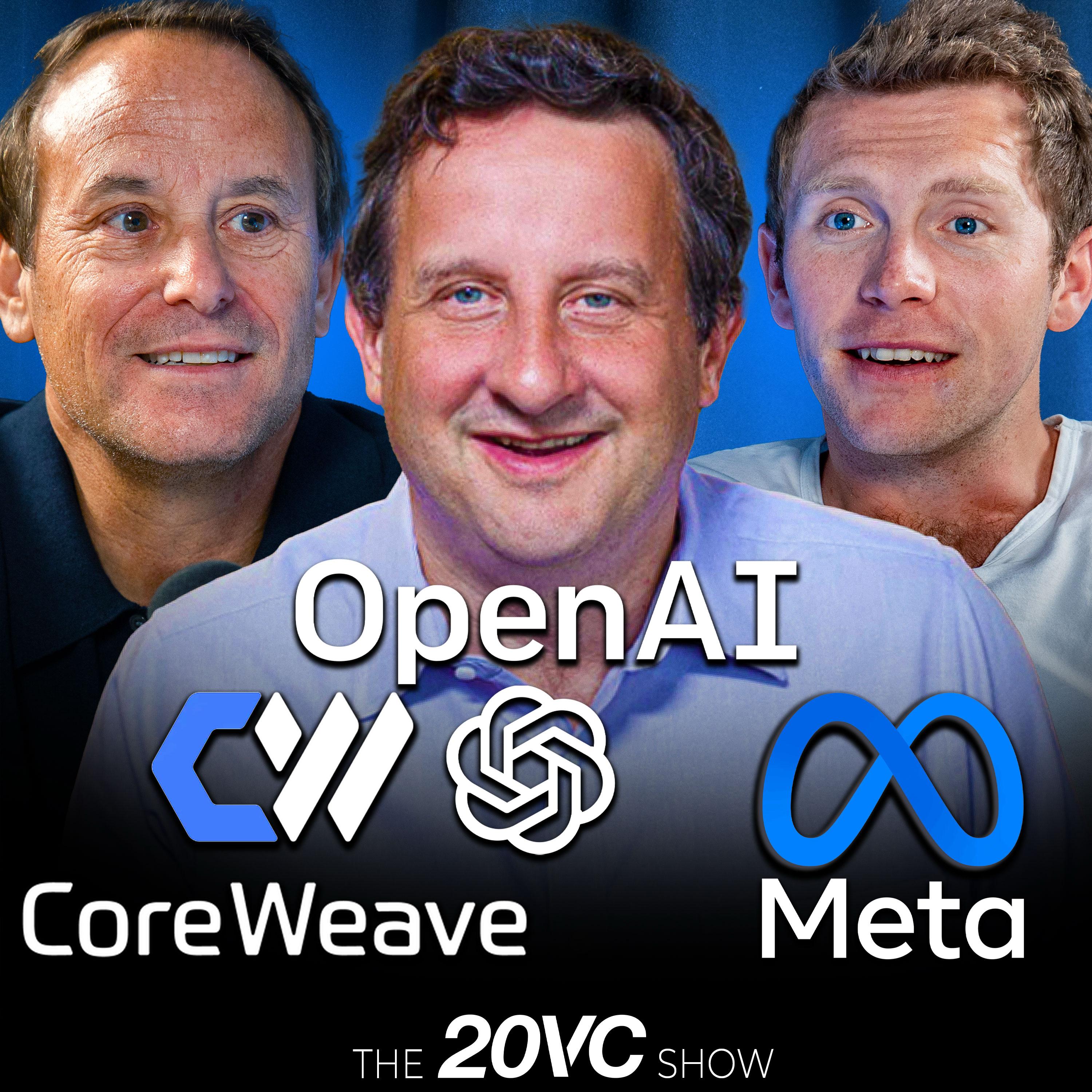
Daniel Gross
Frontier Insights
Frontier Thesis: Meta’s massive AI spend is strategic defense against context-aware, persistent personal assistants eroding core platform attention. Capturing labor value—not just software margin—is the only path justifying multi-billion-dollar application valuations.
Strategic Decisions: Consolidating top-tier talent like Daniel Gross accelerates recruiting and model development, deploying balance-sheet firepower to hedge against ecosystem shifts signaled by rapid assistant adoption.
Risks & Warnings: Severe equity dilution and skyrocketing engineer compensation threaten unit economics, while commoditization looms—a fourth-tier frontier LLM lacks distinct business moats. Meanwhile, incumbent platform defense (e.g., locked protocols) and extreme multiples leave thin margin for execution error.
Key Views & Dialogues
20VC: Daniel Gross and Nat Friedman: Acquired by Meta | OpenAI’s SBC Bombshell: More Stock Comp Than Revenue | Privat Equity is Back: Olo Bought for $2BN | Microsoft Lays Off 9,000 People: Is This Just the Start | Will Sequoia Part with Shaun Maguire
- 🗓️ Date:
2025-07-10| 🎙️ Show:20VC
Meta’s hire of Daniel Gross and Nat Friedman may monetize a $1.1 billion fund marked 4x, while potentially sacrificing roughly $800 million-$1 billion of future carry and venture economics. The sharper 2026 constraint is scarce AI talent, with $800,000-plus packages and possible 0.5%-1% equity per engineer challenging application-company economics, even as Olo’s $2 billion take-private shows defensible vertical SaaS can still transact.
View Dialogue Notes & Key Takeaways
Meta’s hire of Daniel Gross and Nat Friedman may outweigh even a spectacular venture franchise. Jason and Rory’s rough math starts with a $1.1 billion fund, roughly half deployed and marked 4x: about $1.5 billion of paper gains and roughly $300 million of carry, plus perhaps $800 million-$1 billion of forgone future economics. Rory believed Meta would buy an aggregate 49% of the fund, allowing LPs to sell some or all of their interests; an LP could get roughly “jilted with a 2X” while retaining unsold exposure, but Harry argues they still lose prized stewardship.
The talent-accumulation strategy probably works as recruiting, but that does not settle Meta’s return on it. Jason calls it a “mega-mecca for talent”: prominence attracts the best, who attract more of the best. Rory agrees the AI “inner circle” can build the product, yet asks whether being the fourth or fifth broadly capable LLM is compelling; once Meta decides AI is existential, however, it should do what it has to do to win.
The panel’s sharpest 2026 B2B AI risk is labor scarcity, not model access. Cursor-level compensation—$800,000-plus, RSUs and guarantees—forces even a nearly $200 million ARR company to contemplate 0.5%-1% equity per AI engineer, economics that cannot scale to 50 hires. Rory’s nuance is that application companies need not employ frontier-model builders, but Jason insists average teams sharing the same models disappear into “the sea of sameness.”
OpenAI’s reported stock compensation is alarming, but GAAP expense is not the same thing as dilution. Jason cited $4.4 billion of SBC, equal to 119% of GAAP revenue versus a projected fall to 45%; Rory wants shares issued considered against valuation, noting that $10 billion at $300 billion is 3%, while freely tradable stock is more cash-like. His conclusion is blunt: 20%-30% extra dilution can hurt, but “not getting it is the fatal error.”
CoreWeave is using appreciated equity to exchange fixed obligations for de-risking. The $9 billion Core Scientific purchase, after $1 billion for Weights & Biases, can replace lease, rent and debt exposure with dilution; Rory frames it as moving from 100% to 80% leveraged to endless data-center demand. Circle should also exploit rich equity, the panel says, but as a profitable business with $156 million of net income, its likely target is distribution rather than cost structure.
Olo’s $2 billion take-private shows a functioning exit market, not a broad SaaS rescue. At roughly $320 million ARR, 20%-21% growth, GAAP profitability and 6x-6.5x revenue, Thoma Bravo gets a “meat and potatoes deal” it can compound through bolt-ons and greater restaurant-wallet share. It demonstrates that defensible vertical SaaS can transact, but Rory says it will not save 500-700 unicorns.
Venture has become a flight to consensus in which a small set of AI leaders absorbs money, talent and attention. Cursor illustrates the loop—“attention begets more attention”—while “nearly as good” attracts little; meanwhile, Carta showed deal count at an eight-year low. Even triple-triple-double-double growth can be passed over unless it is cheaper, durably differentiated and financeable through later rounds, though Harry argues firms with weaker AI-halo brands should exploit that abandoned lane.
AI is raising the minimum technical fluency of both sellers and incumbent employees. Microsoft’s 9,000 layoffs were framed as replacing generalist relationship sellers with solution engineers, with Jason estimating AI may remove 30%-40% of one- or two-call sales roles; Canva’s discovery week for all 5,000 employees made adoption expectations explicit. Harry would fire persistent resisters, while Rory sees method as secondary: in two to four years, nobody will credibly say, “I’m too busy to use AI.”
The later capital-market signals are mixed. Vanguard’s partnership with Blackstone may add private-market capital, but target-date liquidity and private marks complicate retail access; university funding pressure should reduce venture-LP activity even as Jason says the QSBS exclusion rose to $15 million. In the quick-fire discussion, Sean Maguire’s Kalshi odds were quoted as Yes 34.8% and No 11.5%; Jason argued he might leave Sequoia, while Rory argued No.
20VC: Nat Friedman and Daniel Gross Bought with Zuck’s $100BN AI Budget | Navan Files to Go Public and Canva Pulls the Brakes: Why and What Happens | Why Larry Ellison is the Smartest Man in Tech | Substance or Sizzle: What is Real and What is BS in AI
- 🗓️ Date:
2025-06-26| 🎙️ Show:20VC
Meta’s $100BN AI budget looks less like a business plan than deplatforming insurance, with ChatGPT’s 29.5M mobile downloads approaching 32M for TikTok, Facebook, Instagram and X combined. Harvey’s $5BN valuation tests whether marketing-led market capture can replace labor and retain value, while Circle’s 57x run-rate revenue and Slack’s MCP lockdown leave pricing and distribution risks.
View Dialogue Notes & Key Takeaways
Meta’s $100BN AI spend is insurance, not a business plan. Rory’s frame: the only coherent fear is a memory-laden assistant that “sucks attention minutes away from Facebook” — not Llama as an open-source or API business, which “just won’t be big.” The Oculus precedent ($2BN buy plus ~$60BN sunk) proves Zuck buys deplatforming insurance at scale; Jason’s math makes it rational — a quick $100BN M&A budget is only ~8% of Meta’s $1.8T cap. Rory can “simultaneously believe it’s totally a bad idea and it won’t work, and it’s totally a good idea to do it just in case it might.”
The tell that Meta is right to panic: Sam Altman quote-tweeted 28-day App Store data showing ChatGPT at 29.5M mobile downloads vs 32M for TikTok, Facebook, Instagram and X combined — “probably half the answer right there.”
The billion-dollar packages go only to people who were “in the room when the magic happened” — OpenAI alumni at Anthropic, SSI, Mira’s company. Cohere, Adept, Inflection have no “magic moment money.” California’s hard-to-enforce non-competes (since the 1870s) are the release valve — in a five-year-non-compete state, “all those guys would be sitting at home on their 300 grand a year.”
Harvey’s $5BN round rewards marketing that froze the market before the product existed — “make noise, freeze the market, declare yourself the winner, details to follow.” The TAM math only works if AI “eats the work”: ~1M lawyers at software prices is a rounding error, and unbundling (patents, immigration, plaintiff law peel off) halves it further. The open question from Rory: “Can they replace labor and keep the value? Excel doesn’t charge 60 grand a year ‘cause it replaced an analyst.”
The episode’s manifesto, from the “Leverage Beta Is All You Need” piece Rory read aloud: “Harvey isn’t some breakthrough in legal AI, it’s ChatGPT with a law costume” — either lie about the present (11x, Icon) or arbitrage the obvious (Harvey, Lovable), because models improve fast enough that claiming territory early beats building better product.
Circle is trading like a meme stock and everyone knows it — $83 to $231 in two weeks on zero news, up 46.4% in five days, $68BN business (above Coinbase, to whom it hands half its gross revenue) at ~57x run-rate revenue. Rory: buyers think “someone else thinks it’s worth 58 times revenues… that kind of thing always ends badly” — and when the other 80% of stock comes off in six months, Rory doesn’t think it will still trade at 57x revenues. Meanwhile the IPO window is wide open: filings up 62.5%, and “anyone that’s got the numbers is gonna go public” in the next 12 months.
The Ellison masterclass: 23% ownership at IPO compounded to 41% via 10 or 15 years of buybacks at 43% operating margins — then this year he abandoned buybacks, swung ~$30BN into AI CapEx (Oracle went FCF-negative), and caught a 40% stock pop just when he owned most of the company. “He took the Warren Buffett bible for 15 years… and then last year he said, ‘Fuck it, I’m 80.’” Canva’s IPO delay is the same logic inverted: post-capital, cash-generative companies are net buyers of their own stock and don’t need public markets.
Jason’s call: MCP is “an existential threat within 12 months to every B2B company” — hence Slack’s lockdown, which Rory reads as “a sign of a decaying empire… it’s like when PE moves in. Price rises are coming.” HubSpot’s launch-day ChatGPT partnership is the counter-model: embrace the threat.