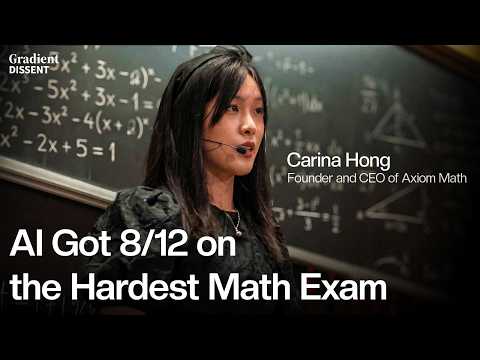
Carina Hong
Frontier Insights
Frontier Thesis
Formal mathematics is the ultimate high-signal ground truth for next-gen reasoning. By coupling generative conjecture with Lean’s deterministic proof verification, Axiom transforms formal systems into scalable RL reward environments that transcend the noise of informal AI.
Strategic Moat
Commercialize provable correctness where hallucinations are fatal: chip design, safety-critical systems, legacy code equivalence, and database verification, leveraging math-bench triumphs (e.g., Putnam) as proof of reasoning supremacy.
Critical Risks
Scaling bottlenecks hinge on mathlib coverage limits, translating messy enterprise ambiguity into rigorous specifications, and proving formal verification can command enterprise value beyond narrow mission-critical niches.
Key Views & Dialogues
Scaling Past Informal AI - Carina Hong, Axiom Math
- 🗓️ Date:
2026-06-03| 🎙️ Show:Latent Space
Axiom’s $200 million Series A at a reported $1.6 billion valuation bets that formal math can become infrastructure for AI-generated code, software, hardware, and science. Lean’s binary proof signal supported a 120/120 Putnam result and efficient reinforcement learning, while hardware offers the clearest willingness to pay; specification quality, ecosystem coverage, and commercial speed remain unresolved risks.
View Dialogue Notes & Key Takeaways
Axiom’s $200 million Series A at a reported $1.6 billion valuation rests on formal math becoming infrastructure, not remaining a niche market. The seven-to-eight-month-old, roughly 30-person company sees math as its DNA and verification as its first commercial wedge into software, hardware, science, and general reasoning. Hong’s proposed TAM is “a right of first refusal on all AI-generated code.”
Hong argues that verification’s strategic value is higher intelligence per unit of data and compute, not merely fewer hallucinations. Axiom’s verified system scored 120/120 on the December 2025 Putnam, versus a reported 110 for the top human and 103 for DeepSeek in MASS Arena’s comparison. Her signature framing is “scaling brilliance, compounding brilliance”: proofs turn intuition into reusable, collaborative intellectual capital.
Formal data gives Axiom an unusually strong reinforcement-learning signal, but its reach still depends on the underlying Lean ecosystem. Lean proofs compile as correct or fail, enabling recursive decomposition, backtracking, and verified rewards without human or LLM judges. Yet Hong concedes that domains lacking definitions and infrastructure in mathlib—particularly parts of differential topology and geometry—remain difficult regardless of model quality.
Proof generation alone does not solve the specification problem, which Hong calls the unresolved bottleneck for verified software. A proof can establish that code satisfies a formal specification, but humans still must determine whether the specification captures what a bank, aircraft controller, or user actually wants. “If it’s not specified, it’s not proven”; testing and AI-generated edge cases may therefore serve as conjectures that iteratively improve the spec.
Hardware offers the sharpest near-term willingness to pay because “there is no partial credit for a mostly verified GPU.” The episode cites ASIC projects where verification can consume three to four times the design headcount and duration, while stochastic retries that might be tolerable in recreational theorem proving are unacceptable. Software verification is broader but optional, so adoption will be governed by verification’s latency, accuracy, and cost.
Axiom’s formal-first bet is categorical but not formal-only. Hong says, “We do not believe that an informal math system is going to be the math AGI solution,” arguing that human experts and LLM judges become prohibitively expensive at the frontier. The intended engine bridges informal intuition and formal proof, while separate mathematical-discovery systems generate examples and constructions before a theorem is even ready to prove.
The enduring moat is execution speed, specialist concentration, and workflow ownership rather than proprietary proofs alone. Hong calls accumulated data only a “time moat,” while emphasizing the feedback loop among mathematicians, Lean contributors, applied-ML researchers, and compiler specialists. Axel, Axiom’s free suite of about 14 Lean tools, also positions the company as a verification partner to frontier labs: “Claude plus Axel” today, potentially an Axiom API call inside future coding agents.
Hong’s broadest claim is that “verified AI is for openness,” enabling human-AI and eventually agent-agent collaboration through shared, machine-checkable grounding. Recursive self-improvement may happen regardless, she says; formal verification must “earn its place” by outperforming alternatives. The principal field-level risk is fragmentation and pressure to demonstrate short-term commercial value before the underlying reasoning capability is mature.
🔗 Original source & video: Scaling Past Informal AI - Carina Hong, Axiom Math
She Raised $64M to Build an AI Math Prodigy | Carina Hong, CEO of Axiom
- 🗓️ Date:
2026-02-05| 🎙️ Show:Gradient Dissent
Axiom’s $64 million wager combines probabilistic generation with deterministic Lean verification through a prover, conjecturer, shared knowledge base, and auto-formalization layer. Its provisional Putnam 2026 result of eight problems within exam time and a reported ninth signals capability, while chip verification, safety-critical code, and legacy-code equivalence offer commercial wedges whose harder constraint may be specifying what “correct” means.
View Dialogue Notes & Key Takeaways
Axiom’s $64 million wager is that reliable reasoning needs generation and verification in one self-improving loop, not merely a larger informal model. Hong’s architecture joins a theorem prover, conjecturer, shared knowledge base, and auto-formalization layer, using Lean to combine probabilistic search with deterministic checking: “A proof is a proof.”
The early technical signal is a Putnam 2026 run of eight problems out of 12 within the exam time and a ninth reported two hours after Hong’s initial post, with final scoring still pending. Nine would match the previous year’s top score among roughly 4,000 humans and sit around Putnam Fellow territory, while “the median score is like a zero.” Hong herself scored four and joked about holding a “beat Carina” party.
The commercial wedge is verification labor: hardware design teams may be one-third or one-quarter the size of verification teams, verification can take three years, and Hong thinks AWS spent five years formalizing one hypervisor memory-isolation component. Axiom is targeting chip verification, safety-critical code review, legacy-code equivalence, and database consistency—cases where customers “just want this to not be wrong.”
Axiom does not claim every program should or can be formally verified; Hong divides the market into critical systems, “good to have” cases, and lower-stakes vibe-coded applications. A Lovable website “wouldn’t necessarily need formal verification,” and “you cannot verify all code in Python,” though she argues much of it might still be covered. The harder product problem may be formalizing the correct specification amid ambiguity, not checking the resulting proof.
Hong expects mathematics to shift abstraction rather than disappear, with elite researchers supplying intuition while AI becomes “the diligent grad student or postdoc” proving ideas, constructing examples, and rejecting bad conjectures. Biewald presses that machines might eventually surpass human intuition; she answers “different intuitions” and thinks catching the top 0.00001% of mathematicians will take a long time. Axiom is “not there yet” on P versus NP or the Riemann hypothesis.
The $64 million financing gives runway to a company that is roughly six months old, calls itself “at day zero,” and remains in early conversations with trusted partners. Hong wants Axiom “constantly uncomfortable” around large incumbents, preserving the “small and mighty” hunger she heard in underground Chinese rock bands before later commercialization. The technical milestones are striking; commercialization and specification usability remain the tests ahead.
🔗 Original source & video: She Raised $64M to Build an AI Math Prodigy | Carina Hong, CEO of Axiom