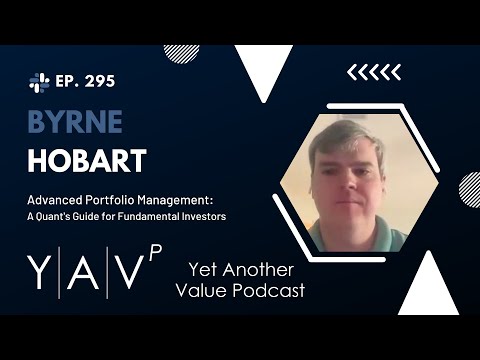
Byrne Hobart
Frontier Insights
Frontier Thesis: Static factor screening is dead; alpha lies strictly in forecasting dynamic rate-of-change across margins and cash flows. Concurrently, hyper-scale AI capex outpaces underlying unit economics, challenging traditional valuation and accounting frameworks.
Strategic Decisions: Enforce rigorous factor-neutrality and path-risk management to decouple skill from survival bias. Capitalize on prolonged (3–5 year) mispricings fueled by auditing lag and aggressive capitalization, positioning ahead of private equity and activist cash-flow corrections.
Risks & Warnings: Collateral opacity and systemic pipeline contagion mimic 2008 fault lines. While rapid hardware depreciation may cap peak AI capex losses by 2030–2031, AI-driven information erosion and aggressive accounting distortions threaten portfolio durability.
Key Views & Dialogues
March 2025 Fintwit Book Club: Diary of a Very Bad Year with Byne Hobart from The Diff
- 🗓️ Date:
2025-04-01| 🎙️ Show:Yet Another Value Podcast
Expertise offered a probabilistic edge, not immunity from error, as the manager’s March 2008 calls show. Systemic crisis emerged when uncertainty over AAA collateral seized financial plumbing, while cheap funding scaled tiny credit-pricing errors into concentrated books. Hobart says AI economics do not support capex, though shorter asset duration may limit losses; peak spending could be depreciated by 2030 or 2031.
View Dialogue Notes & Key Takeaways
The book’s core lesson is that genuine expertise provides a probabilistic edge, not immunity from consequential error. The anonymous hedge fund manager is incisive across markets yet says in March 2008 that “the worst has passed,” “subprime looks contained,” and Bear Stearns lacks a solvency problem. Byrne Hobart’s corrective to hindsight bias: “on a dollar-weighted basis almost nobody saw a financial crisis like that coming”—otherwise positioning would have defused it before it became a crisis.
The decisive 2008 failure was not merely mortgage losses but an information shock that seized the financial plumbing. Once AAA could mean either “money good” or “probably worth 95 cents on the dollar,” paper financed with 3 cents of collateral suddenly demanded far more, forcing deleveraging across apparently unrelated strategies. The book’s tap-water analogy carries the mechanism: systemic failure begins when a foundational assumption stops being true.
Credit bubbles can grow from tiny pricing errors because scalable funding attracts precisely the borrowers who should pay more. Equities can trade at 10 times fair value or 30 times forward revenue; credit may only be mispriced from 7% to 6.5%, but scalable funding turns that half-point error into a concentrated book. As Walker puts it, the scariest financial institution is a fast-growing one: losses appear years later or all at once in a downturn.
The most clarifying underwriting question is “what economic activity is being funded here?” Hobart’s specimen is 2021 DeFi yield farming: a dollar-pegged asset paying 20% was ultimately the riskiest layer of a leveraged margin-lending stack, not a productive source of 20% returns. In housing, actual credit funded construction, wages, remittances, and consumption abroad—so unlike vanished equity market capitalization, the money went somewhere real and often irrecoverable.
Uncertainty can damage an economy before conventional fundamentals reveal the break. Home prices roughly stalled in 2005, the first Bear Stearns hedge fund collapsed in 2007, and the full crisis arrived later; Walker wonders whether the March “tariffs on, tariffs off” regime could similarly freeze investment with effects visible only 15 months afterward. Hobart refuses false precision: Q4 2018 also felt ominous, yet going entirely to cash would have been “catastrophically bad.”
The AI boom has obvious misallocation risk, but its asset duration is materially shorter than housing or WeWork’s long-lease structure. Walker says CoreWeave used to depreciate GPUs over three years and, he thinks, was using five years in its IPO, while Hobart expects almost all peak capex to be fully depreciated by 2030 or 2031. Extra generation and cheaper power could remain useful even if demand forecasts disappoint, though Walker warns that prolonged exuberance could create follow-on distortions. Hobart’s balanced verdict is blunt: “current economics do not support current capex,” yet AI research already compresses hours of source-finding into roughly 10 minutes.
AI adoption in investing may divide flexible thinkers from rigid ones more than young analysts from older portfolio managers. A 23-year-old may resist LLM transcript summaries because meticulous manual reading is the only process he knows, while a 52-year-old accustomed to delegation may adopt them immediately. The investable edge remains judgment: recognize when to verify deeply, when a shortcut is enough, and when “something has switched” and it is time to “go for the jugular.”
🔗 Original source & video: March 2025 Fintwit Book Club: Diary of a Very Bad Year with Byne Hobart from The Diff
Fintwit Book Club Feb 2025: Advanced Portfolio Management: A Quant’s Guide for Fundamental Investors
- 🗓️ Date:
2025-03-05| 🎙️ Show:Yet Another Value Podcast
Advanced portfolio management argues that factor neutrality and path risk are essential to separating stock-picking skill from luck, beta, and survivability risk. Static screens have become cheap beta, shifting edge toward forecasting changes in margins, growth, EBITDA, multiples, and the events that reveal them. Thesis-dependent stop-losses, hidden thematic exposures, incentive-driven volatility, and AI’s erosion of information scarcity remain key risks to monitor.
View Dialogue Notes & Key Takeaways
The book’s central claim is that stock-picking skill becomes investable only when portfolio construction separates it from luck and accidental factor exposure. An investor earning 133% a year while the market returns 10% may be paid on 13.3% in many cases, but deserves credit for roughly three percentage points; Hobart’s ideal is therefore a return stream “as pure skill as possible.”
Stop-losses are not universally correct, but price action is most informative when the thesis depends on near-term changes in sentiment. They are less useful for deep-value or pink-sheet situations where the stock price provides little new information. Walker’s dilemma is concrete: EchoStar (SATS) can move from $25 to $20 without meaningful new information, yet “I don’t know many stocks that I’ve written down 50% that I’ve ever ended up making money on.”
Path risk matters as much as the terminal call, especially with leverage and shorts. A 15% return with a ±5% range is fundamentally different from 15% with ±40%, while a short rising from $7 to $50 can destroy the trade before the thesis resolves. As Hobart puts it, “nobody gets credit for finding the stock at $10 and realizing it’s going to zero, but first it’s going to $200.”
A brilliant idea is insufficient without capital, sizing, execution, and a series of good decisions that converts insight into returns. The Winklevoss twins identified both Bitcoin and Zuckerberg’s social network early, yet did not execute perfectly and failed to make as much as they might have. Walker applies the same point to Bill Ackman’s Howard Hughes bid: rare “comet” trades are difficult to monetize consistently through a company.
Systematic screens steadily turn old alpha into cheap beta, pushing fundamental investors toward predicting changes rather than identifying static attributes. “Eight times pre-tax earnings” once required manual work; now a computer finds it instantly. The remaining edge is explaining why margins, growth, EBITDA, or the market-assigned multiple will change—and mapping the event path through which investors recognize it.
Risk systems can hide emerging thematic exposure rather than eliminate it. Before AI was fully recognized as a factor, managers could express the same bullish view through NVIDIA, Microsoft, utilities, and nuclear-power plays; after DeepSeek, some power names fell harder than direct AI beneficiaries. Hobart’s warning is that managers paid on P&L hold a call option and will naturally seek volatility and ways to “outsmart the risk system.”
AI will automate more research, but it also moves the human advantage toward judgment, serendipity, and recognizing when the framework itself is incomplete. Investors may gain “an extra 10 hours a day or an extra 50 hours a day to read,” yet still need “a lot of tokens in your own personal context window” to catch the odd disclosure or category distinction a generic summary misses. Japanese filings and 20 hours of CEO podcasts become searchable, so edge may migrate toward small companies where sophisticated tooling exists but large funds are unlikely to deploy expensive analysts.
🔗 Original source & video: Fintwit Book Club Feb 2025: Advanced Portfolio Management: A Quant’s Guide for Fundamental Investors
More Than a Numbers Game: A Brief History of Accounting (Fintwit Book Club January 2025)
- 🗓️ Date:
2025-01-15| 🎙️ Show:Yet Another Value Podcast
Accounting quality is a public good: WorldCom’s capitalization of line costs made AT&T fire 20,000 people and spend over $100B on cable companies, nearly destroying itself. Super Micro shows the audit signal in real time, with its Big Four resignation identifying accounts not to trust and a costly confirmation audit plus massive restatement proposed. Meanwhile, screen-driven mispricings can persist 3–5 years until activists or private equity reconnect reported metrics with cash flow, while AI’s software economics challenge P/E and price-to-sales-plus-growth rules.
View Dialogue Notes & Key Takeaways
Byrne Hobart’s core case for the book: accounting quality is a public good, and fraud’s blast radius extends to honest competitors. The episode’s best anecdote is WorldCom capitalizing line costs to look much more profitable than AT&T—which responded by firing 20,000 people and spending over $100B on cable companies, nearly destroying itself. Andrew’s takeaway: “I just never heard of a company almost getting destroyed by a competitor’s fraud before.”
There is no good answer to who pays for the audit, and Super Micro is the live case study. Byrne walks the options—investors paying means duplicated work or a free-rider tax on the biggest holder—so companies pay, and investors learn to treat auditor identity as a signal. Andrew describes Super Micro’s Big Four resignation as effectively identifying the portions of the accounts not to trust. Byrne’s proposed successor play is a costly confirmation and massive restatement, with the hope of later moving back to a Big Four firm; Andrew thought a lower-tier mid-market firm took the engagement.
A century of companies screaming that accounting changes would “destroy the capital markets”—and, according to the book’s studies as relayed by Andrew, markets almost never cared, on- or off-balance sheet, expensed or capitalized. Byrne’s stock-comp thought experiment says switching from half-stock to all-cash compensation while issuing enough stock to fund it changes nothing economic, apart from employee incentives and possible issuance/administrative-cost differences. “So if there’s any change in how you value a company… something is wrong with your accounting.” Companies that only look cheap ex-SBC, like Snap, have punished believers.
Screen optics create short-to-medium-term mispricings that private equity may eventually arbitrage away. Andrew’s example: a company moved inventory financing on-balance sheet to save 50bps on hundreds of millions, worsening its screens for quants. Byrne counters that this shifts the shareholder base toward cash-flow investors, while PE—which “fixates on cash flow” and accepts persistent GAAP losses when the business is good—can eventually correct the mismatch. Andrew notes that this can take 3–5 years and an activist.
Broken market-level rules of thumb are where the alpha is. Dow price-to-book sat around 1–2x from roughly 1920 to 1990, rose to 6x in the ’90s, and later fell back toward 4x; Andrew argues the Buffett indicator also looks different in a world of international firms. Byrne says P/E and price-to-sales-plus-growth may be breaking because “one company’s net dollar retention is another company’s lower steady-state gross margin” and AI businesses “may be a software business [but do] not have software margins”—some software may look “more like you’re investing in a steel mill than in Microsoft circa 1994.”
Byrne’s non-hot-button candidate for the 2035 accounting debate: capitalizing more big-tech intangibles. He says Google’s true economic balance sheet feels “more like a 10% return-on-equity business,” once its algorithm, brand and culture are treated as accumulated capital. Andrew’s pushback is that market-value swings would make such accounting highly unstable; Byrne concedes he is exaggerating and says capitalizing more R&D and marketing is possible but “I don’t actually think it’s worth doing.” His tentative concrete complaint is SPAC-warrant mark-to-market treatment.
Tax-code coevolution is underrated history: the book/Andrew point to 1981 accelerated depreciation as one Milken-era tailwind, while Byrne adds a Treasury-stripping basis-allocation loophole that let investors book immediate capital losses. Andrew calls it “basically an infinite money machine.” Byrne says Ronald Reagan’s cut in meal and entertainment deductibility from 100% to 50% helped destroy the Midtown dining scene; at a 92% top marginal rate, the three-martini lunch was “a 92% off happy hour,” and the tax code became “this massive cirrhosis subsidy.”
🔗 Original source & video: More Than a Numbers Game: A Brief History of Accounting (Fintwit Book Club January 2025)