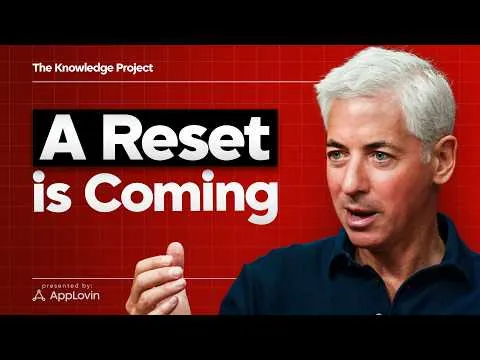
Bill Ackman
Key Views & Dialogues
Bill Ackman: People are Going to Lose a Lot of Money
AI is transformational but bubble-like, with one startup’s valuation jumping from $400 million to $1 billion in two weeks and another reaching $5 billion in Series A. Cognition’s claimed COBOL modernization in days could lower bank costs, but pricing power determines whether shareholders retain the savings. Ackman therefore emphasizes disciplined capital use, continual moat reassessment, and exiting when confidence—not merely price—breaks.
View summary (7)
- Ackman sees AI as a genuinely transformational technology wrapped in unmistakable bubble behavior. He cites the same startup raising $50 million at a $400 million valuation and, two weeks later, another $50 million at $1 billion; another raised a Series A at a $5 billion valuation. Founders should raise while capital is abundant but “treat every dollar as if it were your own money,” because a loud reset will come and “people will lose a lot of money.”
- AI has raised the probability that apparently dominant businesses simply disappear, making moat analysis harder than at any point in Ackman’s career. Investors valuing 10, 20, or 30 years of cash flows must now imagine disruption that even Warren Buffett missed during the internet transition. AI may dramatically lower incumbents’ costs—Ackman says Cognition can modernize banks’ COBOL systems in days rather than months—but whether shareholders retain those savings depends on pricing power.
- Pershing Square distinguishes public-market durability from venture investing’s dependence on a singular founder. Public holdings should be dominant, highly profitable, strongly financed businesses whose management can be replaced if needed; early-stage companies are bets on people who can survive the failure of their original plan. Ackman disliked Bom Kim’s 2009 plan to build a Korean Groupon but backed Kim, who ultimately turned Coupang into what Ackman calls “the Amazon of South Korea.”
- A billion-dollar position usually begins with years in Pershing Square’s “library” of researched companies. Two team members study filings, calls, competitors, former employees, experts, and valuation; Ackman and the wider team independently challenge the work before deciding. AI helps with research, but Ackman doubts it will originate the non-consensus trades that produced Pershing’s best outcomes: pandemic credit-default swaps, distressed equities, or pre-crisis protection on AAA credit.
- Ackman is turning Howard Hughes from a discounted real-estate vehicle into a “modern Berkshire Hathaway” built around insurance and permanent capital. Pershing owns 47%; land sales, roughly $4 billion of contracted Hawaiian condominiums, and about $300 million of real-estate net operating income are intended to fund Vantage Holdings rather than further property accumulation. He says today’s roughly 70% real-estate/30% insurance mix may move to roughly 70–75% insurance within five years.
- His daughter Lucy’s catastrophic brain hemorrhage redirected Ackman’s capital, relationships, and attention toward brain recovery. After roughly 19 hours of pressure on her brain and removal of about 40% of her skull, she recovered her cognition and humor while gradually relearning movement, speech, and vision. Ackman closed on a biotechnology building within 60 days and signed for remaining plots totaling 3.4 acres to build a patient-centered institute spanning rehabilitation, brain-computer interfaces, AI-assisted therapy, nutrition, and longevity: “I literally feel like I was created to help her.”
- The recurring investment lesson is to preserve optionality and leave when confidence, not merely price, breaks. Pershing sold Netflix after management abruptly reversed its “never advertising” position, later rebuying only after the ad model, cash generation, and valuation improved; it abandoned short selling because the payoff is capped while losses and personal conflict are not. For ordinary savers, Ackman’s prescription is simpler: start young, compound through index funds unless willing to do serious company work, and do not sit indefinitely in cash because the market looks expensive.
Bill Ackman: Here’s What the Market is MISSING
Ackman now prioritizes long-term, durable, protected, non-disruptable growth as AI makes disruption the first underwriting question. He sees Microsoft, Meta, and Amazon as undervalued amid enthusiasm for chips and energy, while SaaS requires company-by-company analysis of pricing power and platform value. Howard Hughes is his 50-year compounding project, combining below-liquidation-value real estate with insurance float and a potential path toward “a trillion-dollar thing over time.”
View summary (7)
Ackman’s investment evolution is a shift toward business quality, not away from activism. As Pershing Square became larger and more concentrated, “long-term, durable, protected, non-disruptable growth” became paramount. He says he is as activist as ever, but more of that activism now happens on Twitter; the ideal holding requires no intervention, though a large shareholder can support investments that depress near-term earnings while creating value over three, five, or more years.
AI has dramatically increased disruption risk, yet Ackman thinks the market is overlooking proven platforms while chasing chips, semiconductors, and energy. Pershing Square owns Microsoft, Meta, and Amazon, which he considers undervalued; his qualified analogy is 2000, when investors dismissed Berkshire Hathaway as “old stuff,” though he explicitly said today’s market is different.
The SaaS selloff cannot be underwritten as a basket because pricing power and platform value differ by company. Ackman worries more about Salesforce and niche vendors charging roughly $30,000 annually for narrow products than Microsoft, where an average customer might pay about $50 per seat. “You’ve got to do the work”—and every software company must become as AI-enabled as possible.
Ackman sees valuation as a tether that pulls both overvalued and undervalued assets back toward fundamentals. His recent bullish call followed “crazy cheap” prices for high-quality cash-generating companies. For the host’s examples of businesses valued at 50–150 times revenue, Ackman said companies such as SpaceX require venture-style underwriting around “people, opportunity, context, deal,” rather than a simple public-market multiple analysis.
Howard Hughes is Ackman’s attempt to build a 50-year Berkshire-like compounding machine from an ignored real-estate base. At roughly $63 per share, he said investors were buying below liquidation value—about “60 cents on the dollar”—while the plan is to redirect cash into insurance, keep policyholder float in short-term Treasuries, invest insurer surplus in equities, and potentially grow a roughly $4 billion company into “a trillion-dollar thing over time.”
Investors seeking Ackman exposure have three materially different choices. Pershing Square’s management company is a no-CapEx royalty on three permanent-capital vehicles; PSUS offers the investment portfolio at a stated 18% discount to cash, and Ackman described the public vehicle as charging only a 2% fee; Howard Hughes is the long-duration bet that he can build “the next Berkshire Hathaway.”
Founder control and follower-backed valuation can become strategic advantages in an AI-speed economy. Ackman contrasted founders’ lifelong economic and reputational stakes with an S&P 500 CEO tenure he estimated at roughly three to four years. Ryan Cohen illustrates how a personality can gather “armies of followers,” while Elon Musk illustrates how belief can support a higher valuation, lower capital costs, and greater strategic flexibility.