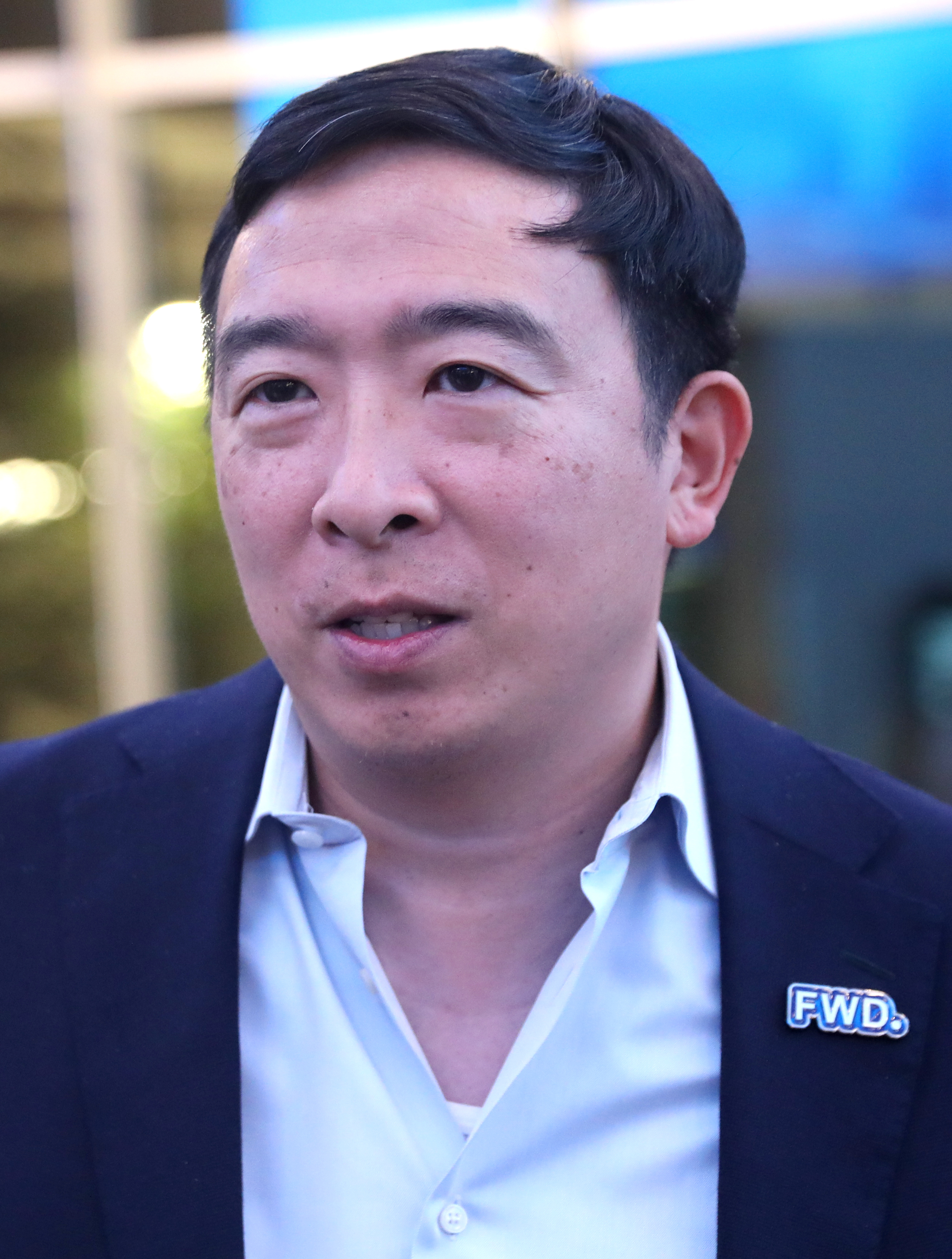
Andrew Yang
Frontier Insights
Core Thesis: Corporate incentives have aligned around aggressive labor reduction to drive equity valuation, triggering an imminent “SaaSpocalypse.” AI will displace 20% to 50% of the 70 million US knowledge workers within 12 to 18 months, necessitating direct financial intervention before broader systemic reforms.
Strategic Decisions: Fund an emergency safety net via a $1,200 monthly AI dividend, financed through targeted structural levies like a 3% token tax, prioritizing immediate Universal Basic Income (UBI) over Universal Healthcare (UHI) to absorb rapid white-collar dislocation.
Risks & Warnings: Severe fiscal and political friction in funding larger UBI baselines, coupled with enterprise-level vulnerabilities as tech giants increasingly outsource core AI capabilities, deepening platform dependencies amidst mass labor volatility.
Key Views & Dialogues
Tim Cook’s Legacy + The Future of U.B.I. With Andrew Yang + HatGPT
- 🗓️ Date:
2026-04-24| 🎙️ Show:Hard Fork
Tim Cook leaves Apple after expanding its market value from $350 billion to around $4 trillion, but services monetization, China supply-chain exposure, and delayed AI execution complicate the legacy. John Ternus inherits the Siri and device challenge, while Andrew Yang proposes a 3% token tax and about $1,200 monthly dividends as AI displacement and inequality accelerate.
View Dialogue Notes & Key Takeaways
Tim Cook is stepping down as Apple CEO to become executive chairman, leaving Apple transformed from a $350 billion company in 2011 into one worth around $4 trillion, with annual revenue nearly quadrupled and the stock up roughly 2,000%. The Apple Watch found its mass market through health, AirPods became ubiquitous, and bringing chip design in-house produced Apple silicon and the M1. For the hosts, Cook proved that iteration and operational control could create major categories even if he was “not a product guy.”
Cook’s operating advantages also became Apple’s strategic liabilities: services monetization weakened customer affection, while a superb China supply chain turned into a tariff-exposed dependency. Titan consumed more than $10 billion without producing a prototype, and Vision Pro failed to become the next general-purpose computing platform. Apple remained the “uncontested leader in consumer hardware,” but its speculative bets exposed a persistent software and platform problem.
AI is the most consequential unresolved item on Cook’s ledger and the defining test for incoming CEO John Ternus. Apple Intelligence and Siri repeatedly slipped, frontier researchers went elsewhere, and Apple now licenses Gemini instead of building a leading model—far cheaper than training one, but a new strategic dependency. Casey’s first-year prescription is “fix Siri”; Kevin’s is “make some damn glasses,” as AI devices could eventually chip away at Apple Watch and iPad demand.
Cook’s political maneuvering may have protected billions in shareholder value while damaging Apple’s claim to stand for something larger. Casey cited Cook’s August 2025 golden-glass statue for President Trump, subsequent tariff relief, attendance at the Melania screening and muted responses to controversies involving federal agents and Grok. “If the only thing that is important to you is Apple’s stock price, this was the right thing to do,” Casey conceded, before arguing that society might reasonably apply other values.
Andrew Yang still views AI labor displacement as a “freight train,” though he concedes that language-first automation changed the expected sequencing. His campaign emphasized manufacturing, retail, call centers and trucking; the first pressure instead landed on coders, paralegals and other educated office workers. Against Dario Amodei’s warning that half of entry-level white-collar jobs might disappear within a year or two, Yang offered a lower—but still “tectonic”—estimate of 20% to 30% within five years across a 70 million-person white-collar workforce.
Yang’s renewed UBI proposal is a direct AI dividend: levy an AI tax and pay every American about $1,200 a month. He embraced Amodei’s suggested 3% token tax, argued that taxation should move away from human labor, and reduced the principle to “tax AI, tax the bots, don’t tax humans.” Yang predicts GDP will roar past $100,000 per person and says “we’re going to have our first trillionaire”; he expects AI to compound inequality unless gains reach household bank accounts quickly.
Yang insists cash is only the economic floor because a job supplies “structure, purpose, fulfillment, community” that a check cannot replace. He prefers giving people room to form businesses, nonprofits and local groups over a government job guarantee—his caricature of the latter was “gray overalls and a pickaxe.” The political window is narrowing: AI’s approval rating is 26%, Congress combines 16% approval with 94% incumbent reelection, and Yang says the conflict is “not left or right” but “top or bottom.”
HatGPT’s smaller stories showed AI simultaneously compressing software markets, reproducing workplace dysfunction and demanding ever more training data. A Claude Sonnet 4.6-managed store lost $13,000, ordered 1,000 toilet-seat covers and paid its male employee $2 more per hour; Meta plans to capture employee keystrokes, mouse movements and screen snapshots; and SpaceX’s $60 billion Cursor agreement illustrated Casey’s “SaaSpocalypse,” in which model providers absorb the applications built above them.
🔗 Original source & video: Tim Cook’s Legacy + The Future of U.B.I. With Andrew Yang + HatGPT
Andrew Yang: UBI Before UHI, Solving Job Loss, and the Future of Work | #236
- 🗓️ Date:
2026-03-07| 🎙️ Show:Moonshots
AI-driven job displacement could hit 20% to 50% of 70 million US office workers within 12 to 18 months, rewarding layoffs through higher margins while hollowing out demand, offices, and the college pipeline. Yang sees UBI as the urgent bridge before universal high income, but a larger floor may be necessary and financing remains unresolved as private pilots, payroll subsidies, and cheaper basic services compete with delayed Washington action.
View Dialogue Notes & Key Takeaways
Andrew Yang’s core call is that universal high income likely requires a major political realignment, with universal basic income probably coming first. The transition problem is the 50-year-old middle manager with a mortgage, two children, and no large savings pool—not the eventual robot-rich end state. With jobs about to be “whisked away,” Yang sees the bridge as more urgent than the destination; Diamandis described Washington as being on a “multidecade tape delay” that has become catastrophic.
The labor shock is already becoming an earnings lever: fewer workers can raise margins and stock prices while hollowing out demand, offices, and the college pipeline. Block shares rose 24% after 4,000 layoffs; Yang relayed one tech CEO’s plan to cut 15% of staff, then 20%, then another 20%, while Anthropic had warned that 50% of entry-level white-collar jobs could be automated within one to five years. His own forecast—20% to 50% of 70 million US office workers displaced within 12 to 18 months—implies simultaneous pressure on commercial real estate, indebted graduates, and commuter suburbs.
Yang’s old $1,000-a-month UBI benchmark may now be too low, but the larger the floor becomes, the harder the financing arithmetic gets. He cited GDP of roughly $84,000 per capita, heading toward $90,000 and then $100,000, and a poverty threshold in the vicinity of $25,000 per person; “maybe like twice the thousand dollars a month” could therefore be necessary. Diamandis calculated that $50,000 annually for 200 million Americans would consume about $10 trillion a year—a thought experiment, not a number Yang endorsed.
Private individuals and geographically focused pilots may move before either public companies or Washington. Yang imagined AI fortunes funding $100 million or $500 million demonstrations that prove direct cash works, while shareholder duties make corporate giveaways vulnerable to lawsuits. His model is “human billionaires” acting where they live, because many would help preserve social stability but doubt that a check sent to government reaches anything useful.
Cash transfers are the emergency bridge, while cheaper basic services, subsidized employment, and infrastructure abundance are complementary longer-duration plays. Yang welcomed attacks on every household cost but argued that money can reach bank accounts faster than housing, healthcare, or education supply can be rebuilt; Diamandis proposed subsidizing one-half to three-quarters of payroll for private employers finding durable AI-era work. Data centers could also provide a “shadow UBS” by financing power infrastructure and making electricity cheaper or free locally.
The old career ladder is becoming a narrow column, leaving entrepreneurship as the most controllable path but not a mass-market answer. Yang said “the only career path you can rely on is entrepreneurship,” then immediately estimated that perhaps 80% of people are not suited to it. Trades such as plumbing, HVAC, and electrical work may hold up—he gives human plumbers at least 10 years and probably longer—but there are not enough such roles to absorb a wholesale white-collar surplus.
The decisive variable is not whether AI grows the economic pie, but whether value escapes the firms and capital owners producing it. Yang expects trillions of dollars of value and work equivalent to “millions of humans in hours instead of years,” yet the default distribution is a very small ownership slice. His more expansive answer combines UBI with paid care, wellness, creativity, and community activity: “UBI buys human coherence,” but purpose requires an economy that recognizes more than market labor.
🔗 Original source & video: Andrew Yang: UBI Before UHI, Solving Job Loss, and the Future of Work | #236