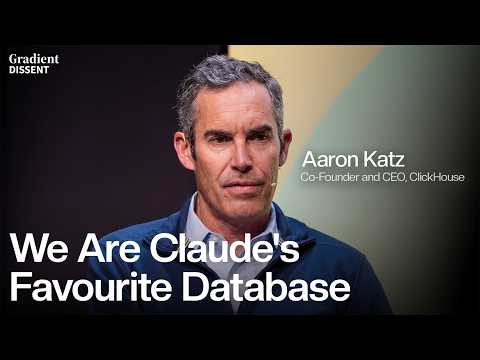
Aaron Katz
Frontier Insights
Thesis: The AI bubble narrative is dead wrong—adoption and real revenue velocity are surging at unprecedented rates, positioning foundational infrastructure as the primary beneficiary.
Strategy: ClickHouse weaponized organic open-source momentum among tier-one tech giants by commercializing through serverless cloud, low-friction self-serve evaluation, and engineer-led enterprise migrations, driving elite retention metrics (NDR >200%, GRR >99%).
Risks: While AI scales raw compute and storage demand, it may compress software valuation multiples. Crucially, low switching costs in agentic workflows create severe revenue volatility, threatening long-term customer persistence as autonomous agents commoditize database provisioning.
Key Views & Dialogues
20VC: The AI Bubble Is Wrong | AI Margins Need to Improve | Revenue Concentration Should be a Concern | Why People Over-Estimate Open Models But Enterprises Still Fear Frontier Models with Aaron Katz, ClickHouse
- 🗓️ Date:
2026-08-31| 🎙️ Show:20VC
Aaron Katz rejects the AI-bubble thesis, citing unprecedented adoption and revenue acceleration. ClickHouse grew from zero to over 500 in revenue, with over 99% gross retention and over 200% net dollar retention. AI customers remain below 12% of revenue, but agentic applications’ low switching costs leave durability unresolved.
View Dialogue Notes & Key Takeaways
Aaron Katz’s core macro call is that the AI bubble thesis is wrong: “We’re just getting started.” Having lived through internet, mobile and social cycles, he says those “were much more gradual” while this one is “accelerating at an unprecedented pace” — “we haven’t seen revenue growth like this in our lifetime.” His one contrarian close: “I can’t pick the winners and losers, but I think the winners are gonna far offset the losers.”
The single biggest investor risk is not gross margins but durability of revenue. Switching costs are very high for infrastructure software and “can be very low for agentic applications,” with model providers “leapfrogging one another what seems like every other week” — so he’d “call into question the durability of some of the revenue for some of these AI applications,” explicitly putting Claude Code in the low-switching-cost bucket even as ClickHouse’s own Anthropic spend is “up 100 times from what it was at the beginning of the year.”
ClickHouse’s numbers are the episode’s hard data: revenue went “zero, 12, 50, 200, and we’ll finish this year north of 500,” with $1B ARR over/under at December 2027 — “I would take the under.” Gross retention is north of 99%, net dollar retention north of 200%, 4,000+ customers with a ~$100k midpoint spend, and the entire AI-native basket (Anthropic, OpenAI, Harvey, Sierra, Decagon) is “less than 12% of revenue” — “even if half of that goes away, the winners are gonna offset the loss from the losers.”
Katz rejects the consensus that 90% of tokens go through open models: his answer is “50/50,” especially in the enterprise. Enterprises want indemnification and output-inference protections that open-weights models — “especially those that come out of China” — can’t provide today; but Harry’s counter stands too: enterprises distrust frontier labs’ zero-data-retention promises (“It’s basically you saying, ‘Just trust me. I got you’”), which Katz confirms he sees “every day,” including internally. Separately, Katz says ClickHouse uses some open-weight models for code review but not necessarily to ship production code because of inference-output concerns.
The three-to-five-year thesis: agents become the buyers of infrastructure, selecting the database, compute and storage behind applications — but they’ll need identity, budget and authorization that don’t exist yet. Agentic query patterns demand low latency first and efficiency second (Tesla ingests “a billion events per second into ClickHouse”), and Katz’s tip to investors: figure out “what companies are best positioned to give that agent everything they need to build a software application.”
His biggest operating regret is being “too efficient” — under-investing in sales capacity. With only ~100 quota reps against data-warehousing incumbents fielding 2,000–3,000 sellers, he deliberately followed “the Datadog playbook” (PLG, developer-led) over “the Snowflake playbook” (expensive enterprise sales), but concedes “at some point, you need to layer in an enterprise sales motion on top.”
On going public: “We could take the company public next year if we wanted to. There’s no rush.” Private status eliminates two material burdens — employees watching the stock daily and short sellers (“you don’t have people shorting your company when you’re a private company”) — while structured tenders solve liquidity; Harry notes even M&A currency is no longer a reason, citing private-market deals like a reported ~$8B OpenRouter (as stated) acquisition. Katz would still “take the under” on being public within five years.
🔗 Original source & video: 20VC: The AI Bubble Is Wrong | AI Margins Need to Improve | Revenue Concentration Should be a Concern | Why People Over-Estimate Open Models But Enterprises Still Fear Frontier Models with Aaron Katz, ClickHouse
Why Anthropic, Meta, and Tesla All Chose the Same Database | Aaron Katz, ClickHouse
- 🗓️ Date:
2026-03-31| 🎙️ Show:Gradient Dissent
ClickHouse reached product-market evidence before its 2021 formation, then built a serverless, engineer-led cloud business reporting more than 3,000 customers and hundreds added monthly. AI agents could provision ClickHouse alongside Postgres, supporting infrastructure demand even as software multiples reset, while Datadog and warehouse incumbents remain formidable and database-grade reliability, geopolitical exposure, and execution stay central risks.
View Dialogue Notes & Key Takeaways
ClickHouse entered venture formation with product-market evidence that most startups only earn later. Alexey Milovidov built it inside Yandex in 2009 for petabyte-scale streaming analytics, open-sourced it in 2016, and enterprises were already moving logging, metrics, and warehouse workloads onto it. In August 2021, Katz raised a $50 million seed/pre-seed with “no pitch deck…no product…no customers…and no revenue,” followed quickly by $250 million.
Its commercial moat is as much distribution design as database performance. ClickHouse Cloud was built serverless with compute-storage separation for bursty workloads, then sold through self-service evaluation, free migration help, and engineer-to-engineer Slack channels intended to put customers in production “before our competitors have even scoped the project.” Katz now reports more than 3,000 cloud customers and hundreds added monthly.
Katz sees AI adoption as SaaS history replaying at radically higher speed. Salesforce’s on-prem incumbents called cloud a fad; he expects objections to model reliability and enterprise data sharing to be debunked and says AI is being adopted “100 times faster” than SaaS was 20 years ago.
The investor call is lower software multiples but durable infrastructure demand. Katz does not expect old forward-revenue valuations to return; free cash flow and terminal value now carry more weight, while databases remain “picks and shovels” purchased on price and performance once reliability, durability, security, and scalability are table stakes. He separates Datadog and Snowflake from application SaaS and cites Databricks at $4 billion of revenue, with warehousing and AI workloads each above $1 billion.
Agents could become the buyers and operators of databases, not merely their recommendation layer. Claude recommended ClickHouse to Anthropic, a European fintech CEO said every LLM he queried did likewise, and Katz imagines agents provisioning ClickHouse plus Postgres automatically. Managed Postgres is in private preview, due for public beta in a few months and general availability by year-end; Katz says the unified stack will be “the world’s fastest Postgres service in the cloud.”
Datadog faces interface disintermediation, but Katz thinks its near-term product moat is underestimated. Biewald argued agent users and easy custom UIs favor direct ClickHouse; Katz called the logic valid yet described Datadog as premium and formidable over a realistic one-to-three-year horizon. ClickHouse itself once spent seven figures on Datadog before earning revenue and faced an internal “mutiny” when migrating away.
AI is expanding ClickHouse’s operating ambition without relaxing database-grade controls. Headcount is planned to rise from about 500 to nearly 1,000 this year, AI-assisted code contributions from an estimated 50% to 80% within six months, and agents are aimed at SDR- and CSM-like work. Human review stays because “move fast and break things doesn’t apply to a database.”
The smooth external trajectory conceals concentrated execution risks. The core team moved from Moscow to Amsterdam six weeks before Russia’s February 24, 2022 invasion. Katz later says he believed $200 million was custodied at U.S. Bank while $100 million was on SVB’s balance sheet; he pulled the $100 million 30 minutes before SVB’s system went down, while the remaining $200 million stayed uncertain for 72 hours. Reliability is P0, and well-capitalized warehouse and observability incumbents are “waking up to the threat.”
🔗 Original source & video: Why Anthropic, Meta, and Tesla All Chose the Same Database | Aaron Katz, ClickHouse